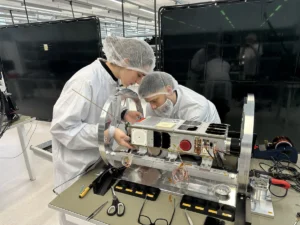
The realm of space exploration and technological innovation is currently experiencing an unprecedented surge of activity, with breakthroughs spanning from the fundamental physics of propulsion to the strategic complexities of orbital defense. Governments and private entities alike are investing heavily in technologies designed to extend humanity’s reach deeper into the cosmos, enhance terrestrial security through space-based assets, and unravel the universe’s most profound mysteries. These advancements are not merely incremental; they represent a significant leap forward, promising to redefine our capabilities and understanding of space as a critical domain for science, commerce, and national security.
Powering Future Missions: Energy and Propulsion Innovations
Sustaining long-duration missions beyond Earth orbit, particularly on the Moon or Mars, necessitates robust and reliable power generation. Traditional solar panels, while effective in Earth orbit, face significant challenges on celestial bodies with extended night cycles or in deep space where solar flux is diminished. This critical need is driving the development of advanced energy solutions.
One such innovation comes in the form of hydrogen fuel cells that operate without air, specifically targeting long-duration Moon missions. Developed by companies like Teledyne Technologies, these fuel cells are designed to provide continuous power in the vacuum of space and through lunar nights that can last for two Earth weeks. The technology leverages the chemical reaction between hydrogen and oxygen to produce electricity and water, with the water often being a valuable byproduct for life support systems or for electrolysis to regenerate propellants. The system’s closed-loop nature and independence from atmospheric oxygen make it ideal for lunar environments, which lack a substantial atmosphere. This development is crucial for establishing permanent lunar outposts, supporting scientific instruments, and enabling future human habitation, providing a reliable power source where solar power alone is insufficient or intermittent. The U.S. government, through initiatives like NASA’s Artemis program, has consistently emphasized the need for diverse power solutions for a sustained lunar presence, making such fuel cell technology a high-priority investment.
Further underscoring the demand for robust space power, a space nuclear reactor recently secured a substantial $161 million defense deal, aiming to bridge a 60-year gap in orbital power capabilities. This contract, likely awarded by agencies such as the Defense Advanced Research Projects Agency (DARPA) or the Space Force, signifies a renewed commitment to nuclear fission power for space applications. Nuclear reactors offer unparalleled energy density and independence from solar illumination, making them ideal for deep space probes, military satellites requiring high power, and future lunar or Martian bases. The last U.S. space reactor, SNAP-10A, flew in 1965. This new investment seeks to develop a compact, safe, and efficient reactor system that can provide megawatts of power, far exceeding current battery and solar array capabilities for certain mission profiles. The implications are profound, enabling more powerful sensors, faster data transmission, and the potential for electrically propelled spacecraft that can reach distant targets in a fraction of the time.
Beyond power, significant strides are being made in propulsion systems, promising to make space travel faster, more efficient, and more versatile. A new Houston test stand is putting a Rotating Detonation Rocket Engine (RDRE) through mission-like tests. RDREs represent a revolutionary departure from traditional rocket engines. Instead of continuous, stable combustion, they utilize a continuous detonation wave that travels around an annular channel. This detonation wave compresses and ignites the propellant, leading to significantly higher thermodynamic efficiency and potentially a simpler, lighter engine design compared to conventional deflagration-based engines. If successful, RDREs could offer up to a 15% increase in fuel efficiency, translating into larger payloads or longer mission durations for the same amount of propellant. This technology could drastically reduce launch costs and enhance the performance of both reusable and expendable launch vehicles.
Adding to the propulsion breakthroughs, the world’s first zinc Hall-effect thruster successfully fired in space on its maiden attempt. Hall-effect thrusters are a type of ion propulsion system that uses an electric field to accelerate ions, generating thrust. Traditionally, these thrusters have used xenon gas as a propellant. The successful demonstration of a zinc-fueled variant is a significant step, as zinc is more abundant, cheaper, and easier to store than xenon. This innovation could make electric propulsion more accessible and cost-effective for a wider range of satellites and spacecraft, particularly for orbital maneuvering, station-keeping, and potentially even interplanetary travel. The increased availability and reduced cost of propellant could lead to smaller, more agile spacecraft with extended operational lives.
Safeguarding Space Assets and Personnel: Protection and Re-entry
As missions become more ambitious, the engineering challenges associated with protecting spacecraft and ensuring safe return to Earth intensify. Extreme temperatures, radiation, and the violent forces of atmospheric re-entry demand cutting-edge material science and precise operational control.
US scientists are taking a real-time look inside spacecraft heat shields that withstand temperatures of 1,652°F (900°C). This research is critical for developing more resilient and reliable thermal protection systems (TPS). During atmospheric re-entry, spacecraft experience immense friction, generating plasma that can reach thousands of degrees Celsius. The ability to monitor the internal structural integrity and thermal performance of heat shields in real-time during such extreme conditions provides invaluable data for validating designs and predicting potential failures. This research likely involves advanced sensors embedded within the ablative materials or using techniques like X-ray imaging during hypervelocity wind tunnel tests. Improved heat shield technology is paramount for the safety of astronauts returning from the International Space Station or future lunar and Martian missions, as well as for protecting valuable scientific samples or sensitive instruments during planetary probe entries.
The process of how spacecraft survive the trip back to Earth after leaving the planet is a testament to complex engineering and meticulous planning. This involves a precisely calculated re-entry trajectory, often utilizing Earth’s atmosphere for aerobraking to shed velocity. The spacecraft’s orientation, angle of attack, and the design of its heat shield are all critical factors. Ablative heat shields, which sacrifice layers of material to dissipate heat, are common. The recent advancements in real-time monitoring contribute directly to refining these processes, ensuring that the critical balance between deceleration and thermal stress is maintained throughout the fiery descent. This understanding is vital not only for human spaceflight but also for the safe return of uncrewed capsules carrying experiments, samples, or even defunct satellites for controlled disposal.
The New Frontier of Space Security: Defense and Surveillance
The increasing reliance on space assets for communication, navigation, intelligence, and military operations has transformed Earth’s orbit into a strategic domain. This has led to a rapid escalation in the development of defensive and offensive space capabilities, creating a complex and potentially volatile environment.
The UK’s deployment of ground-based lasers to blind enemy spy satellites and shield military secrets signals a significant shift in space defense strategy. These directed energy weapons are designed not to destroy satellites but to temporarily or permanently disrupt their optical sensors, effectively denying an adversary critical intelligence gathering capabilities. This "soft kill" approach avoids creating orbital debris, which could escalate conflicts, while still providing a potent deterrent. The development of such counter-space capabilities highlights the growing recognition that space assets are vulnerable and that protecting them is paramount for national security. This technology, while defensive in nature, contributes to the ongoing debate about the weaponization of space and the need for clear international norms.
Against this backdrop, China fears that the US deployment of space weapons raises the risks of a fresh arms race. This sentiment reflects a broader international concern about the militarization of space. While the US maintains that its space capabilities are for defensive purposes and to ensure freedom of navigation and operation in space, other nations, including China and Russia, view these developments with apprehension. The deployment of advanced surveillance satellites, anti-satellite (ASAT) weapons (whether kinetic, directed energy, or electronic warfare), and on-orbit servicing capabilities that could have dual-use applications (repair or capture) contribute to an environment of mistrust. China’s concerns are not unfounded; the history of arms races on Earth often sees defensive technologies quickly evolving into offensive ones, leading to an expensive and dangerous cycle of escalation.
The US sets a 24-month deadline for a new spy satellite prototype built for space warfare, likely under the moniker "Ghost R" or a similar program. This aggressive timeline underscores the urgency with which the US military, particularly the Space Force, views the need to develop resilient and capable space assets. These next-generation spy satellites are likely designed with enhanced maneuverability, advanced sensor suites, and potentially defensive capabilities to operate effectively in a contested space environment. The focus on "space warfare" suggests a shift from simply observing to operating within an active conflict zone in orbit, capable of evading threats, conducting sophisticated reconnaissance, and possibly even engaging hostile targets if authorized. This rapid development cycle aims to maintain a technological edge and ensure critical intelligence and communication pathways remain open even in wartime scenarios.
Complementing these offensive and defensive developments, the US boosts its on-orbit threat inspection capability with a new successful demonstration. This refers to technologies that allow a nation to closely observe and identify other satellites, particularly those exhibiting unusual behavior or suspected of carrying hostile payloads. Such capabilities often involve "inspector satellites" that can rendezvous with and image other objects in orbit. This demonstration enhances space situational awareness (SSA), providing crucial data for understanding the intentions and capabilities of potential adversaries. The ability to identify threats in orbit is a foundational element of space deterrence and defense, allowing for informed decision-making and preventing surprise attacks.
Further solidifying its space defense posture, the US Space Force is turning to Leonardo DRS to track hypersonic projectiles from space. Hypersonic weapons, which travel at speeds exceeding Mach 5 and are highly maneuverable, pose a significant challenge to traditional missile defense systems. Tracking them from space offers a crucial advantage by providing early detection and persistent surveillance, overcoming the limitations of ground-based radar systems that struggle with Earth’s curvature. Leonardo DRS, a prominent defense contractor, is likely developing advanced infrared sensor constellations or other space-based tracking technologies capable of detecting the faint heat signatures of these fast-moving threats. This capability is vital for missile warning, missile defense, and ensuring strategic stability in an era of advanced conventional weaponry.

Expanding Our Digital and Data Horizons in Orbit
The digital revolution is extending into space, with ambitions to establish orbital data centers, expand global communication and tracking networks, and enable high-speed data transmission across vast cosmic distances.
Google is sending TPU chips into orbit to test hardware for future space data centers, under a project potentially dubbed "Project Suncatcher." TPU (Tensor Processing Unit) chips are Google’s custom-designed application-specific integrated circuits (ASICs) for accelerating machine learning workloads. Testing these chips in the harsh radiation environment of space is a critical step towards realizing the vision of orbital data centers. Such data centers could significantly reduce latency for space-based applications (like satellite imagery processing or autonomous spacecraft operations), offload processing from Earth-based infrastructure, and provide resilient computing resources. The ability to process data closer to its source, rather than beaming it all back to Earth, would revolutionize how we manage and utilize information gathered from space, making AI and complex analytics directly accessible in orbit.
Meanwhile, China has launched its first trio of satellites to initiate a 60-spacecraft radio tracker network. This ambitious constellation is designed to provide global, real-time tracking of ships, aircraft, and potentially other objects, enhancing China’s maritime and aviation surveillance capabilities. A network of 60 satellites would offer continuous coverage, enabling precise monitoring of global logistics and military movements. This project underscores China’s rapid expansion in space infrastructure, mirroring initiatives by other major spacefaring nations to build comprehensive satellite networks for various applications, from navigation to communication and Earth observation. The dual-use nature of such networks, serving both civilian and military purposes, adds to the strategic competition in space.
Bridging immense distances with unprecedented speed, Earth-Moon space laser communication has been verified at a staggering 248,000-mile (400,000 km) distance. This achievement represents a major leap forward in deep space communication. Traditional radio frequency communication is limited by bandwidth and signal degradation over vast distances. Laser communication, or optical communication, uses modulated laser beams to transmit data, offering significantly higher data rates and improved security. This successful demonstration, likely involving NASA’s Lunar Laser Communication Demonstration (LLCD) or a similar project, proves the viability of using lasers for high-bandwidth communication between Earth and future lunar bases, and eventually for Mars missions. Faster data transfer means more scientific data can be sent back, higher-resolution imagery, and more robust command and control for distant probes.
Unlocking Cosmic Secrets: Astronomy and Origin Science
The quest to understand the universe, its origins, and the potential for life beyond Earth remains a primary driver for space science, with new instruments and discoveries continually reshaping our cosmic perspective.
NASA has launched a new telescope that can scan the universe 1,000 times faster than Hubble. While the article doesn’t specify the telescope, this likely refers to a wide-field survey telescope, such as the Nancy Grace Roman Space Telescope (formerly WFIRST), designed for large-scale surveys of the universe. Hubble excels at detailed observations of small patches of sky, but a wide-field telescope can image vast swathes of the cosmos in a single snapshot. This capability is crucial for discovering exoplanets through microlensing, mapping dark matter distribution, studying galaxy evolution across cosmic time, and detecting transient phenomena like supernovae. By surveying significantly larger volumes of space, this new telescope promises to revolutionize our understanding of cosmic structures and the distribution of matter and energy.
Complementing observational astronomy, the world’s largest atlas of the universe’s gas bodies has been compiled, which could decode how galaxies form and evolve. This monumental undertaking likely involves combining data from multiple radio telescopes, such as the Atacama Large Millimeter/submillimeter Array (ALMA) or the Very Large Array (VLA), which are adept at detecting the faint radio emissions from neutral hydrogen and other gases that constitute the raw material for stars and galaxies. Mapping these gas reservoirs across vast cosmic distances provides a detailed blueprint of the intergalactic medium and the filaments of the cosmic web, offering crucial insights into how galaxies accrete gas, fuel star formation, and interact with their environments over billions of years. This atlas will be an invaluable resource for cosmological simulations and theoretical models of galaxy formation.
Delving into the very beginnings of our own solar system, ancient oxygen signatures in meteorites are tracing the origins of early Solar System organics. Meteorites are time capsules from the early solar nebula, preserving clues about the conditions under which planets formed. By analyzing the isotopic ratios of oxygen within these extraterrestrial rocks, scientists can infer the chemical processes and environments that existed before the planets coalesced. The discovery of specific oxygen signatures linked to organic molecules suggests that the building blocks of life might have been present and forming very early in the solar system’s history, potentially delivered to Earth by these very meteorites. This research provides critical context for understanding abiogenesis and the potential for life elsewhere in the universe.
Further solidifying the importance of meteorite analysis, a 5.5-billion-year-old meteorite has revealed tens of thousands of molecules from the early solar system. This extraordinary discovery, likely from a pristine carbonaceous chondrite, showcases the incredible chemical complexity present even before the planets fully formed. The analysis of such a diverse array of molecules, including complex organic compounds, provides direct evidence of the chemical inventory available for planet formation. It supports theories that the ingredients for life were not unique to Earth but were broadly distributed throughout the young solar nebula, increasing the probability that similar chemical pathways could lead to life on other exoplanets. The study of these ancient samples offers a tangible link to the primordial conditions that ultimately led to our existence.
Finally, the historical and future role of radio astronomy, which helped us land on the Moon, could now enable ‘first contact’ with aliens. Radio astronomy played a crucial role in space communication and navigation during the Apollo missions, tracking spacecraft and relaying data. Today, it remains at the forefront of the search for extraterrestrial intelligence (SETI). Large radio telescopes, like Arecibo (before its collapse) and FAST, scan the skies for artificial signals that might indicate intelligent life. While no definitive "first contact" has been made, the continuous improvement in sensitivity and processing power of radio telescopes, combined with advanced signal analysis techniques, increases the chances. The sheer scale of the universe and the growing number of exoplanet discoveries suggest that the question is not if life exists elsewhere, but when we might detect it, and radio astronomy remains our most potent tool for this endeavor.
Commercial Space and In-Orbit Manufacturing
The burgeoning commercial space sector is not only launching satellites but also envisioning entirely new economies in orbit, including advanced manufacturing.
Helogen plans to manufacture medical materials in orbit with autonomous factories in space. This ambitious initiative highlights the transformative potential of microgravity manufacturing. In the weightless environment of space, materials can be processed in ways impossible on Earth, leading to purer crystals, novel alloys, and enhanced biomaterials. Helogen’s focus on medical materials suggests applications such as creating superior protein crystals for drug discovery, developing more effective implants, or even manufacturing organs for transplantation. Autonomous factories would significantly reduce the cost and complexity of in-space production, paving the way for a self-sustaining orbital economy. This represents a paradigm shift, moving beyond simply using space for observation and communication to actively utilizing its unique environment for industrial production, with profound implications for healthcare and material science.
Broader Implications: The Convergence of Ambition and Engineering
The diverse range of advancements described above paints a clear picture of a rapidly evolving space landscape. The "About Space" editorial perspective of Interesting Engineering – viewing space as both an engineering problem and a scientific one – is deeply resonant with these developments. Each breakthrough, from hydrogen fuel cells for lunar outposts to advanced heat shields, directly addresses the harsh environmental constraints and logistical challenges inherent in space operations. The focus on reliable systems, long-term observations, and precise measurements underscores the practical work required to make space "useful and usable."
The geopolitical implications are particularly striking. The intensified development of space security capabilities by nations like the UK and the US, coupled with China’s concerns about an arms race and its own expanding satellite networks, indicates that space is no longer merely a domain for scientific discovery but a critical theater for strategic competition. The convergence of scientific, commercial, and military uses is shaping new governance frameworks and demanding sophisticated approaches to managing orbital activity, preventing congestion, and mitigating the growing threat of space debris.
Furthermore, the integration of advanced computing (Google’s TPUs) and high-bandwidth communication (laser links) promises to transform data handling and processing in space, enabling more sophisticated autonomous missions and unlocking unprecedented scientific insights. The continued exploration of meteorites and the development of powerful new telescopes push the boundaries of our fundamental understanding of the universe, offering glimpses into its formation and the potential for life.
In essence, these developments collectively demonstrate humanity’s unwavering ambition to push the boundaries of what is possible in space. They highlight a future where human presence extends beyond Earth, where orbital infrastructure supports advanced industries, and where our understanding of the cosmos deepens with every new mission and technological leap. The challenges remain immense – from the unforgiving nature of the space environment to the complexities of international cooperation – but the pace of innovation suggests that the next few decades will witness a profound transformation in our relationship with the final frontier.