For decades, the search for extraterrestrial life has been governed by a singular, Earth-centric mantra: "follow the water." This paradigm has led astrobiologists to focus primarily on planets and moons with liquid water oceans or histories of aqueous environments. However, a groundbreaking study from the Massachusetts Institute of Technology (MIT) is now challenging this fundamental assumption. Researchers have discovered that the building blocks of life—specifically short chains of amino acids known as peptides—can not only survive but also adopt complex, functional shapes within the highly concentrated sulfuric acid clouds of Venus.
The study, published in the Proceedings of the National Academy of Sciences (PNAS), suggests that the traditional definition of a "habitable" environment may be far too narrow. By demonstrating that biological molecules can maintain their integrity and structure in conditions previously thought to be completely corrosive to life, the MIT team has opened a new chapter in the search for life beyond Earth, shifting the focus toward the "hellish" atmosphere of our nearest planetary neighbor.
Challenging the Earth-Centric Biological Paradigm
Venus is often described as Earth’s "evil twin." While similar in size and composition, its surface is a nightmare of crushing pressure and temperatures hot enough to melt lead. However, approximately 30 to 40 miles above the scorched surface lies a layer of clouds where temperatures and pressures are remarkably Earth-like. For years, scientists have speculated that these clouds could harbor microbial life. The primary obstacle to this theory has always been the composition of the clouds: they are comprised of 98 percent sulfuric acid.
On Earth, sulfuric acid is a notoriously aggressive solvent. It is known to dissolve metals, char organic tissue, and rapidly break down the fundamental molecules of life through a process called hydrolysis. Conventional wisdom held that any biological precursor, such as DNA or protein, would be instantly obliterated upon contact with these droplets.
"We are seeking exoplanets that might be a true Earth twin, but what if they’re all Venuses?" says Sara Seager, the Class of 1941 Professor of Planetary Sciences at MIT and a senior author of the study. Seager, who is also a professor in the departments of Physics and of Aeronautics and Astronautics, notes that the findings "definitely open up a whole range of possibilities" for planetary archetypes that do not resemble our own world.
The Chemical Resilience of Peptides in Acidic Extremes
The core of the MIT research involved testing how peptides—short strings of amino acids—fare when submerged in 98 percent sulfuric acid. Peptides are essential to life as we know it; they are the precursors to proteins, which perform almost all functional tasks within a cell, from catalyzing reactions to providing structural support.
The researchers discovered a counterintuitive chemical reality: in an environment of 98 percent sulfuric acid, there is almost no water. Because hydrolysis requires water molecules to break the chemical bonds between amino acids, the lack of water actually protects the peptides.
"Without water, an acid that you would consider a harsh solvent suddenly is not as menacing as one might think," explains Mei Hong, an MIT professor of chemistry and a senior author of the study. The team found that the peptides remained stable for several weeks, showing no signs of degradation. This stability is a prerequisite for life, as it allows complex molecules to persist long enough to participate in biological processes.
A Chronology of Venusian Biological Research
This latest discovery is the culmination of years of systematic investigation into the survival of organic molecules in acidic environments. The timeline of this research reflects a growing momentum in Venusian science:
- September 2020: A team led by Jane Greaves and including Sara Seager announced the detection of phosphine gas in the Venusian atmosphere. On Earth, phosphine is primarily produced by anaerobic biological processes, sparking a global debate about the possibility of life in the Venusian clouds.
- 2020-2021: Seager’s lab began testing the stability of various biological building blocks. Initial experiments used nuclear magnetic resonance (NMR) spectroscopy to show that nucleic acids (the components of DNA and RNA) could remain intact in concentrated sulfuric acid.
- 2022-2023: The research expanded to include lipids and amino acids. The results consistently showed that these molecules could survive the harsh acidity, provided the water content remained extremely low.
- 2024: The current study was published, moving beyond mere survival to "folding." The team demonstrated that not only do the molecules stay intact, but they also take on specific three-dimensional structures.
The Role of NMR Spectroscopy in Unlocking Molecular Secrets
To analyze the behavior of peptides at a molecular level, the researchers utilized the MIT Department of Chemistry Instrumentation Facility (DCIF). The primary tool was an 800-megahertz solution NMR spectrometer, an advanced instrument capable of measuring the magnetic properties of atomic nuclei to determine the precise three-dimensional structure of molecules.
The lead author of the paper, MIT graduate student Jia Yi Zhang, along with former postdoc Aurelio Dregni, focused on three specific peptides:
- HHQ: A synthetic seven-amino-acid peptide.
- HHQ13: A longer variation of the HHQ peptide.
- K7: A different peptide also containing seven amino acids.
In a water-based environment, these peptides typically form "beta sheets"—flat, elongated structures that can eventually aggregate into long fibrils. However, when placed in concentrated sulfuric acid, the molecules behaved differently.
Discovering the Omega Loop: A New Structural Motif in Acid
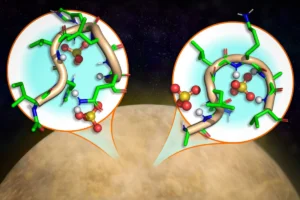
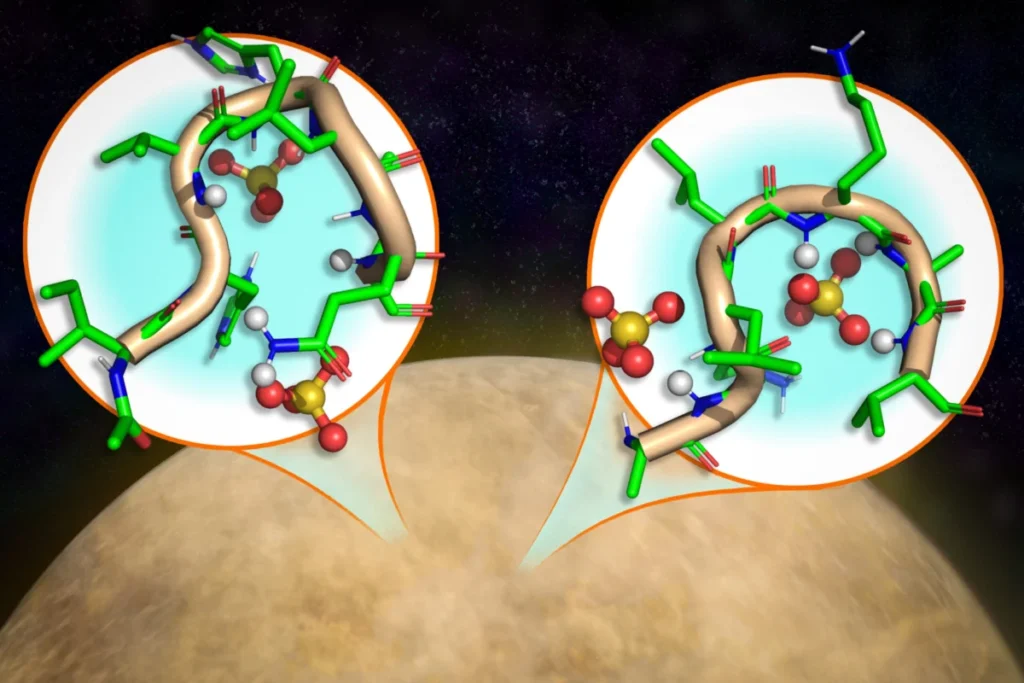
The most significant finding of the study was that in sulfuric acid, the peptides folded into a shape known as an "omega loop." Named for its resemblance to the Greek letter Ω, the omega loop is a non-regular structural motif where the chain of amino acids turns back on itself.
In Earth-based proteins, omega loops are often found on the protein surface and are crucial for molecular recognition and protein-protein interactions. The MIT researchers believe that the sulfuric acid molecules themselves act as a chemical "scaffold." The acid molecules slide into the center of the peptide loop, providing the necessary stabilization to hold the shape.
"What hadn’t been known is that peptides can survive so well and have specific three-dimensional shapes in an acidic environment," says Hong. This discovery is vital because, in biology, shape dictates function. For a molecule to act as an enzyme or a signaling component, it must have a defined structure that allows it to "latch onto" other molecules.
Expert Perspectives and Independent Validation
The implications of the MIT study have resonated throughout the scientific community. Adriaan Bax, chief of the Section on Biophysical NMR at the National Institute of Diabetes and Digestive and Kidney Diseases, who was not involved in the research, described the results as "important and unexpected."
According to Bax, the fact that these peptides retain conformational order in concentrated sulfuric acid raises the prospect that folded protein structures can exist in such environments. This supports the possibility of life in atmospheric conditions that are radically different from those on Earth.
Janusz Petkowski, a research assistant professor at Wroclaw University of Science and Technology and a senior author of the paper, emphasized that this research provides a chemical foundation for astrobiology missions. If meteorites—which are known to carry amino acids—enter the Venusian atmosphere, those building blocks could potentially be preserved and organized within the cloud droplets.
Supporting Data: Comparative Stability
The study provided rigorous data comparing the behavior of peptides in different solvents. Key observations included:
- Stability Duration: Peptides remained stable in 98% sulfuric acid for the entire duration of the multi-week observation period.
- Concentration Thresholds: The stability was found to be highest at concentrations above 90% sulfuric acid. As water content increases, the rate of hydrolysis increases, leading to molecular breakdown.
- Structural Uniformity: Unlike random polymer chains that might clump together, the peptides in the study adopted uniform, repeatable omega-loop structures, suggesting a predictable chemistry in the Venusian cloud environment.
Broader Implications for Exoplanetary Science and Future Missions
The discovery has immediate implications for how we search for life on exoplanets. Currently, the search for "habitable" worlds is largely restricted to the "Goldilocks Zone"—the distance from a star where liquid water can exist on a planet’s surface. However, if concentrated sulfuric acid can serve as a solvent for biological molecules, the number of potentially habitable worlds in the galaxy could increase exponentially.
"Life needs to have specially shaped proteins so that they have a specific target they can latch onto and perform their function," says Seager. "Before this, people thought that peptides couldn’t survive in sulfuric acid, so showing peptides are not only stable, but also fold, is a really big deal."
This research serves as the theoretical groundwork for the "Morning Star Missions to Venus," a series of privately funded missions led by Seager and supported by organizations like Rocket Lab and the Massachusetts Institute of Technology. These missions aim to send a small probe to Venus to directly sample the cloud particles and search for organic molecules and signs of life.
Concluding Research Directions: Beyond Peptides
While the current study focuses on naturally occurring amino acids and synthetic peptides, the researchers are already looking toward the next frontier. Seager’s lab is planning to investigate Peptide Nucleic Acid (PNA). PNA is a synthetic molecule that mimics the information-carrying capacity of DNA but uses a peptide-like backbone instead of a sugar-phosphate backbone.
Previous tests have shown that single-stranded PNA is stable in sulfuric acid. The next step is to determine if double-stranded PNA—the form required for stable genetic inheritance—can also survive and maintain its structure. Furthermore, the team hopes to test even longer peptides to see if they can form more complex structures, such as alpha-helices or larger tertiary folds, in the acidic environment.
The research, funded by the Alfred P. Sloan Foundation, the NOMIS Foundation, and the National Institutes of Health, fundamentally shifts the narrative of Venus from a dead planet to a laboratory for exotic biochemistry. As the Morning Star Missions prepare for launch, the scientific community must now consider the possibility that the "hell" of Venus might actually be a cradle for a form of life we are only beginning to understand.