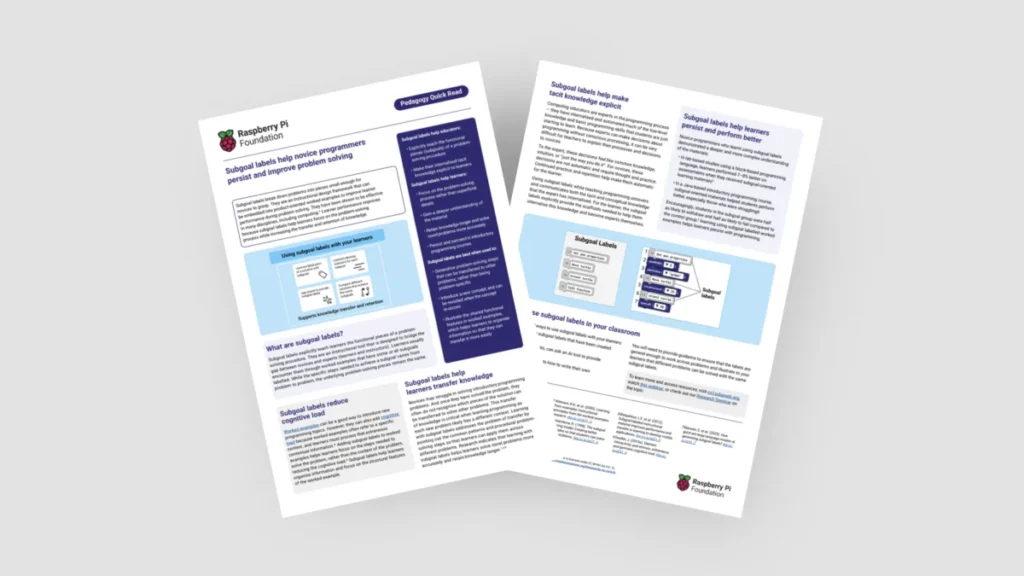
The pedagogical landscape of computer science education is undergoing a significant shift as researchers and educators identify the "expert blind spot"—a cognitive phenomenon where experienced programmers overlook the complex, multi-step mental processes they perform automatically. In response to this challenge, the Raspberry Pi Foundation has released new instructional resources focusing on "subgoal labels," a scaffolding technique designed to decompose complex programming tasks into manageable, conceptual components. This methodology aims to bridge the gap between the intuitive problem-solving of veteran developers and the intensive cognitive requirements faced by students who are new to coding.
The Cognitive Challenge of Learning to Program
For an experienced software engineer, the act of starting a new project or solving a bug involves a series of rapid-fire decisions regarding architecture, syntax, and logic. These decisions, honed through years of practice, often occur in the subconscious. However, for a beginner, every line of code represents a high-stakes decision. This discrepancy is often explained through Cognitive Load Theory, which suggests that the human brain has a limited capacity for processing new information in working memory. When a student is asked to "write a program," the sheer volume of simultaneous requirements—syntax, logic, variable naming, and algorithmic structure—can lead to cognitive overload, resulting in frustration and a lack of retention.
Subgoal labels serve as a structural intervention. By providing high-level descriptors for clusters of actions within a programming task, educators can reduce the extraneous cognitive load. Instead of viewing a program as a monolithic block of text, students learn to see it as a sequence of functional milestones.
Defining Subgoal Labels in the Classroom
Subgoal labels are concise, instructional headers or tags integrated into worked examples and programming exercises. They act as "signposts" that guide a learner through the logic of a solution without providing the code itself. The primary function of these labels is to highlight the purpose of a code segment rather than just its mechanics.
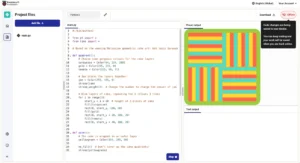
Consider a standard introductory task: using a "turtle" graphics library to draw a geometric shape on a screen. A traditional approach might show a student a completed block of Python or Scratch code. In contrast, an approach utilizing subgoal labels would break the task down into specific, labeled phases:
- Environment Setup: Initializing the canvas and the sprite.
- Defining Geometry: Determining the angles and side lengths.
- Execution of Movement: Coding the loops required to draw the shape.
- Visual Styling: Adjusting colors, line thickness, or screen position.
By isolating these steps, the student learns to categorize programming actions into functional patterns, which eventually helps them build mental "schemas" that can be applied to more complex, unrelated problems in the future.
Chronology of Instructional Design in Computing
The integration of subgoal labels into computer science is the result of decades of evolving educational research. The timeline of this development highlights a shift from rote memorization to structural understanding:
- 1980s – Early 1990s: Early computer science education focused heavily on syntax and the "grammar" of specific languages like BASIC or Pascal. Students often struggled to transfer skills from one language to another because they learned what to type rather than how to think.
- Late 1990s: Educational psychologists began applying Cognitive Load Theory to STEM subjects. Research by Richard Catrambone demonstrated that students who were taught using subgoals were better at solving "transfer problems"—tasks that were slightly different from the examples they had studied.
- 2010s: The rise of "block-based" programming (such as Scratch) addressed some syntax hurdles, but the logical gap remained. Researchers like Lauren Margulieux began specifically testing subgoal labels in computing contexts, finding that they significantly improved performance in both block-based and text-based environments.
- 2020 – Present: Organizations like the Raspberry Pi Foundation and the National Centre for Computing Education (NCCE) have begun formalizing these research findings into practical "Quick Read" guides and curriculum frameworks for K-12 educators worldwide.
Supporting Data and Research Efficacy
The push for subgoal labels is not merely theoretical; it is backed by quantitative data from various educational trials. Studies in the field of Instructional Design have shown that students provided with subgoal-labeled worked examples perform up to 20% better on independent problem-solving tasks compared to those who receive standard instructions.
Furthermore, data suggests that subgoal labels are particularly effective for "low-prior-knowledge" learners. In a study comparing instructional methods, students who used subgoal labels were found to be more resilient when encountering errors. Because the task was broken down, they could identify exactly which phase of the problem they were struggling with, rather than feeling that they had failed the entire assignment. This leads to higher self-efficacy and lower attrition rates in introductory computer science courses.
Practical Implementation Strategies for Educators
The Raspberry Pi Foundation’s latest guidance emphasizes that implementing subgoal labels does not require a total curriculum overhaul. Instead, it involves modifying how existing problems are presented. Three primary methods have been identified for classroom use:
- Annotated Worked Examples: When presenting a solution on a whiteboard or screen, teachers can use comments or headers to label the subgoals. This allows students to see the "why" behind the "how."
- Scaffolded Problem Solving: Teachers can provide the subgoal labels as a template, requiring students to write the code that fits under each label. This "fill-in-the-blank" approach ensures students stay on the right logical track.
- Subgoal Identification Exercises: Once students become familiar with the concept, they can be given a completed script and asked to work backward, identifying and labeling the subgoals themselves. This reverse-engineering process is vital for developing deep comprehension.
Official Responses and Institutional Support
Educational leaders have expressed a growing need for these structured methodologies. Representatives from the Raspberry Pi Foundation note that the goal of their "Quick Read" series is to make academic research accessible to frontline teachers who may not have the time to digest lengthy peer-reviewed journals.
"We recognize that teaching computing is as much about teaching a way of thinking as it is about teaching a language," stated a summary from the Foundation’s research wing. "Subgoal labels are a low-effort, high-impact tool that empowers teachers to make the invisible visible."
The National Centre for Computing Education (NCCE) in the United Kingdom has also integrated similar scaffolding techniques into its "Teach Computing" curriculum, which is used by thousands of schools. This institutional alignment suggests that subgoal labeling is becoming a standard best practice in modern STEM education.
Broader Implications and Analysis
The move toward subgoal labeling reflects a broader trend in the tech industry: the prioritization of computational thinking over language-specific expertise. As AI-driven coding assistants (like GitHub Copilot or ChatGPT) become more prevalent, the role of the human programmer is shifting from "syntax writer" to "architect" and "problem decomposer."
By training students to think in subgoals, educators are preparing them for a future where the ability to break down a complex system into logical components is more valuable than memorizing the specific syntax of a fleetingly popular language. This approach also has significant implications for diversity and inclusion in tech. By lowering the "barrier of overwhelm" that often discourages students from underrepresented backgrounds, subgoal labels can help create a more equitable pipeline into the technology sector.
Moreover, the use of subgoal labels addresses the "fragile knowledge" problem. Many students can pass a coding test by mimicking patterns they have seen, but they fail when asked to apply those patterns to a new context. Subgoal labels force a conceptual understanding that is "language agnostic," meaning a student who understands the subgoal of "data validation" in Python will more easily recognize and implement that same concept when they eventually learn Java or C++.
Future Outlook
As computer science continues to be integrated into primary and secondary education globally, the demand for evidence-based teaching methods will only increase. The Raspberry Pi Foundation’s commitment to providing free, research-backed resources like the "Subgoal Labels Quick Read" is a critical step in professionalizing the field of computing pedagogy.
In the coming years, it is expected that subgoal labeling will be further refined through the use of digital learning platforms. These platforms could potentially offer "dynamic scaffolding," where subgoal labels are automatically provided to students who are struggling and gradually faded out as the student demonstrates mastery. For now, the focus remains on equipping teachers with the manual tools necessary to deconstruct their own expertise, ensuring that the next generation of programmers can approach a blank screen with confidence rather than confusion.