The Evolution of Bipedal Charm: From Disney’s BDX to Microduck
The journey of Microduck is deeply rooted in a fascinating progression of robotic innovation, beginning with a notable benchmark set by Disney. The widespread appeal of small, charismatic robots has long been a driving force in both entertainment and technological development, a sentiment encapsulated perfectly by the adage that "the smallest ones are the cutest ones," a truth that applies equally to both the animal kingdom and the realm of robotics. This inherent charm often serves as an initial gateway, inviting curiosity and engagement, especially when dealing with complex subjects like artificial intelligence and advanced mechanics.
Years prior, the robotics community was captivated by Disney’s unveiling of their BDX droid. This groundbreaking bipedal robot, while primarily a research and development project, demonstrated remarkable agility and a distinctive waddling gait that resonated deeply with observers. The BDX wasn’t just a technical marvel; it possessed an undeniable personality, hinting at a future where robots could be both functional and endearing companions. Its design showcased advanced balancing algorithms and locomotion capabilities, sparking immense interest within academic and DIY robotics circles. The proprietary nature of Disney’s research, however, meant that direct replication was challenging, but the inspiration it provided was immeasurable. It proved that a small, bipedal robot could perform complex movements and exhibit a form of "character" through its physical interactions with the environment, setting a precedent for what accessible bipedal robots could aspire to be.
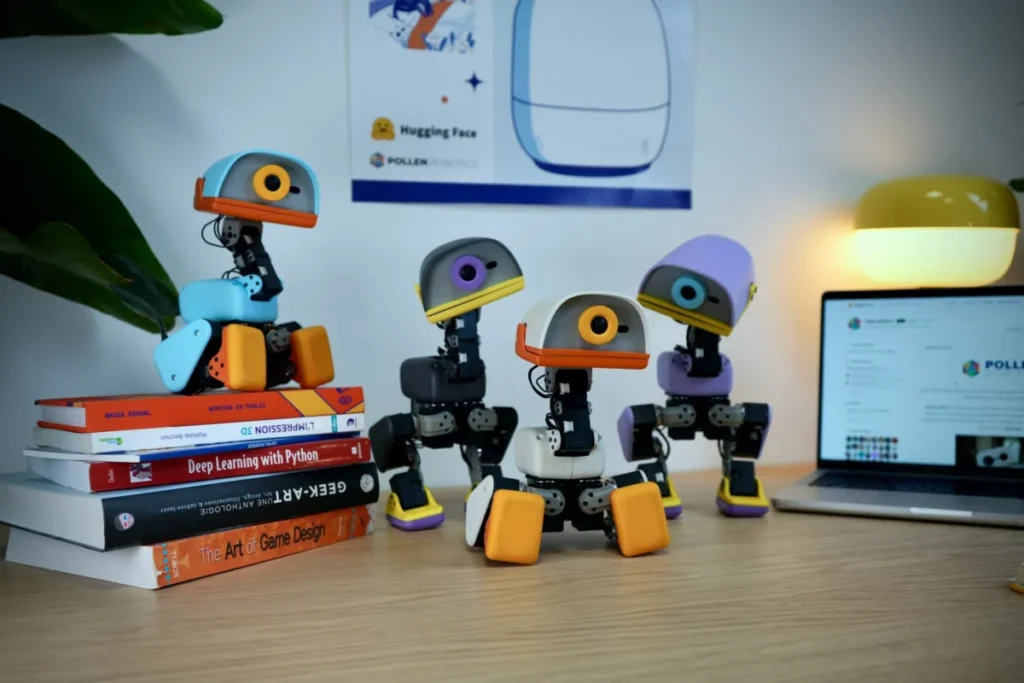
Inspired by the BDX’s potential and the desire to democratize access to such sophisticated robotics, the open-source community took up the mantle. This collective endeavor led to the conceptualization and development of the DIY Open Duck Mini. The Open Duck Mini was a testament to the power of collaborative innovation, aiming to distill the core principles of bipedal locomotion and control into an accessible, build-it-yourself package. This initiative gained significant traction, drawing support from prominent entities in the AI and robotics landscape. Hugging Face, a leading platform for machine learning models and datasets, and Pollen Robotics, known for its expertise in open-source robotic arms and platforms, became key sponsors. Their involvement transformed the Open Duck Mini from a grassroots project into a more structured, well-resourced development effort. The goal was clear: to create an open-source hardware and software platform that would allow individuals to build, program, and experiment with bipedal robotics without requiring institutional-level resources. This phase was crucial, as it established the foundational open-source principles and community engagement that would pave the way for Microduck.
The Open Duck Mini fostered a vibrant community of makers, students, and researchers who contributed to its design, documentation, and software development. It served as a vital bridge, translating advanced research concepts into practical, hands-on learning experiences. The iterative process of building, testing, and refining within this open-source framework provided invaluable insights into designing for durability, ease of assembly, and effective learning. This direct community engagement not only improved the robot’s design but also validated the strong demand for affordable, trainable robotic platforms, demonstrating the viability of community-driven hardware development in complex fields.
Microduck: A New Era of Accessible AI Training
Building upon the robust foundation laid by the Open Duck Mini project and leveraging the expertise gained through community collaboration, Pollen Robotics and Hugging Face have now officially launched Microduck. This adorable, compact robot represents the culmination of these efforts, translating advanced bipedal mechanics and AI training capabilities into a commercial product accessible to a broad audience. Priced at approximately $400, Microduck is designed specifically as a platform for learning and experimenting with reinforcement learning, a critical branch of artificial intelligence.
Reinforcement learning (RL) is a machine learning paradigm where an agent learns to make decisions by performing actions in an environment to maximize a cumulative reward. Unlike supervised learning, which relies on labeled data, or unsupervised learning, which finds patterns in unlabeled data, RL agents learn through trial and error, receiving feedback in the form of rewards or penalties for their actions. This makes RL particularly well-suited for tasks involving sequential decision-making, such as robot locomotion, game playing, and resource management. Microduck’s design directly facilitates this learning process. Its physical form and inherent "clumsiness" – characterized by a pigeon-toed walk and bowlegged skating – are not accidental flaws but deliberate design choices. These imperfections create a rich environment for RL algorithms to learn robust control policies. When failure is an inevitability, as is often the case in early stages of RL training, a physically resilient and low-cost platform like Microduck becomes an ideal candidate. Users can experiment freely, allowing the robot to "fail" repeatedly as it learns to navigate, balance, and perform tasks, without the prohibitive cost or fragility of larger, more complex robotic systems. This iterative learning process is fundamental to how robots will operate autonomously in unstructured environments.
Beyond its physical attributes, Microduck boasts an open-source SDK (Software Development Kit) and its repository is readily available on GitHub. This commitment to open-source principles is a cornerstone of its educational mission. An open SDK allows developers, students, and researchers to delve deep into the robot’s control systems, modify its behavior, integrate new sensors, and develop custom applications. It fosters an environment of transparency and collaboration, where the community can collectively contribute to the robot’s capabilities, share code, and accelerate innovation. The availability on GitHub ensures version control, easy collaboration, and broad accessibility to the project’s codebase, further solidifying its role as a community-driven learning tool. This model has been proven effective in rapid development and dissemination of technology, particularly in the software domain, and its application to robotics hardware and software is a significant step forward.

Technical Specifications and Inferred Capabilities
While detailed specifications are often subject to ongoing development, a robot like Microduck, priced at $400 and designed for reinforcement learning, would typically incorporate a carefully selected suite of components to balance cost with functionality. At its core, Microduck likely features a powerful yet energy-efficient microcontroller or a single-board computer, capable of executing complex control algorithms and processing sensor data in real-time. This processing unit would manage the robot’s gait, balance, and communication protocols, likely supporting a variety of programming languages suitable for AI development, such as Python.
Locomotion is achieved through multiple servo motors, strategically placed in the robot’s "hips," "knees," and potentially "ankles," to enable its characteristic bipedal movement. The number and type of servos would dictate the robot’s degrees of freedom and the complexity of movements it can achieve. Given its "pigeon-toed walk" and "bowlegged skating," it implies a sophisticated control over individual limb movements, requiring precise timing and coordination, which are prime targets for RL optimization. The robust construction necessary for repeated falls and learning cycles would also be a key design consideration.
Sensory input is crucial for any learning robot. Microduck would almost certainly include an Inertial Measurement Unit (IMU), comprising accelerometers and gyroscopes, to provide real-time data on its orientation, angular velocity, and linear acceleration. This data is vital for maintaining balance and understanding its position in space, enabling the RL agent to learn how its actions affect its stability. Additional sensors, such as basic touch sensors or infrared distance sensors, might also be incorporated to allow for simple environmental interaction and obstacle avoidance, expanding the complexity of tasks it can learn.
The mention of each Microduck having its "own individual ‘voice’" is particularly intriguing. While not explicitly detailed, this could refer to a variety of features: unique sound profiles generated by its internal components, distinct actuator noise signatures that naturally vary between units, or perhaps a small speaker capable of emitting simple, programmable beeps, chirps, or synthesized sounds unique to each unit. This auditory feedback would add to the robot’s charm and provide another channel for feedback during training, allowing users to differentiate between multiple robots in a learning swarm or simply enhancing the interactive experience.
The article also touches upon the potential for language processing onboard. While not a current feature, the possibility is openly discussed by the developers, suggesting that the underlying hardware might be capable of supporting such an upgrade in the future, perhaps through additional modules or more powerful processing. The quote, "It’s technically feasible and could be a future development. Even if we’re not the ones doing it, I expect the community to build it in a matter of weeks after the first users get their robots," highlights the profound confidence in the open-source community’s ability to extend and enhance the robot’s functionalities. This vision includes the potential for natural language understanding and interaction, transforming Microduck from a simple learning platform into a more interactive companion, capable of responding to verbal commands or even engaging in basic dialogue. This modularity and extensibility are key benefits of its open-source nature.
Implications for Education and Research
The launch of Microduck carries significant implications for both educational institutions and individual researchers. For educators, it provides an affordable and engaging platform to teach fundamental concepts in robotics, artificial intelligence, control theory, and programming. Students can gain hands-on experience with:
- Robot Kinematics and Dynamics: Understanding how the robot’s joints and links move to achieve desired locomotion.
- Sensor Integration and Data Processing: Working with IMUs and other sensors to interpret the robot’s state and environment.
- Control Systems: Implementing PID controllers or more advanced model predictive control for balance and movement.
- Reinforcement Learning: Designing reward functions, implementing various RL algorithms (e.g., Q-learning, policy gradients), and observing the learning process in real-time on a physical system.
- Open-Source Development: Contributing to a real-world open-source project, collaborating with a global community, and learning best practices in software development.
The low price point of $400 makes Microduck accessible to a much wider demographic than traditional research robots, which often cost thousands or tens of thousands of dollars. This democratizes access to advanced robotics, enabling high school robotics clubs, individual hobbyists, and universities with limited budgets to engage in cutting-edge AI research. It lowers the barrier to entry, fostering a more inclusive and diverse community of roboticists and AI practitioners, which is critical for accelerating innovation in the field. This accessibility contrasts sharply with the proprietary and costly nature of many advanced robotics platforms, making complex learning available to a broader audience.
For researchers, Microduck offers a standardized, open platform for testing novel RL algorithms, experimenting with different reward functions, and studying emergent behaviors in bipedal locomotion. Its inherent "cuteness" and robustness make it an excellent tool for human-robot interaction studies, especially in educational or therapeutic contexts where approachability is key. The ability to simulate real-world physics and handle unexpected events on a physical robot provides a more realistic testing ground than purely virtual simulations, bridging the gap between theoretical AI models and practical robotic deployment. This physical interaction allows for the study of real-world phenomena such as friction, inertia, and unexpected disturbances, which are difficult to perfectly model in simulation.

The Broader Impact: Democratizing AI and Shaping Future Robotics
The advent of Microduck represents more than just the release of a new robot; it signifies a broader trend in the democratization of advanced technology. Just as platforms like Arduino and Raspberry Pi made microcontrollers and single-board computing accessible, Microduck aims to do the same for complex bipedal robotics and reinforcement learning. This trend is crucial for accelerating innovation, as it expands the pool of contributors and ideas beyond institutional boundaries, fostering a more diverse and dynamic ecosystem for technological advancement.
The promise of Microduck extends to the potential for future home robotics. While its current capabilities are focused on learning and experimentation, the underlying principles of reinforcement learning and adaptable control systems are exactly what will drive the next generation of domestic robots. The article speculates on future capabilities, such as instructing the robot to "clean your room," albeit initially limited to lightweight items like socks. This seemingly whimsical example underscores a serious long-term vision: robots that can learn to perform diverse household chores through interaction and training, adapting to the unique layout and challenges of individual homes. The ability to grasp, manipulate, and navigate complex environments is a cornerstone of general-purpose domestic robotics, and Microduck provides an early, foundational platform for exploring these challenges in a scalable and affordable manner. The lessons learned from training Microduck could inform the development of larger, more capable household assistants.
The emphasis on community contribution is also a powerful driver. By providing an open SDK and hosting the project on GitHub, Pollen Robotics and Hugging Face are not just selling a product; they are cultivating an ecosystem. This ecosystem will undoubtedly lead to unforeseen applications, innovative modifications, and a rapid expansion of Microduck’s capabilities, far beyond what the initial developers could envision. The collective intelligence of a global open-source community is a formidable force, capable of solving complex problems and driving rapid technological evolution, a model that has proven highly successful in software development and is increasingly impactful in hardware.
Market Context and Future Outlook
The robotics market has seen a surge in accessible, programmable platforms in recent years, ranging from wheeled mobile robots to humanoid kits. Microduck enters this landscape with a distinct niche: an affordable, open-source, bipedal robot specifically tailored for reinforcement learning. This differentiates it from many general-purpose educational robots and higher-end research platforms. The $400 price point places it within reach of many educational budgets and serious hobbyists, offering advanced capabilities without the prohibitive cost associated with more robust humanoid or industrial robots. The growing demand for STEM education tools further solidifies Microduck’s market position, as institutions seek engaging and effective ways to introduce students to cutting-edge technologies.
The targeted delivery timeline of "before Christmas 2026" indicates a strategic launch, allowing for refinement and production scaling. This also gives the community ample time to anticipate and prepare for the robot’s arrival, fostering pre-launch discussions and development planning within the open-source community. The ability to pre-order now demonstrates confidence in the production pipeline and a commitment to meeting the high demand expected for such an innovative and charming device, ensuring that early adopters can begin their experimentation as soon as possible. The enthusiasm generated by its predecessors suggests a strong uptake, promising a vibrant community of users and developers.
In conclusion, Microduck is more than just an adorable waddling robot; it is a meticulously designed educational tool and a testament to the power of open-source collaboration. By democratizing access to reinforcement learning and advanced bipedal robotics, it is poised to inspire a new generation of innovators, accelerate research in AI, and lay the groundwork for a future where intelligent, adaptable robots play an increasingly integrated role in our lives. Its journey from Disney’s BDX to a community-driven open-source project and finally to a commercially available, affordable platform highlights a promising trajectory for robotics, emphasizing accessibility, learning, and the boundless potential of collective innovation. The stage is set for Microduck to waddle its way into labs, classrooms, and homes, leaving a trail of learned behaviors and groundbreaking discoveries in its wake.