Atlas, a pioneering company born from MIT research, is revolutionizing the construction industry by transforming discarded plastic pollution into durable building composites, with an ambitious mission to construct one billion homes. A.J. Perez, Atlas’s chair and co-founder, who also holds a PhD from MIT and is an MIT research scientist, articulated this vision: "Our mission is to convert waste plastic pollution into durable composites to build 1 billion homes. You can’t divorce these things from each other. We’re not here just to build homes, and we’re not here just to recycle plastic. The conventional way of building homes involves cutting down trees, mining, refining, and a bunch of other dirty activities. We want to avoid all that and address all the plastic bound for our oceans and landfills. We’re turning bottles into buildings." This dual-pronged approach directly confronts two of the planet’s most pressing environmental challenges: the overwhelming accumulation of plastic waste and the unsustainable resource demands of traditional construction.
The Genesis of an Ambitious Endeavor
The genesis of Atlas can be traced back to A.J. Perez’s doctoral research at MIT, where he focused on advanced fabrication techniques for housing and innovative methods for plastic recycling. In 2019, he co-founded MIT HAUS with David Hardt, MIT’s Ralph E. and Eloise F. Cross Professor in Manufacturing. The initial objective was straightforward yet monumental: to enable the production of one billion homes within a 30-year timeframe. However, during this developmental phase, the stark reality of the material requirements for such an undertaking became apparent. Perez elaborated on this critical juncture: "It started with the simple mission of enabling the production of 1 billion homes over a 30-year period. Then we realized how much the materials needed for those homes would strain global supply chains."
A deeper analysis revealed the staggering environmental toll of conventional construction. Building a billion homes using current methods would necessitate a doubling of global production capacity for essential materials like concrete. This alone presents a formidable challenge, but the impact on global deforestation would be even more catastrophic, requiring a dramatic acceleration of tree felling. It was at this point, as Perez described, that "the light bulb went off." He recognized a powerful synergy between the housing crisis and the escalating plastic pollution crisis. "There’s this other problem humanity has, which is 8 gigatons of plastic that have been produced and are polluting our oceans, rivers, and cities. We decided to plug two really big, hairy problems together."
This realization led to the establishment of Atlas. Perez partnered with Matt Pouliot, a former Maine senator, to commercialize the groundbreaking technology developed at MIT. The founders collaborated closely with MIT’s Technology Licensing Office. Their work has since expanded to include partnerships with researchers at other universities, contributing to the independent development of the company’s innovative robotic manufacturing platform, aptly named the Atlas Factory Stack.
A Waterless Revolution in Recycling and Manufacturing
A cornerstone of Atlas’s technological innovation is its ability to recycle low-grade plastic into high-performance building components without the use of water. This "waterless recycling process," as Perez terms it, is crucial for democratizing recycling on a global scale. He explained the significance: "This is key to democratizing recycling. Now, every country around the world, regardless of their water access, will be able to do something about their plastic." The implications for developing nations, often disproportionately affected by both plastic pollution and resource scarcity, are profound. Traditional recycling facilities require significant water resources, often posing a barrier to implementation in water-stressed regions. Furthermore, the permitting processes for establishing such facilities can be arduous, involving extensive engagement with local water agencies. Atlas’s waterless process significantly streamlines these bureaucratic hurdles, making sustainable recycling more accessible and faster to deploy.
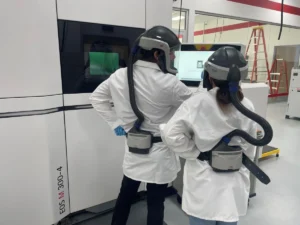
The manufacturing process itself is a testament to efficiency and innovation. Single-use plastics, such as those found in water bottles and other discarded items, are first shredded. This shredded material is then fed into the Atlas system, where it is melted and combined with American-made fiberglass. This fusion creates a composite material that is not only stronger than traditional wood but also boasts superior durability. The resulting composite is then processed by a large-scale 3D printer, which precisely forms the building components, including trusses for floors, walls, and roofs, as well as elements for bridges.
Quantifiable Performance and Scalability
The efficacy of Atlas’s technology has been rigorously tested and validated. Through extensive research conducted at MIT, Perez has demonstrated the capability to print large composite trusses in under 13 minutes. Critically, these printed components have proven to support over 4,000 pounds, comfortably exceeding key building code standards. This level of performance underscores the structural integrity and reliability of Atlas’s recycled plastic composites.
On a production level, Perez stated, "At MIT, we’ve demonstrated we can produce 60 to 80 pounds of parts per hour, and the systems we’re specifying in Atlas factories operate in the 150 to 200 pound per hour range." The company projects that their robotic manufacturing platform has the potential to produce each part at a lower cost than traditional injection molding. Beyond cost-effectiveness, the flexibility and convenience of the Atlas system are significant advantages. For instance, the system can manufacture parts in reverse order, ensuring they are ready for palletizing in the precise sequence needed for assembly, streamlining the construction workflow.
The founders envision Atlas as a technology provider that empowers the creation of localized "home factories." Each Atlas factory cell is currently designed to produce the structural framing components for approximately one small home per day. This decentralized manufacturing model stands in stark contrast to the conventional approach of mass production in massive, often distant, factories. Perez critiqued this old model: "The old way of doing things would be some huge factory in China would mass produce one type of part and ship it far away. I don’t think that’s good for the planet."
Environmental Stewardship and Economic Empowerment
The environmental benefits extend beyond the immediate reduction of plastic waste. Atlas’s recycled plastic composites offer a significant advantage in terms of longevity and reduced maintenance, particularly in applications exposed to moisture or ground contact. Pouliot highlighted this aspect: "Plastics last far longer than wood, especially for applications where they’re in contact with the ground or water. That adds to the company’s environmental benefits. If you get a material into the building world and it does its job, it’s going to be used for a very long time and not need to be recycled again for a very long time." This extended lifespan means less frequent replacement and, consequently, a reduced demand for new materials over time. Pouliot further emphasized, "That’s important because when you recycle something over and over again, it degrades. This is one of the most sustainable use cases for recycled petrochemical products."
The economic implications of Atlas’s localized manufacturing model are equally significant. By fostering the creation of "home factories," Atlas aims to generate employment opportunities within local communities, encompassing roles in recycling, manufacturing, and construction. This approach directly counters the job displacement often associated with mega-factories. Perez elaborated on the economic and environmental rationale: "Another reason we don’t use injection molding is economic: Mega factories don’t produce as many jobs and have a much higher carbon footprint. We want this to be localized to benefit local communities. The plastic is already everywhere. The more local Atlas is, the lower the cost and footprint."
Demonstrating Impact: From Sheds to Bridges
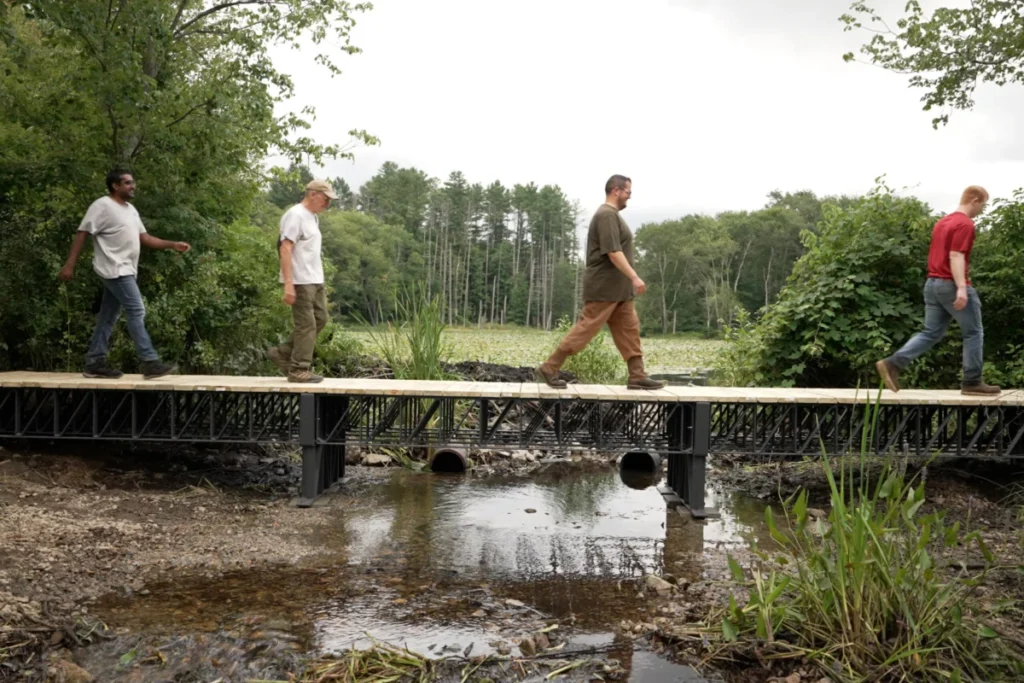
Atlas’s innovative materials are already finding practical applications. Their composite parts are currently being utilized in the construction of barns, sheds, decks, and docks, demonstrating their versatility and durability in various environments. A particularly noteworthy recent project involved the U.S. Army Corps of Engineers. Atlas supplied American-made recycled composite trusses for the construction of a 40-foot bridge in a Massachusetts wetland. The installation of this bridge was remarkably swift, completed in less than a day, showcasing the efficiency of Atlas’s prefabricated components.
A Global Vision for Sustainable Development
Looking ahead, Atlas has ambitious plans for global expansion. The company is actively engaged in discussions with international franchise partners, aiming to deploy its Atlas Factory Stack technology across the world. This global strategy is rooted in the belief that true sustainable development requires a distributed, localized approach. Perez articulated this vision: "To accomplish our mission, I fundamentally believe it’s not going to be one far-away company dominating the industry. It’s going to be every country leveraging Atlas Factory Stacks to create local recycling jobs, local factory jobs, local construction jobs, and to stimulate their economies with local materials."
The company’s commitment to real-world impact is evident in its approach. By focusing on practical applications and tangible solutions, Atlas is not merely innovating in a laboratory setting but actively contributing to a more sustainable and equitable future. The integration of recycled plastic into the built environment represents a paradigm shift, moving away from linear "take-make-dispose" models towards a circular economy where waste is viewed as a valuable resource. Atlas’s success in turning discarded bottles into robust building components offers a compelling blueprint for addressing global challenges through technological ingenuity and a deep commitment to environmental stewardship. The company’s trajectory suggests a future where the construction industry not only shelters humanity but also actively contributes to healing the planet.