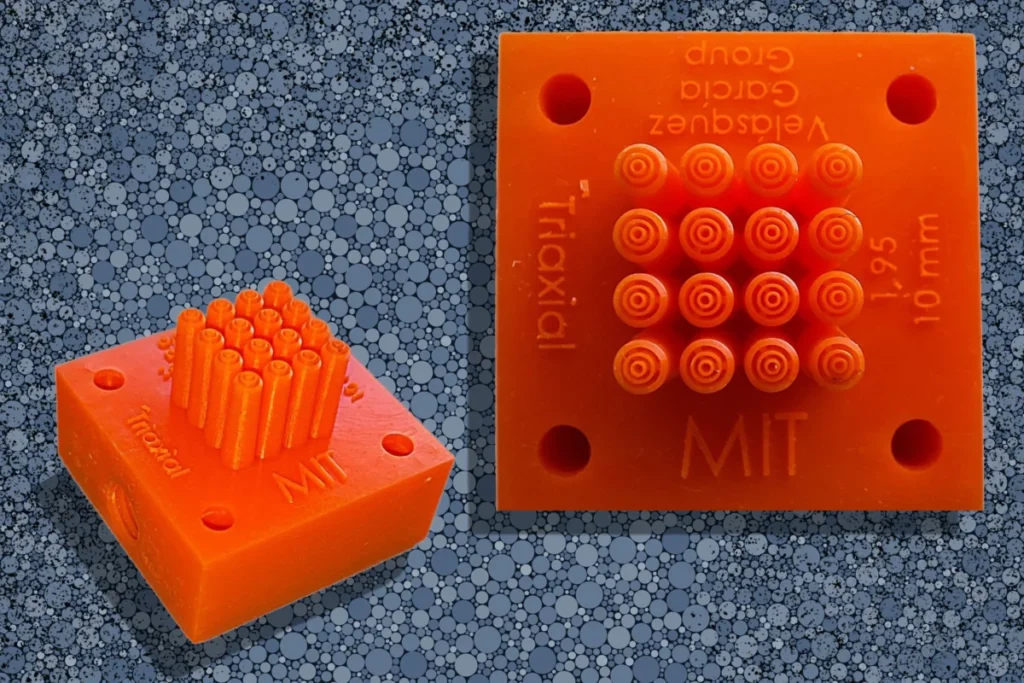
Massachusetts Institute of Technology (MIT) researchers have achieved a significant breakthrough in microfabrication technology with the development of a cost-effective design for specialized electronic nozzles, known as triaxial electrospray emitters. This innovation promises to dramatically enhance the efficiency and scalability of producing time-release drug-delivery particles and self-healing materials. Unlike previous methods that demanded expensive and time-consuming cleanroom processes, this new approach leverages advanced 3D printing to create intricate emitter arrays with remarkable precision and speed. The development, detailed in a recent publication in Virtual and Physical Prototyping, opens new avenues for democratizing advanced material manufacturing and accelerating scientific discovery.
The Science Behind Triaxial Electrospray Emitters
At its core, triaxial electrospray technology utilizes electrical fields to precisely control the expulsion of multiple liquids from microscopic nozzles. These specialized emitters are designed with three concentric nozzles, each dispensing a distinct, immiscible fluid. As these liquids exit the nozzle under a high voltage, they form a stable, layered stream of microscopic droplets. The key innovation lies in the ability to solidify these multilayered droplets into microparticles, each possessing a distinct internal structure defined by the fluid layers.
This layered structure is particularly advantageous for sophisticated applications. For instance, in drug delivery, a triaxial emitter could fabricate a nanoparticle with an outer shell designed to degrade slowly in the acidic environment of the stomach. This initial layer would then reveal a second material engineered to control the release rate of a core payload, delivering medicine precisely to a specific segment of the intestines. Such targeted delivery mechanisms are crucial for optimizing therapeutic efficacy and minimizing systemic side effects. Beyond pharmaceuticals, this technology holds promise for creating self-healing composites where microcapsules containing repair agents are embedded within a material, releasing their contents upon damage.
Overcoming Fabrication Hurdles with 3D Printing
Historically, the creation of miniaturized electrospray emitter arrays has been a significant bottleneck. Traditional fabrication methods, rooted in semiconductor cleanroom microfabrication, are inherently complex, expensive, and time-consuming. These processes often involve photolithography and etching techniques that are precise but rigid, limiting the geometries and designs that can be realized. The need for specialized equipment and ultra-clean environments also restricts accessibility to a handful of advanced research institutions.
The MIT team, led by principal research scientist Luis Fernando Velásquez-García of MIT’s Microsystems Technology Laboratories (MTL), circumvented these limitations by employing a sophisticated 3D printing technique known as vat photopolymerization. This additive manufacturing process uses light to selectively cure and solidify layers of liquid resin, building complex three-dimensional structures with remarkable resolution. The researchers were able to achieve layer heights as small as 25 micrometers, a fraction of the width of a human hair, enabling the creation of intricate internal microchannel networks essential for the triaxial emitters.
This one-step fabrication process dramatically reduces production time and cost. Instead of weeks or months spent in a cleanroom, the MIT team can now produce complex emitter arrays, each featuring 16 nozzles within an area of approximately one square centimeter, in just a few hours. This rapid prototyping capability allows for faster iteration and optimization of designs, a critical advantage in developing cutting-edge technologies.
A Leap Forward in Precision and Uniformity
The uniformity and consistency of the generated microdroplets are paramount for high-throughput manufacturing and reliable performance of the resulting microparticles. In testing, the 3D-printed triaxial electrospray arrays consistently produced uniform, three-layered droplets at scale. This uniformity is a direct result of the meticulously designed internal architecture of the emitters.
Each 3D-printed device incorporates a complex network of coiled, three-dimensional microchannels. These helical pathways are engineered to deliver liquid uniformly to each of the 16 nozzles, ensuring that every emitter operates independently and consistently without interference from its neighbors. Velásquez-García emphasized the importance of this design, stating, "In a sense, the emitters in the array never learn they have company, or otherwise there would be cross-talking and causing interference between them. We achieved uniformity because of the work that went into our designs."
Furthermore, the researchers faced the challenge of fabricating extremely fine channels without relying on support structures that could clog the device. The vat photopolymerization technique allowed them to precisely create these intricate geometries and ensure thorough removal of uncured resin, a critical step for device functionality. The concentric nozzles themselves had to be perfectly aligned to achieve consistent droplet formation.
Optimizing for Performance: The Role of Viscosity and Flow Rates
The development process involved extensive experimentation and refinement. The researchers explored multiple device architectures and meticulously optimized liquid flow rates and voltages to maximize the stability and consistency of the emitted microdroplets. A key finding from their research was the critical role of the viscosity of the middle liquid layer in maintaining droplet stability. This intermediate layer acts as a buffer, preserving the distinctness and integrity of each fluid layer within the droplet.
By carefully adjusting flow rates and voltages, the MIT team demonstrated the ability to precisely tailor the thickness of each microdroplet layer. This fine-tuned control is invaluable for applications like drug delivery, where specific layer thicknesses can dictate the precise timing and rate of medication release. For biosensors, the ability to control layer composition allows for the integration of multiple distinct chemical markers within a single microparticle, enhancing sensitivity and specificity.
Broader Impact and Future Directions
The implications of this low-cost, scalable fabrication method are far-reaching. Velásquez-García articulated a vision of democratizing this technology, stating, "We want to democratize this technology so the benefits can touch many more people." By making these advanced emitter arrays more accessible, the researchers aim to empower a wider range of scientists, engineers, and entrepreneurs to pursue novel applications in medicine, materials science, and beyond.
The immediate impact is on the production of layered microparticles for biosensors capable of detecting minute quantities of chemical substances, and for creating artificial cells that could aid in tissue regeneration. The ability to produce these complex particles at scale and at a lower cost could accelerate research and development in these fields, leading to faster clinical translation of new therapies and diagnostic tools.
Looking ahead, the MIT team plans to further refine their fabrication process to achieve even smaller dimensions and integrate novel materials, such as conductive or dielectric elements, into the emitter arrays. These advancements could lead to even more sophisticated electrospray emitter arrays with enhanced functionalities, potentially enabling new forms of additive manufacturing for microelectronics or advanced biomedical devices. The collaboration with Bryan Ivan Quintanar-Abarca of the Technological Institute of Monterrey in Mexico underscores the international effort to push the boundaries of microfabrication.
The research was supported in part by the Tecnológico de Monterrey – MIT Nanotechnology Program, highlighting the synergistic relationship between these institutions in fostering innovation in nanotechnology and advanced manufacturing. This breakthrough represents a pivotal moment in the journey towards making complex microfabrication technologies more practical, affordable, and widely available, promising to catalyze innovation across numerous scientific and industrial sectors.