The European Organization for Nuclear Research, known as CERN, has officially entered a transformative phase in its scientific mission as engineers began the delicate process of dismantling the Large Hadron Collider’s (LHC) inner triplet magnets. This operation, which commenced at Point 1 near the ATLAS experiment, represents the inaugural step of a multi-year overhaul designed to transition the world’s most powerful particle accelerator into the High-Luminosity LHC (HL-LHC). By replacing the foundational hardware that has guided particle beams for nearly two decades, CERN aims to significantly increase the collider’s "luminosity"—a metric reflecting the number of potential particle collisions—thereby opening new frontiers in the study of fundamental physics.
The Large Hadron Collider is a marvel of 21st-century engineering, a 27-kilometer subterranean ring situated beneath the Franco-Swiss border. To function, it relies on a complex architecture of thousands of superconducting magnets. These include dipoles, which bend the particle beams around the circular track; quadrupoles, which focus the beams; and higher-order magnets like sextupoles and decapoles, which correct minute trajectories. Among these, the inner triplets are arguably the most critical for the final stage of the acceleration process. These groups of three specialized quadrupole magnets are positioned on either side of the collider’s four primary interaction points: ATLAS, CMS, ALICE, and LHCb. Their specific function is to compress the counter-rotating beams of protons into incredibly tight bunches just before they cross paths inside the detectors.
The Science of Luminosity and Beam Compression
In the world of high-energy physics, luminosity is the lifeblood of discovery. While the energy of the beams determines which particles can be produced (such as the Higgs boson, discovered in 2012), the luminosity determines how often those production events occur. Currently, the LHC’s beams are roughly the width of a human hair at the point of collision. The inner triplets are responsible for this "squeezing" effect. The tighter the compression, the higher the density of protons within a given cross-section, which directly correlates to a higher probability of collisions.
The transition to the High-Luminosity LHC is intended to increase the integrated luminosity by a factor of ten beyond the LHC’s original design specifications. This upgrade will allow the machine to produce more data in a single year than it did in its first decade of operation. For researchers, this means the ability to observe rare physical processes that are currently masked by statistical noise and to perform high-precision measurements of the Higgs boson’s properties, potentially revealing cracks in the Standard Model of particle physics.
A Technological Leap: From Niobium-Titanium to Niobium-Tin
The centerpiece of the HL-LHC project is the replacement of the existing inner triplets with a more advanced generation of superconducting magnets. The current magnets, which have served the LHC since its construction began in the mid-2000s, utilize niobium-titanium (NbTi) superconducting coils. While highly reliable, NbTi has a physical limit to the strength of the magnetic field it can generate—roughly 8 tesla in the LHC’s operational environment.
To push the boundaries of beam focusing, CERN’s engineers have turned to niobium-tin (Nb3Sn). This material remains superconducting at higher magnetic fields, allowing the new inner triplets to reach a peak field of 11.3 tesla. This represents a 40% increase in magnetic strength over the legacy hardware. However, the shift to niobium-tin has presented significant engineering hurdles. Unlike the relatively ductile niobium-titanium, niobium-tin is brittle and sensitive to mechanical stress. Developing the manufacturing processes to wind these coils into the massive, precise structures required for the LHC has taken over a decade of research and international collaboration, involving laboratories in the United States and across Europe.
The Chronology of Long Shutdown 3
The current dismantling operation is a key component of Long Shutdown 3 (LS3), a scheduled hiatus in the LHC’s operation dedicated to maintenance and major upgrades. The timeline for this transition is rigorous:
- September 2024: Removal of the first interconnections between magnets begins. This involves cutting through the complex vacuum systems and cryogenic cooling lines that keep the magnets at 1.9 Kelvin (-271.3°C).
- 2024–2026: Systematic removal of 28 superconducting magnets from the tunnel, focusing on the areas surrounding the ATLAS (Point 1) and CMS (Point 5) experiments.
- 2026–2028: Civil engineering and infrastructure preparation. This includes the installation of new power converters, cooling systems, and the "crab cavities"—another HL-LHC innovation that tilts the particle bunches to maximize their overlap at the collision point.
- 2029: The first of the new niobium-tin inner triplet quadrupoles are scheduled to be lowered into the tunnel.
- 2030 and beyond: Following a period of rigorous testing and hardware commissioning, the High-Luminosity LHC will begin its first physics runs.
Jean-Philippe Tock, Head of the LS3 Coordination Team, emphasized the scale of the task: "The replacement of these magnets with the new HiLumi LHC inner triplets is crucial for the coming high-luminosity years. In total, 16 cryostats and 28 cryo-assemblies will be installed—a major undertaking that requires surgical precision within the tight confines of the LHC tunnel."
Strategic Implementation Across Experiments
The upgrade strategy is not uniform across all four of the LHC’s major experiments, reflecting their different scientific goals. The ATLAS and CMS detectors, which are general-purpose "discovery" machines, will receive the full suite of new inner triplets. These experiments require the highest possible instantaneous luminosity to search for heavy new particles, such as those predicted by theories of supersymmetry or dark matter.
In contrast, the ALICE experiment (which focuses on heavy-ion collisions and the quark-gluon plasma) and the LHCb experiment (which specializes in "beauty" quark physics) have different requirements. These detectors are designed to handle lower collision rates to prevent their sensitive electronics from being overwhelmed. Consequently, their existing inner triplets will remain in place, though they will undergo maintenance and peripheral upgrades to ensure they can benefit from the overall increase in the collider’s efficiency and beam stability.
Official Responses and the End of an Era
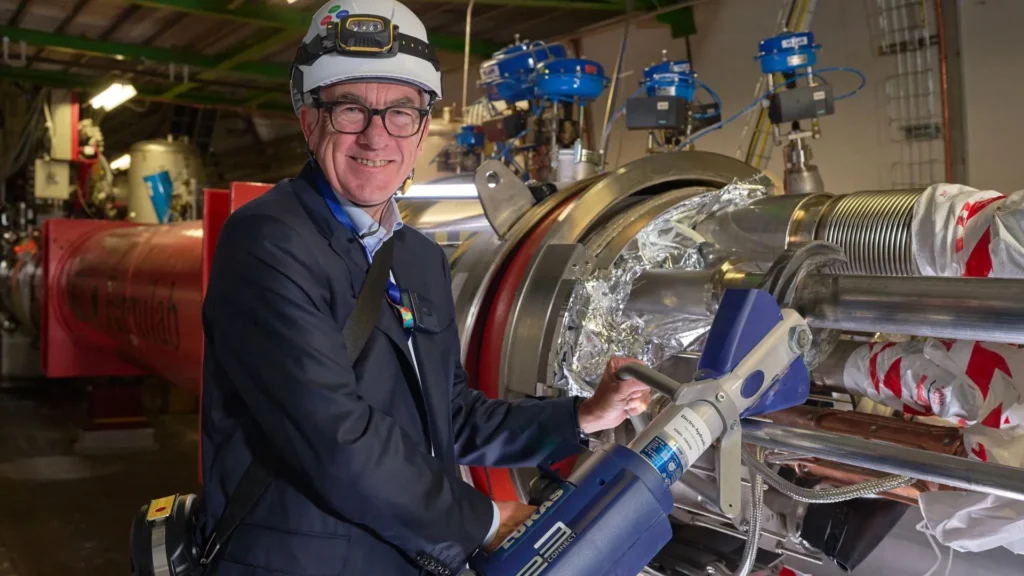
The commencement of the removal process was marked by a visit from CERN Director-General Mark Thomson to LHC Point 1. The event served as a symbolic handover between the generation of physicists who built the LHC and those who will operate its high-luminosity successor.
Markus Zerlauth, the HiLumi LHC Project Leader, reflected on the historical significance of the hardware being removed. "The current inner triplets date back to the LHC construction phase and were installed in the machine between 2005 and 2007," Zerlauth stated. "After nearly twenty years of operation, including the period that led to the discovery of the Higgs boson, they will give way to a new generation of even more powerful magnets. It’s truly remarkable to witness such a handover from one generation of innovation to the next."
The removal of the 28 superconducting magnets is not merely a logistical task but a high-stakes engineering operation. Each magnet assembly, or cryostat, weighs several tons and is packed with delicate instrumentation. Because the magnets have been exposed to high levels of radiation during their years of service, the dismantling process must be handled with strict adherence to safety protocols, utilizing remote-handling equipment where necessary to minimize human exposure.
Broader Implications for Global Science
The High-Luminosity LHC project is more than just a hardware upgrade; it is a commitment to the future of particle physics through the mid-2040s. By extending the life and productivity of the LHC, CERN is ensuring that the global scientific community has access to the data required to answer some of the universe’s most enduring mysteries.
The data surge provided by the HL-LHC will allow for:
- Precision Higgs Physics: Measuring how the Higgs boson interacts with other particles with a precision of 1–5%, which could indicate the presence of "new physics" beyond the Standard Model.
- Searching for Dark Matter: Providing more opportunities to detect weakly interacting massive particles (WIMPs) or other dark matter candidates.
- Exploring the Vacuum: Investigating the self-coupling of the Higgs boson, which is essential to understanding the stability of the universe’s vacuum state.
Furthermore, the technological innovations developed for the HL-LHC, particularly in the field of niobium-tin superconductivity and high-capacity cryogenics, have applications beyond high-energy physics. These advancements often trickle down into medical imaging (MRI), energy storage, and the development of more efficient power grids.
As the first magnet interconnections are severed and the legacy hardware is moved to the surface, CERN stands at the threshold of a new era. The transition to the High-Luminosity LHC represents a massive investment in human ingenuity and a testament to the international collaboration that defines modern science. While the tunnel may be quiet during LS3, the activity within it is the heartbeat of a project that will define the next two decades of human understanding regarding the fundamental building blocks of reality.