The mysteries of the early universe, specifically the era known as the "Cosmic Dark Ages," are set to be explored by a pioneering UK-led satellite mission named CosmoCube. This spacecraft, roughly the size of a carry-on suitcase, represents a significant leap in astrophysical research, aiming to observe a period of cosmic history that has remained invisible to human instruments for billions of years. Developed by an international consortium led by the University of Cambridge, the mission intends to utilize the unique radio-quiet environment of the Moon’s far side to detect signals from the first 150 million years following the Big Bang. This ambitious project, recently detailed in the journal Nature Astronomy, could fundamentally reshape our understanding of how the first stars formed and the role dark matter played in the architecture of the modern cosmos.
Unlocking the Secrets of the 21-Centimeter Line
The primary scientific objective of CosmoCube is the detection of the 21-centimeter line, a spectral signature produced by neutral hydrogen atoms. In the infancy of the universe, long before the first stars ignited their nuclear furnaces, the cosmos was filled with a vast, cooling fog of hydrogen gas. This period, which began after the initial afterglow of the Big Bang faded and ended with the "Cosmic Dawn," is one of the most significant gaps in the human record of the universe.
The 21-centimeter line is a radio signal emitted when the spin of a hydrogen atom’s electron flips. Because the universe has been expanding for more than 13.5 billion years, these radio waves have been stretched—or "redshifted"—to much longer wavelengths and lower frequencies. By the time they reach the vicinity of Earth, these signals occupy the 10 to 50 MHz range. Observing these frequencies is the only way to "see" into the Dark Ages, but doing so from the surface of the Earth is a physical impossibility.
The Shield of the Moon: Overcoming Earth’s Interference
Terrestrial radio astronomy faces two insurmountable hurdles when attempting to observe the early universe at low frequencies. First, the Earth’s ionosphere—a layer of the upper atmosphere ionized by solar radiation—acts as a refractive and reflective barrier, preventing low-frequency cosmic radio waves from reaching ground-based telescopes. Second, the modern world is saturated with human-generated radio frequency interference (RFI). Everything from FM radio broadcasts and television signals to satellite telecommunications and global positioning systems produces "noise" that is millions of times stronger than the faint whispers from the Big Bang.
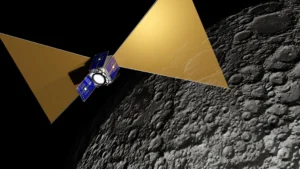
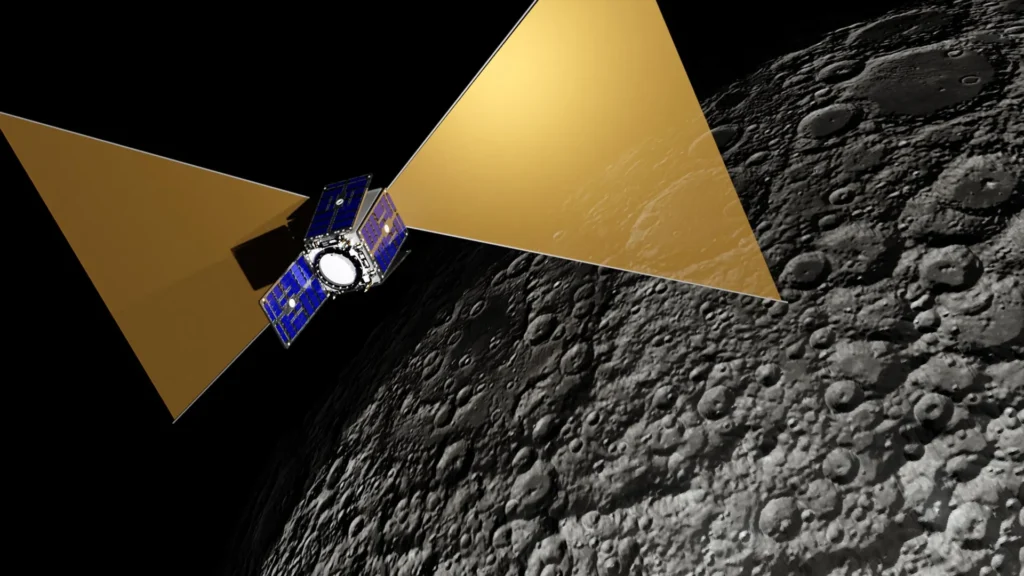
The Moon offers the only viable solution to these challenges. As CosmoCube orbits the Moon, it will periodically pass behind the lunar body, entering a region known as the lunar far side. This massive celestial body acts as a physical shield, blocking out the cacophony of Earth’s radio transmissions. During each two-hour orbit, the satellite will spend approximately 40 minutes in total radio silence. Over the course of its projected two-year mission, researchers expect to accumulate over 1,000 hours of pristine, interference-free data. This "quiet window" is essential for isolating a signal that is buried under layers of local and galactic noise.
Engineering a Miniature Powerhouse: The CosmoCube Platform
Despite its small stature, CosmoCube is a marvel of modern aerospace engineering. The spacecraft is built upon the SSTL-21 platform, developed by Surrey Space Technology Limited (SSTL), a UK-based firm renowned for its expertise in small satellite manufacturing. The mission utilizes a highly integrated miniature radiometer, which leverages "Radio Frequency System on Chip" (RFSoC) technology. This allows the satellite to process complex signals using a fraction of the power and space required by traditional hardware.
One of the most critical components of the mission is the "Dicke switched" calibrator. Because the 21-centimeter signal is so incredibly weak, even the tiny amount of heat-generated electronic noise from the satellite’s own circuitry could be mistaken for a cosmic discovery. The Dicke switch allows the system to rapidly alternate between looking at the sky and looking at internal reference sources of a known temperature. By constantly comparing the two, the onboard computer can subtract its own electronic signature from the data, ensuring that the final results are an accurate reflection of the deep cosmos.
Once the data is transmitted back to Earth, scientists will employ advanced Bayesian statistical techniques to further refine the signal. These mathematical models are designed to separate the desired hydrogen signal from "foreground" emissions—the radio noise produced by the Milky Way galaxy itself. This multi-staged approach to signal processing is what makes a mission of this scale scientifically viable.
Investigating the Invisible: The Role of Dark Matter
Beyond the study of hydrogen, CosmoCube is tasked with investigating one of the greatest mysteries in physics: dark matter. While dark matter cannot be seen directly because it does not emit or absorb light, it exerts a gravitational pull that is essential for the formation of galaxies. Current cosmological models suggest that dark matter acted as a "gravitational scaffold" during the Dark Ages, pulling hydrogen gas together into dense clouds that eventually collapsed to form the first stars.
By measuring the fluctuations in the 21-centimeter signal, Professor Eloy de Lera Acedo and his team hope to observe the first interactions between dark matter and ordinary matter. "This emission from hydrogen after the Big Bang, but before the first stars, will hopefully allow us to understand the role of dark matter in the early universe," said de Lera Acedo, the lead author from Cambridge’s Cavendish Laboratory and the Kavli Institute for Cosmology. Understanding how dark matter influenced the "Cosmic Dawn" could provide clues about the particle nature of dark matter itself, a discovery that would likely earn a Nobel Prize.
A Timeline for Discovery and International Collaboration
The development of CosmoCube is already well underway. Laboratory prototypes of the instruments have been constructed, and rigorous environmental testing is being conducted at facilities like STFC RAL Space. These tests ensure that the satellite’s delicate electronics can survive the extreme temperature fluctuations of lunar orbit, where the spacecraft will oscillate between the freezing shadows behind the Moon and the intense radiation of direct sunlight.
The project has received crucial support and funding from the UK Space Agency, the Kavli Foundation, and the Science and Technology Facilities Council (STFC). The mission team recently participated in the European Space Agency (ESA) "mini Fast missions" Call for Ideas, proposing a mission cost of under 50 million Euros. This low-cost approach is a cornerstone of the mission’s philosophy, demonstrating that high-impact "Flagship-level" science can be achieved with a fraction of the budget of traditional space missions.
The current timeline aims for a launch within the next five years. This window is strategically important, as interest in the lunar far side is growing globally. The United States, India, and China have all expressed interest in establishing radio observatories on or around the Moon. By launching CosmoCube soon, the UK and its partners—including the University of Portsmouth and researchers from Malta—position themselves at the forefront of this new era of lunar-based astronomy.
Broader Implications for Space Exploration and Science
The success of CosmoCube would signal a paradigm shift in how we explore the deep past of our universe. Historically, space agencies have relied on massive, multi-billion-dollar telescopes like the James Webb Space Telescope (JWST) to peer into the distance. While JWST is unparalleled at seeing the first galaxies, it cannot see the era before those galaxies existed because there was no light to see. CosmoCube fills this gap by using radio waves instead of light, effectively opening a new window into the "Dark Ages."
Furthermore, the mission highlights the growing importance of the "Radio Quiet Zone" on the lunar far side. As Earth’s orbital space becomes increasingly crowded with "mega-constellations" of communication satellites, the far side of the Moon remains the last sanctuary for low-frequency radio astronomy. The techniques pioneered by CosmoCube—such as the use of lightweight deployable antennas and RFSoC signal processing—will likely serve as the blueprint for larger lunar observatories in the decades to come.
Dr. Will Grainger of STFC RAL Space emphasized the ingenuity required for such a mission: "CosmoCube is aiming to do some ambitious science from a very small satellite in a challenging environment… In the future, we hope to further develop the full payload in preparation for a full mission."
Conclusion: A UK Success Story in the Making
As the global community enters a new race to the Moon, CosmoCube stands out as a mission focused not on territorial claims or resource extraction, but on the fundamental questions of existence. Where did we come from? How did the universe begin? What is the nature of the dark matter that surrounds us?
By combining cutting-edge UK engineering with world-class theoretical physics from the University of Cambridge, CosmoCube is poised to provide the first direct evidence of the universe’s transition from darkness to light. If successful, it will prove that the smallest satellites can sometimes answer the biggest questions, providing a cost-effective and highly efficient path for the future of space exploration. As Professor de Lera Acedo noted, this is more than just a scientific experiment; it is a potential "UK success story" that could define the next chapter of cosmic discovery.