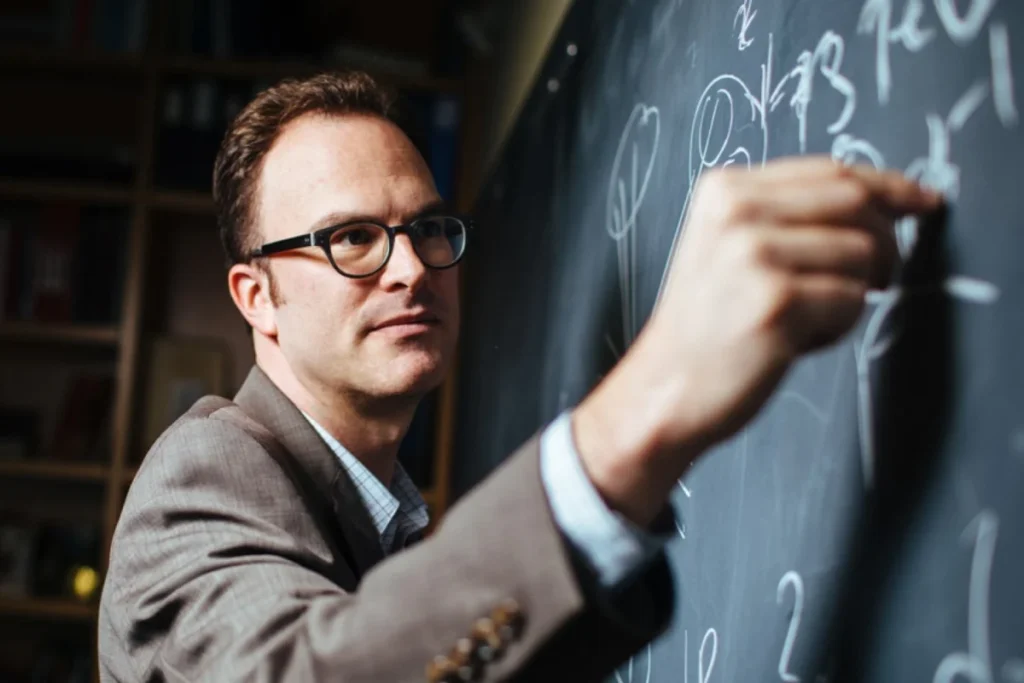
The Massachusetts Institute of Technology (MIT) has officially announced the appointment of Professor Jesse Thaler as the new director of the Laboratory for Nuclear Science (LNS), effective August 1. Thaler, a distinguished theoretical particle physicist and a pioneer in the application of artificial intelligence (AI) to fundamental physics, succeeds Professor Bolek Wyslouch, who has led the laboratory for the past decade. This leadership transition occurs at a pivotal moment for the institution, as the fields of nuclear and particle physics increasingly intersect with advanced computational techniques and machine learning.
Professor Thaler’s appointment is seen as a strategic move to align the laboratory’s research trajectory with the rapid evolution of "AI-driven discovery." Currently the William and Emma Rogers Professor of Physics within the MIT Center for Theoretical Physics—a Leinweber Institute (CTP-LI)—Thaler has built an international reputation for his work in quantum field theory and the development of machine learning techniques designed to probe the most fundamental questions of the universe.
A Legacy of Excellence: The Evolution of the Laboratory for Nuclear Science
Founded in 1946, the Laboratory for Nuclear Science was established in the immediate aftermath of World War II to coordinate MIT’s research in the burgeoning fields of nuclear and particle physics. Over the past 78 years, the LNS has served as an umbrella for a diverse array of research initiatives, evolving from its initial focus on nuclear structure to encompass high-energy particle physics, cosmology, gravity, field theory, and, most recently, quantum information science.
Under the ten-year directorship of Professor Bolek Wyslouch, the LNS maintained its position at the forefront of global scientific inquiry. Wyslouch, an experimentalist who played a key role in the Compact Muon Solenoid (CMS) experiment at the Large Hadron Collider (LHC), oversaw a period of significant growth and technical achievement. His leadership ensured that MIT researchers remained central to major international collaborations, including those at CERN and various neutrino research facilities.
The transition to Thaler’s leadership marks a shift toward a new paradigm. While the fundamental questions regarding the nature of matter and the forces of the universe remain the same, the tools used to answer them are changing. Dean of the MIT School of Science, Nergis Mavalvala, noted the significance of this shift: “The collaborative nature of his research programs will serve the Laboratory for Nuclear Science as science enters a new era of AI-driven discovery.”
Jesse Thaler: A Career at the Intersection of Theory and Computation
Professor Thaler’s academic trajectory reflects a deep commitment to both mathematical rigor and innovative computation. He earned his Bachelor of Science in math and physics from Brown University in 2002, followed by a PhD in physics from Harvard University in 2006. Before joining the MIT faculty in 2010, he served as a fellow at the Miller Institute for Basic Research in Science at the University of California, Berkeley.
Thaler’s research primarily focuses on the Large Hadron Collider (LHC), the world’s most powerful particle accelerator. Specifically, he has performed pioneering work on "particle jets"—the sprays of particles produced when high-energy quarks and gluons are ejected from collisions. By applying techniques from quantum field theory, Thaler has developed new ways to analyze these jets, allowing physicists to better distinguish between known processes and potential signals of "new physics," such as dark matter or supersymmetry.
In recent years, Thaler has become a leading voice in the integration of AI and machine learning into the physical sciences. He has argued that traditional statistical methods are no longer sufficient to handle the "data deluge" generated by modern experiments. His work involves creating "physics-informed" AI—algorithms that are not just black boxes but are built to respect the symmetries and conservation laws of the physical world.
The NSF AI Institute and the Genesis Mission
A cornerstone of Thaler’s recent leadership is his role as the inaugural director of the National Science Foundation (NSF) AI Institute for Artificial Intelligence and Fundamental Interactions (IAIFI). Launched in 2020, IAIFI is a multi-institutional effort led by MIT that aims to advance physics research through AI while simultaneously using physics principles to improve AI technology.
The success of the institute was underscored recently when it was renewed for another five-year term, ensuring a continued pipeline of research at the nexus of these two fields. As Thaler moves to lead the LNS, Professor Mike Williams will take over the directorship of IAIFI. This transition ensures that the synergy between the two organizations remains strong, particularly as the LNS prepares to engage with the Department of Energy’s (DOE) Genesis Mission. The Genesis Mission is a high-priority federal initiative focused on AI-enabled scientific discovery, aiming to use machine learning to accelerate the pace of breakthroughs in energy and fundamental science.
“In my own field of particle physics, researchers are developing cutting-edge AI algorithms to handle the data deluge from collider experiments and to perform heroic theoretical calculations,” Thaler said in a statement. “This work has direct implications for discovering new physics, but the algorithms themselves turn out to be valuable well beyond our field.”
Supporting Data: The Impact of AI on High-Energy Physics
The necessity of AI in modern physics is supported by staggering data metrics from the Large Hadron Collider. The LHC generates approximately 1 petabyte of data per second from its collisions. Even after heavy filtering, the facility stores over 90 petabytes of data annually. Traditional manual analysis or simple algorithmic filtering is increasingly incapable of identifying rare events—such as the production of a Higgs boson or potential dark matter candidates—within this massive volume of noise.
Thaler’s work in "jet tagging" using deep learning has demonstrated that AI can improve the efficiency of identifying specific particle types by significant margins compared to traditional methods. Furthermore, the use of AI in theoretical calculations—such as solving complex lattice QCD (Quantum Chromodynamics) problems—has the potential to reduce the computational time required for "heroic" calculations from years to weeks.
Beyond the data, Thaler has also emphasized the human element of scientific discovery. At IAIFI, he championed the creation of dedicated postdoctoral fellowships and a new doctoral program in physics, statistics, and data science, developed in collaboration with the MIT Institute for Data, Systems, and Society (IDSS). These programs are designed to produce a new generation of "bilingual" scientists who are equally proficient in theoretical physics and advanced data science.
Philanthropic Support and Global Research Networks
As the head of LNS, Thaler will also oversee the Center for Theoretical Physics, which recently underwent a transformative expansion. In 2023, the center was renamed the CTP-Leinweber Institute following a landmark donation from the Leinweber Foundation. This gift, described by the Science Philanthropy Alliance as the largest philanthropic commitment ever made to the field of theoretical physics, was intended to establish a global network of theoretical physics research institutes.
This influx of capital and the creation of a networked research environment provide Thaler with a unique platform. The CTP-LI is poised to become a central hub for international collaboration, hosting visiting scholars and fostering interdisciplinary projects that span the globe. This aligns with Thaler’s vision of building connections across domains and career stages.
“Giving young scientists space to build connections across domains, universities, and career stages has been transformative within IAIFI,” Thaler noted, expressing his intention to bring a similar collaborative framework to the LNS at large.
Analysis: Implications for the Future of Nuclear and Particle Physics
The appointment of an AI specialist to lead one of the world’s premier nuclear science laboratories signals a broader shift in the scientific landscape. For decades, the primary bottlenecks in physics were experimental (the energy of the collider) or theoretical (the complexity of the equations). While those challenges remain, the new bottleneck is increasingly "informational"—how to extract meaning from unprecedentedly large and complex datasets.
By placing Thaler at the helm, MIT is positioning the LNS to lead what many are calling the "Third Paradigm" of science: a move beyond experiment and theory into the realm of data-intensive simulation and AI-driven induction. This has several long-term implications:
- Cross-Disciplinary Utility: Algorithms developed for the LNS to detect subatomic particles are already finding applications in medical imaging (such as PET scans) and financial modeling, where identifying patterns in noisy data is critical.
- Redefining the Physicist: The role of the "nuclear scientist" is expanding. The LNS of the future will likely see a higher concentration of computer scientists and statisticians working alongside traditional physicists.
- Efficiency in Discovery: AI-enabled discovery could significantly lower the cost and time of scientific breakthroughs. By automating the search for anomalies in data, researchers can focus their efforts on interpreting results rather than sorting through raw output.
Chronology of Leadership and Institutional Milestones
- 1946: Establishment of the MIT Laboratory for Nuclear Science.
- 2002: Jesse Thaler graduates from Brown University (BS Math/Physics).
- 2006: Thaler receives PhD from Harvard; begins Miller Fellowship at UC Berkeley.
- 2010: Thaler joins the MIT faculty.
- 2014: Bolek Wyslouch begins his ten-year tenure as Director of LNS.
- 2020: Thaler becomes inaugural director of the NSF AI Institute (IAIFI).
- 2023: The Leinweber Foundation makes a record-breaking donation to the Center for Theoretical Physics.
- June 2024: NSF renews support for IAIFI for an additional five years.
- August 1, 2024: Jesse Thaler officially assumes the role of Director of the Laboratory for Nuclear Science.
Conclusion
As Professor Jesse Thaler prepares to take the lead at the Laboratory for Nuclear Science, the institution stands on the threshold of a transformative era. The integration of AI into fundamental research is no longer a peripheral experiment but a core component of the laboratory’s mission. With a career dedicated to bridging the gap between abstract theory and computational power, Thaler is uniquely equipped to guide the LNS through the challenges of the 21st century.
His leadership is expected to not only advance our understanding of the subatomic world but also to redefine how scientific discovery is conducted in an increasingly digital and data-driven age. Under his guidance, the LNS is poised to remain a beacon of innovation, ensuring that MIT continues to play a central role in uncovering the fundamental laws that govern the universe.