Quantum mechanics has always challenged our everyday understanding of reality, presenting a universe far stranger than our macroscopic experiences suggest. In this fundamental realm, particles can exist in a superposition of states, meaning they can simultaneously occupy multiple possible positions or configurations. Physicists describe these inherent possibilities mathematically using a wavefunction, a probabilistic map of all potential outcomes for a quantum system. This conceptual framework stands in stark contrast to ordinary life, where an object appears to exist in one definite place and one specific state at any given moment. To bridge this profound gap, standard quantum mechanics postulates that when a quantum system is measured or observed, its elusive wavefunction instantaneously collapses into a single, definite outcome, solidifying one of the many possibilities into a concrete reality. This "measurement problem" has been a cornerstone of quantum mechanics, yet also one of its most enigmatic and debated aspects since the theory’s inception in the early 20th century.
Now, with crucial support from the Foundational Questions Institute, FQxI, an international team of physicists has embarked on an exploration of a more radical possibility, venturing beyond the standard interpretation. Their groundbreaking work suggests that certain alternative theories to standard quantum mechanics, collectively known as quantum collapse models, could have surprising and profound consequences not only for the fundamental nature of time itself but also for the ultimate precision achievable by even the most advanced clocks. The findings, recently published in the esteemed journal Physical Review Research, do more than just offer theoretical insights; they also point to a possible new, empirically testable pathway to differentiate these unconventional theories from the prevailing standard quantum mechanics.
The Genesis of the Hypothesis: Linking Collapse to Gravity
"What we did was to take seriously the idea that collapse models may be linked to gravity," explains Nicola Bortolotti, a PhD student at the Enrico Fermi Museum and Research Centre (CREF) in Rome, Italy, who spearheaded the study. "And then we asked a very concrete question: What does this imply for time itself?" This question represents a critical juncture in theoretical physics, touching upon one of the field’s most enduring challenges: the unification of quantum mechanics and gravity.
The concept of wavefunction collapse has been central to quantum mechanics since its formative years in the 1920s and 30s. Pioneers like Niels Bohr and Werner Heisenberg, through the Copenhagen interpretation, posited that the act of observation was intrinsically linked to this collapse. However, this interpretation left many physicists uneasy, questioning the role of a conscious observer or the ill-defined boundary between the quantum system and the classical measuring apparatus. Over the decades, various alternative interpretations emerged, such as Hugh Everett III’s Many-Worlds Interpretation in the 1950s, which posits that all possible outcomes of a quantum measurement are realized in different, diverging universes, thus avoiding a "collapse" altogether. While these interpretations offer different conceptual explanations for the same quantum phenomena, they generally produce identical experimental predictions as standard quantum mechanics.
When Quantum States Collapse on Their Own: The Emergence of Collapse Models
A distinct class of theories began to emerge in the 1980s, offering a different solution to the measurement problem: quantum collapse models. Unlike interpretations, these models propose that wavefunction collapse does not necessitate a measuring device or an external observer. Instead, collapse can happen spontaneously, driven by an intrinsic physical mechanism. This makes collapse models fundamentally different from interpretations because they predict physical effects that, at least in principle, could be measured, thereby opening the door to experimental verification. This shift from philosophical debate to potentially testable physics marks a significant evolution in the study of quantum foundations.
Bortolotti and his colleagues meticulously examined two prominent collapse models. The international team comprised leading experts, including Catalina Curceanu, a distinguished member of FQxI and research director at the Laboratori Nazionali di Frascati of the National Institute for Nuclear Physics (INFN-LNF) in Frascati, Italy; Kristian Piscicchia, affiliated with CREF and INFN-LNF; Lajos Diósi, from the Wigner Research Center for Physics and Eötvös Loránd University, in Budapest, Hungary; and Simone Manti of INFN-LNF.
One of the models under scrutiny was the Diósi-Penrose model, named after FQxI members Lajos Diósi and the eminent Sir Roger Penrose. This model has a long-standing proposition that gravity may play a fundamental role in compelling quantum systems to spontaneously collapse into definite states. Penrose, a Nobel laureate, has long argued that the very nature of spacetime curvature, as described by Einstein’s general relativity, could be the trigger for quantum collapse, suggesting a deep connection between the two seemingly disparate pillars of modern physics.
The researchers also delved into a second approach known as Continuous Spontaneous Localization (CSL). For the first time, their work established a quantitative connection between this CSL model and gravitational fluctuations inherent in spacetime. This novel linkage is particularly significant, as it bridges the conceptual gap between a phenomenological collapse model and the fabric of spacetime itself, suggesting a more unified picture. The CSL model proposes that every particle experiences random, continuous localization events, which become more pronounced for larger, more massive objects, effectively explaining why macroscopic objects always appear to be in definite states, while microscopic ones retain their quantum fuzziness.
Time May Have a Tiny, Built-In Uncertainty: A Striking Conclusion
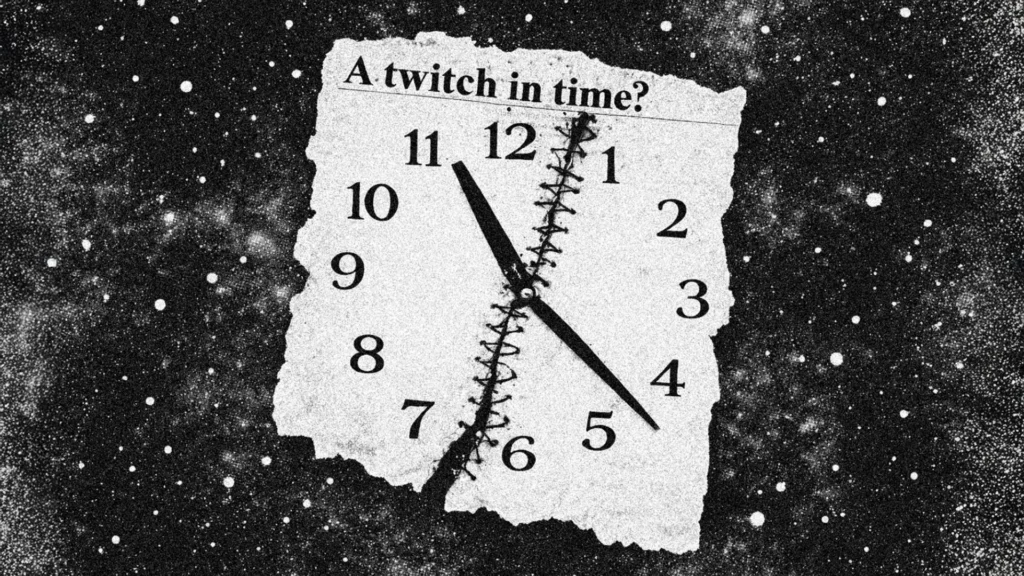
The intricate calculations performed by the team led to a truly striking conclusion: if these quantum collapse models are indeed correct, then time itself should inherently contain a very small, intrinsic amount of uncertainty. In essence, this implies that there may be a fundamental, irreducible limit to how precisely time can ever be measured, a boundary imposed not by technological limitations but by the very fabric of reality at its most fundamental level.
However, the practical implications of this theoretical finding are far from alarming. The predicted effect is extraordinarily minute, many orders of magnitude smaller than anything observable with current technology. "Once you do the calculation, the answer is clear and surprisingly reassuring," Bortolotti stated, emphasizing the negligible practical impact. Even the most advanced atomic clocks operating today, which represent the pinnacle of human ingenuity in timekeeping, or those expected to be developed in the foreseeable future, would not be precise enough to notice this hypothesized effect.
Catalina Curceanu further clarified the scale of this uncertainty: "The uncertainty is many orders of magnitude below anything we can currently measure, so it has no practical consequences for everyday timekeeping." Kristian Piscicchia reiterated this point, adding, "Our results explicitly show that modern timekeeping technologies are entirely unaffected." For instance, the most precise atomic clocks, such as optical lattice clocks using strontium atoms, can achieve a stability of about one part in 10^18, meaning they would lose or gain less than a second over billions of years. While this level of precision is astounding, the intrinsic uncertainty predicted by these collapse models is far beyond even this capability, suggesting a realm of precision that remains purely theoretical for now.
A Possible Clue to Quantum Gravity: Reconciling the Giants of Physics
The profound work of Bortolotti and his colleagues touches upon one of the biggest unsolved problems in modern physics: the elusive quest to reconcile quantum mechanics with gravity. Quantum mechanics has achieved unparalleled success in describing atoms, subatomic particles, and other microscopic systems, forming the bedrock of technologies from lasers to semiconductors. Its predictive power has been repeatedly verified with exquisite precision.
Conversely, Albert Einstein’s general theory of relativity, published in 1915, elegantly describes gravity not as a force, but as a manifestation of the curvature of a flexible four-dimensional structure called spacetime. General relativity reigns supreme in describing the behavior of space and time on much larger scales, governing the dynamics of planets, stars, galaxies, and the universe itself. Both theories have been enormously successful and agree remarkably well with experiments within their respective domains. The problem arises when physicists attempt to combine them, as they treat time in fundamentally different and incompatible ways.
"In standard quantum mechanics, time is treated as an external, classical parameter that is not affected by the quantum system being studied," explains Curceanu. It acts as a fixed backdrop against which quantum events unfold, much like a stage for a play. This implies a universal, absolute time, similar to Newton’s conception.
General relativity, however, offers a radically different perspective. In Einstein’s framework, space and time are not separate entities but are interwoven into a dynamic fabric called spacetime. This fabric is not static; it can bend, stretch, and change in response to the distribution of mass and energy within it. Gravity, from this viewpoint, is merely the consequence of objects following the curves in spacetime created by other massive objects. Time itself is relative, influenced by gravitational fields and relative motion, leading to phenomena like gravitational time dilation, where clocks run slower in stronger gravitational fields.
Because of this fundamental mismatch in their treatment of time, physicists have spent decades searching for a deeper, more comprehensive theory that could unite quantum mechanics and gravity into a single, coherent framework – a theory of quantum gravity. Various approaches have been proposed, including string theory, which posits that fundamental particles are not point-like but one-dimensional vibrating strings, and loop quantum gravity, which attempts to quantize spacetime itself. The new results from the FQxI-supported study suggest that collapse models, particularly those linking collapse to gravity, may contain vital clues about how quantum physics, gravity, and time could ultimately fit together, offering a fresh perspective on this monumental challenge.
A Pathway to Empirical Verification and the Importance of Foundational Research
Beyond their profound theoretical implications, these findings offer a more practical benefit. Since quantum collapse models predict measurable effects that differ from the predictions of standard quantum mechanics, extremely precise experiments could eventually help determine whether these radical ideas describe something real in nature. The intrinsic uncertainty in time, though currently undetectable, provides a concrete target for future experimental endeavors. As technology advances and the precision of timekeeping devices continues to improve, what is now theoretical might one day become empirically verifiable, thus transforming a philosophical debate into a scientific test.
Curceanu underscored the critical importance of supporting research into unconventional questions at the very foundations of physics. "There are not many foundations in the world which are supporting research on these types of fundamental questions about the universe, space, time, and matter," she noted, highlighting the unique role of organizations like FQxI. The Foundational Questions Institute specifically champions research that explores the deepest, most challenging questions in physics and cosmology, often funding ideas that are considered too speculative or radical for traditional grant mechanisms. This willingness to invest in high-risk, high-reward inquiries is precisely what drives breakthroughs at the frontiers of knowledge.
"Our work shows that even radical ideas about quantum mechanics can be tested against precise physical measurements, and that, reassuringly, timekeeping remains one of the most stable pillars of modern physics," Curceanu concluded. This dual message – that foundational theories can be empirically challenged, and that our current understanding of time, while potentially having intrinsic limits, is robust within its observable domain – provides both intellectual excitement and practical assurance.
The implications of this research extend beyond theoretical physics. If time indeed possesses an intrinsic quantum uncertainty, it would fundamentally alter our understanding of causality and the nature of physical events at the most basic level. It would suggest that the universe at its core is not perfectly deterministic, even without the presence of observers, but harbors a quantum "fuzziness" that permeates even the flow of time. While such effects are negligible for human experience and current technology, they could have profound consequences for future quantum technologies operating at the extreme limits of precision or in environments where quantum gravity effects might become more pronounced.
This work, partially supported through FQxI’s Consciousness in the Physical World program, serves as a testament to the enduring power of scientific inquiry to challenge preconceived notions and push the boundaries of human knowledge. By exploring the audacious idea that gravity might be the hidden orchestrator of quantum collapse, and by rigorously calculating the consequences for time, these physicists have not only opened a new window into the quantum gravity problem but have also reaffirmed the vital role of foundational research in illuminating the deepest mysteries of the cosmos. The universe, it seems, continues to hold surprises, even in something as seemingly immutable as time itself.