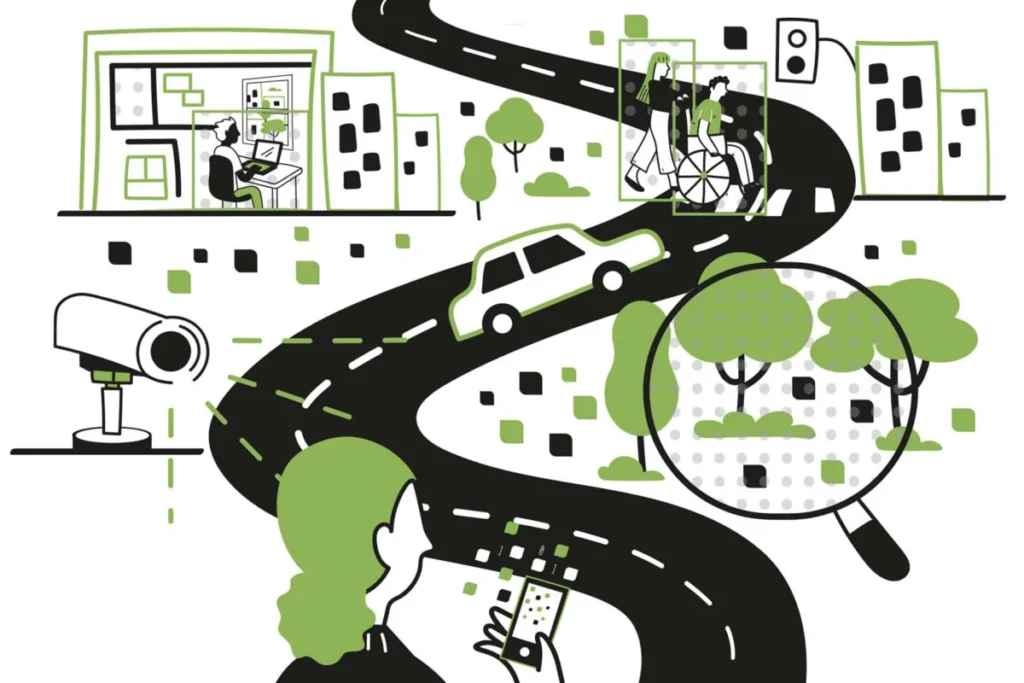
Months prior to the recent publication of a groundbreaking book exploring the intersection of artificial intelligence and urban studies, researchers at the MIT Senseable City Lab unveiled a significant study on pollution within New York City. This pioneering research showcased novel methodologies, most notably the application of machine learning to analyze data from 331 traffic cameras across the metropolis. By identifying vehicle types and estimating emissions from each automobile in real-time, the study demonstrated the potential of visual artificial intelligence techniques to monitor urban environmental impact with unprecedented precision and scale. This advancement offers urban planners a powerful new lens through which to address a myriad of critical questions, from the root causes of traffic congestion and the identification of hazardous intersection elements to the analysis of public space utilization in parks and plazas.
The proliferation of visual data across urban environments presents an unparalleled opportunity for gaining deeper insights into city dynamics. However, this surge in data collection also inevitably raises significant concerns regarding privacy and equity. As Fátima Duarte, an MIT researcher and co-author of the new book, aptly states, "We can treat these digital images as data and quantify features of the city. With computer vision techniques, each image is a dataset." Yet, she cautions, "We have to be careful about it." This sentiment underscores the delicate balance between leveraging technological advancements for urban improvement and safeguarding fundamental societal values.
While urbanists have historically relied on visual analysis to inform their understanding and design of cities, the current capabilities of AI have elevated this practice to an entirely new echelon. Martina Mazzarello, an MIT scholar and fellow co-author, observes, "Everybody has been observing the urban environment and trying to get some insight. But what if we can do that at a large scale and get some insight everywhere?" This question lies at the heart of the research presented in "How AI Sees the City: Urban Visual Intelligence," a comprehensive exploration published this month by Routledge. The book’s authors – Duarte, Mazzarello, MIT Professor Carlo Ratti, and Fan Zhang of Peking University – delve into the profound implications of this emerging field.
The book draws a clear lineage from the foundational work of urban thinkers like Kevin Lynch and William H. Whyte, whose meticulous observations of urban environments laid the groundwork for understanding how people interact with and perceive their surroundings. Ratti, founder and director of the MIT Senseable City Lab, emphasizes this connection: "Great urbanists such as Kevin Lynch and William H. Whyte showed us the extraordinary value of ‘looking’ at the city. Today, visual AI gives us new ways to build on that tradition – allowing us to observe cities at a scale and with a level of detail that was previously impossible."
A New Tool for an Ancient Discipline
The origins of "How AI Sees the City" can be traced to the MIT Senseable City Lab, established in 2004 with the mission of employing data-driven approaches to understand urban dynamics. The authors meticulously chart the historical evolution of visual representations of cities, from ancient Roman marble maps to the transformative impact of photography in documenting significant urban transformations like Baron Haussmann’s redesign of Paris and the stark realities of 19th-century tenement life in New York City’s Lower East Side.
More recent historical developments include the influential work of scholars like Kevin Lynch, whose seminal 1960 book, "The Image of the City," profoundly shaped academic discourse on urban perception. Following in this tradition, sociologist William H. Whyte, initially known for "The Organization Man," became a prominent urbanist dedicated to the empirical study of public spaces. By situating AI within this historical continuum of visual urban studies, the authors articulate a crucial perspective: that despite its immense power, AI should be viewed as a tool that serves human objectives in the ongoing endeavor of designing and refining urban environments.
Duarte elaborates on this continuity, stating, "Kevin Lynch at MIT was only using paper and pen. We can now scale up what he was doing, with visual AI, while also looking at many different dimensions of cities." The practical applications of visual AI in urban planning are vast and varied, extending beyond emissions and traffic flow to encompass safety, detailed street-level activity analysis, and an enhanced understanding of pedestrian movement along sidewalks. The book also examines the nuanced relationship between urban dwellers and green spaces. While satellite imagery provides a macro-level view of tree cover and parkland, ubiquitous imagery from personal devices and other sources can offer insights into the frequency and quality of green space encounters in daily life – a factor directly linked to reported well-being.
Fan Zhang highlights the true potential of this technology: "The real promise of visual AI is not simply that computers can look at millions of images. It is that we can connect what is visible in those images – streets, buildings, greenery, traffic, public space – with larger questions about how cities function and how people experience them." This integration of visual data with qualitative human experience promises to unlock deeper understanding and more effective urban interventions.
The capabilities of image recognition powered by AI extend even to the interiors of urban spaces. One recent study by the Senseable City Lab, analyzing images from over 400,000 Airbnb listings globally, challenged assumptions of increasing global homogeneity in interior design. The findings indicated significant regional variations, underscoring the ability of AI to discern subtle cultural and stylistic differences.
Mazzarello encapsulates the overarching utility of these advancements: "No matter what it is, we can learn from what we can see and then use it as urban designers, planners, policymakers, and citizens. It can be our eyes, or cameras with computers, but in the end it’s the same methodology, and now we are trying to optimize the ways we can use these tools."
Promise and Pitfalls: Navigating the Ethical Landscape
While the promise of visual AI in urban studies is undeniably significant, the authors of "How AI Sees the City" also meticulously outline a range of potential pitfalls and ethical considerations. Central among these are the concerns surrounding widespread visual surveillance and the inherent risk of AI systems perpetuating and amplifying existing societal biases.
The deployment of ubiquitous cameras in urban areas inevitably triggers discussions about privacy and surveillance. London, an early adopter of Closed-Circuit Television (CCTV), maintains an extensive network with approximately 210 cameras per square mile. However, this pales in comparison to China, where eight of the ten most camera-dense cities globally are located, with Shanghai alone boasting over 5,000 cameras per square mile. Such pervasive surveillance has ignited controversy in various regions, and debates surrounding the use of traffic cameras have surfaced in the United States throughout the current year, reflecting a growing public awareness of these issues.
In assessing the potential safety benefits derived from intensive video recording, the authors offer a critical perspective: "the benefits must be weighed against the significant erosion of personal freedom and the potential for abuse inherent in a system of constant monitoring." This statement underscores the imperative for a balanced approach that prioritizes both security and individual liberties.
Furthermore, AI systems are susceptible to reinforcing social biases. If models are trained on datasets that disproportionately represent majority populations, their evaluations of minority groups may be less accurate or equitable. This can lead to the generation of data that reflects and entrenches pre-existing perceptions rather than objective realities concerning individuals, neighborhoods, and entire urban areas.
Duarte emphasizes the crucial role of human input in shaping AI’s perception: "We need to teach AI to see, and depending on how you teach it, it will see what is embedded in the culture. AI is not neutral." This highlights the responsibility of developers and researchers to ensure that AI systems are trained on diverse and representative datasets, and that their algorithms are designed to mitigate bias.
Mazzarello offers a pragmatic counterpoint, noting that human perception is also inherently subjective: "our eyes are not neutral, either. Every tool has to be guided in the right way, and trained in the best way." This perspective suggests that while AI systems require careful development, they can be harnessed effectively when guided by ethical principles and a commitment to fairness.
The book has garnered praise from other scholars in the field. Michael Batty of University College London described it as a "fascinating book" that "shows how we are beginning to interpret the world of urban design, suggesting ways in which we might improve design using urban analytics, AI and large language models." This endorsement highlights the book’s contribution to advancing the discourse on urban planning in the age of artificial intelligence.
Ultimately, the authors express a strong conviction in the value of employing visual AI to deepen our understanding of urban environments, their functionalities, and potential avenues for improvement. They advocate for a judicious and critical approach, concluding in their book: "We should explore this wisely, critically, and creatively." This call to action encapsulates the dual imperative of embracing the transformative potential of visual AI while remaining vigilant about its ethical implications and societal impacts.