Researchers at MIT Lincoln Laboratory have developed a groundbreaking throwable sensor, dubbed TOSSIT, designed to provide early and remote detection of dangerous vapors and aerosols for military service members, first responders, and law enforcement. This innovative device promises to significantly enhance safety and situational awareness in environments potentially contaminated by chemical threats.
A New Era in Chemical Threat Detection
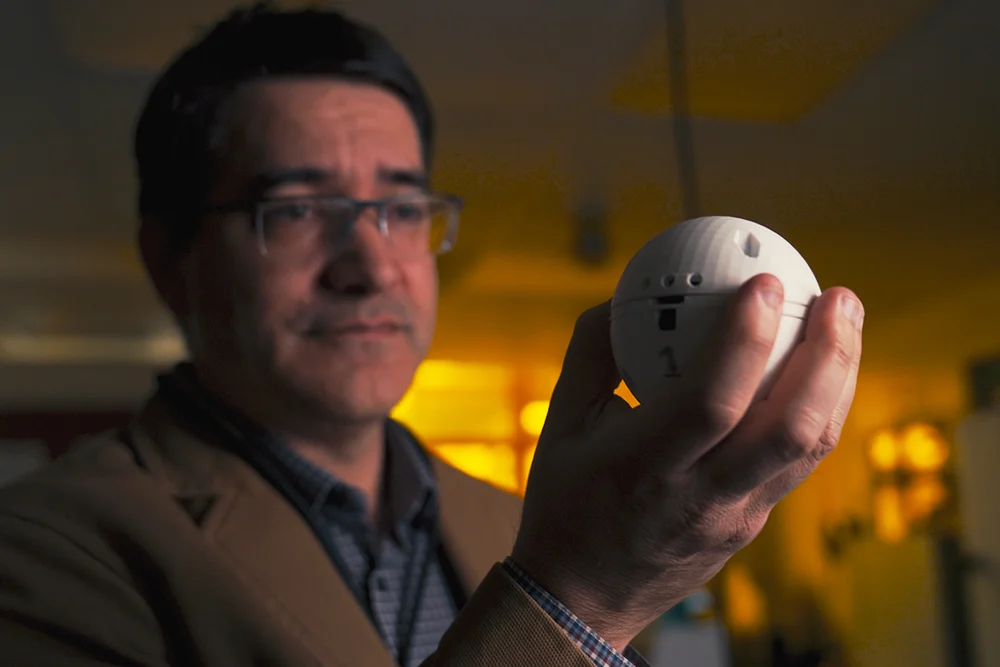
The Tactical Optical Spherical Sensor for Interrogating Threats, or TOSSIT, is a compact, baseball-sized device engineered for rapid deployment and immediate threat identification. Its primary function is to alert personnel to the presence of hazardous airborne substances, including chemical warfare agents like nerve and blister agents, dangerous industrial chemicals released during accidents, and even insidious airborne toxins such as fentanyl dust. The sensor’s intuitive design allows for versatile deployment methods, including manual tossing, drone delivery, or even launch from specialized platforms, enabling its use in a wide range of scenarios and terrains.
How TOSSIT Works: A Visual Chemical Interrogation
At the core of TOSSIT’s functionality is a sophisticated yet user-friendly detection mechanism. Upon deployment into a suspected hazardous area, the sensor begins actively sampling the surrounding air. The collected air is then exposed to a removable dye card, a crucial component that undergoes a distinct color change when it interacts with specific chemical compounds. An integrated camera within the TOSSIT device meticulously observes these color transformations. This visual data is then processed, and if a predetermined threshold of chemical presence is detected, the sensor transmits an alert. These alerts can be received through a dedicated mobile application, providing real-time updates to operators, or directly via audible alarms integrated into the sensor itself, offering immediate, localized warnings.
This visual detection method offers a distinct advantage: it can identify a broad spectrum of chemical agents by observing their reaction with various dyes, rather than relying on a single, highly specific chemical detector that might miss unanticipated threats. The interchangeable dye cards allow for customization based on anticipated threats, making TOSSIT a versatile tool for diverse operational environments.
Addressing an Unmet Need in Sensor Technology
Richard Kingsborough, the principal investigator for the TOSSIT project at MIT Lincoln Laboratory, highlighted the critical gap this technology aims to fill. “TOSSIT fills an unmet need, providing a low-cost sensing option for vapors and solid aerosol threats – think toxic dust particles – that would otherwise not be detectable by small deployed sensor systems,” Kingsborough stated. This emphasizes TOSSIT’s unique capability to detect not only gaseous threats but also dangerous particulate matter, a significant advancement in portable chemical detection.
Traditional chemical detection systems can be expensive, bulky, or require direct proximity to the hazard for accurate readings. TOSSIT’s ability to be deployed remotely and its relatively low cost make it an accessible and scalable solution for widespread use, particularly in situations where immediate human exposure is too risky. The development comes at a time when the threat landscape includes an increasing variety of chemical agents, from state-sponsored weaponization to the clandestine production of dangerous synthetic drugs.
Development and Transition: From Lab to Field
The journey of TOSSIT from concept to a deployable system involved rigorous testing and refinement. Following extensive field trials, which would have simulated various environmental conditions and chemical release scenarios, the technology has now reached a stage where it is being transferred to the U.S. military. This transition signifies the successful validation of TOSSIT’s performance and reliability under demanding operational conditions.
The development timeline, though not explicitly detailed in the initial release, likely involved several phases: initial research and proof-of-concept, prototype development, laboratory testing, environmental simulation, and finally, field deployment exercises. The publication date of July 9, 2026, suggests that the technology has been in development for a considerable period, with significant investment in research and engineering by MIT Lincoln Laboratory.
Supporting Data and Technical Specifications (Inferred)
While specific technical specifications are not provided, the description of TOSSIT as "baseball-sized" suggests a diameter of approximately 2.5 to 3 inches. Its "spherical" design likely contributes to aerodynamic stability during flight and allows for omnidirectional sampling of the air. The "removable dye card" implies a modular design, allowing for easy replacement and potential upgrades to the sensing chemistry.
The operational range of the alerts, whether via app or integrated alarms, would be a critical factor in its deployment. For a throwable device, this range could extend from tens of meters to several kilometers, depending on the communication technology employed (e.g., Bluetooth, Wi-Fi, or dedicated radio frequencies). The "low-cost" aspect suggests that TOSSIT is intended for mass deployment, making it economically feasible to equip numerous personnel or deploy multiple sensors simultaneously in a given area.
Potential Applications and Broader Impact
The implications of TOSSIT extend beyond military applications. First responders, including firefighters and hazardous materials (HAZMAT) teams, frequently encounter chemical emergencies stemming from industrial accidents, transportation spills, or clandestine laboratories. The ability to quickly assess the chemical composition of the air in such situations before entering the scene can dramatically reduce the risk of injury and fatality.
Law enforcement agencies could utilize TOSSIT to detect the presence of illicit drug manufacturing byproducts or to secure scenes where chemical agents might have been deployed. In public safety scenarios, such as investigating suspicious packages or responding to potential terrorist threats, TOSSIT offers a vital layer of early warning.
The successful transfer of TOSSIT technology to the U.S. military underscores its perceived value in national defense. The ability to quickly identify chemical threats on the battlefield, in forward operating bases, or during special operations missions can provide a critical tactical advantage and enhance troop survivability.
Future Developments and Research Directions
While TOSSIT represents a significant leap forward, future research could focus on several areas:
- Enhanced Sensitivity and Specificity: Developing dye cards or other sensing materials that can detect even lower concentrations of chemicals or differentiate between a wider array of specific agents with greater precision.
- Real-time Data Analysis and AI Integration: Incorporating advanced algorithms and artificial intelligence to interpret complex color changes and provide more sophisticated threat assessments, potentially identifying multiple agents simultaneously.
- Extended Battery Life and Environmental Resilience: Improving the power source to allow for longer deployment times and ensuring the sensor can withstand extreme environmental conditions such as high temperatures, humidity, or corrosive atmospheres.
- Networked Sensor Capabilities: Enabling multiple TOSSIT units to communicate with each other, creating a distributed sensing network that can map chemical plumes and provide a more comprehensive understanding of the contaminated area.
- Integration with Unmanned Systems: Further streamlining the integration of TOSSIT with various unmanned aerial vehicles (UAVs) and ground robots for fully automated reconnaissance and threat detection missions.
The development of TOSSIT by MIT Lincoln Laboratory highlights the ongoing commitment to leveraging cutting-edge technology for public safety and national security. By providing an accessible, effective, and remotely deployable solution for detecting hazardous vapors and aerosols, TOSSIT is poised to become an indispensable tool for those on the front lines of chemical threat response. The successful transition to the U.S. military signals a strong endorsement of its capabilities and a commitment to equipping personnel with advanced protective technologies.