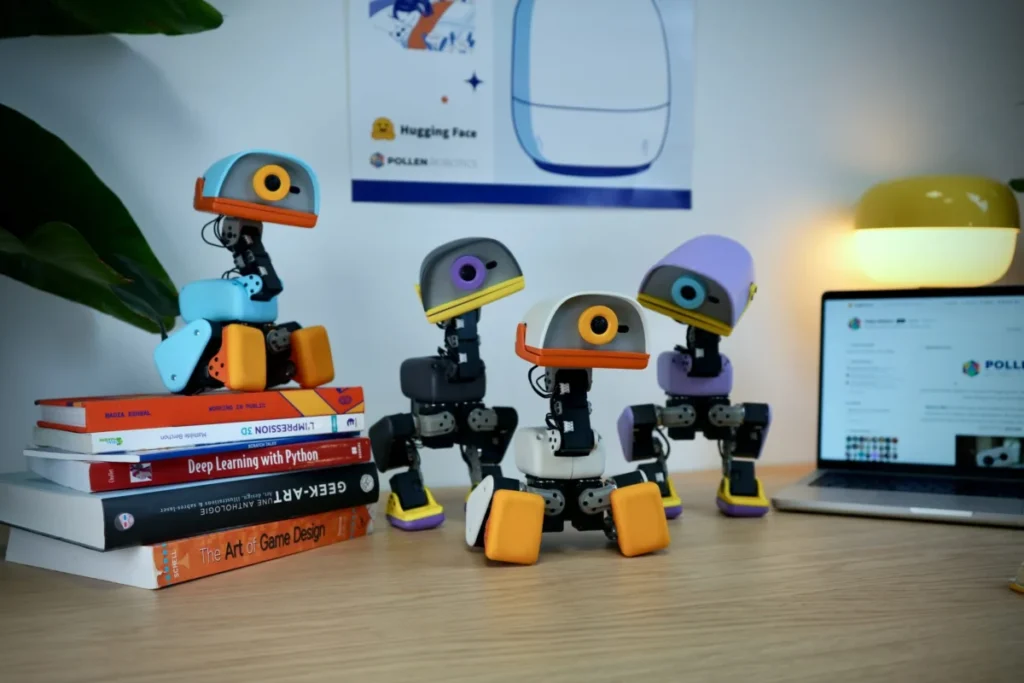
The convergence of artificial intelligence and accessible robotics has heralded a new era for enthusiasts, educators, and researchers alike. In a significant development for the burgeoning field of bipedal robotics, Pollen Robotics, in partnership with AI powerhouse Hugging Face, has officially launched Microduck, an endearing open-source robot designed to democratize the complexities of reinforcement learning. Priced at an accessible $400, this miniature marvel represents a crucial step in making advanced robotics experimentation available to a broader audience, promising to foster innovation from the ground up.
From Cinematic Inspiration to Open-Source Innovation
The lineage of Microduck can be traced back to an initial spark of fascination ignited by Disney’s innovative research. In recent years, Disney Research unveiled the BDX droid, a sophisticated bipedal robot that captivated the public with its remarkably lifelike locomotion and undeniable charm. While the BDX droid showcased the pinnacle of robotic engineering, its proprietary nature and high development costs placed it beyond the reach of independent researchers and hobbyists. This inherent exclusivity created a void that the open-source community, driven by a desire for hands-on experimentation, was eager to fill.
Recognizing this demand, a collaborative effort began to reverse-engineer and democratize the underlying principles demonstrated by the BDX. This community-led initiative ultimately led to the creation of the Open Duck Mini. This project aimed to replicate the BDX’s core functionalities using readily available components and an open-source framework, allowing makers and enthusiasts to construct their own waddling bipedal robots. The Open Duck Mini gained considerable traction within the maker community, proving the viability and appeal of an accessible bipedal platform. Hugging Face, a leading advocate for open-source AI, and Pollen Robotics, a company known for its commitment to open and accessible robotics platforms like Reachy, recognized the immense potential of this community endeavor. Their sponsorship and support were instrumental in nurturing the Open Duck Mini project, providing resources and expertise that propelled its development.
Microduck emerges as the refined and commercialized iteration of this journey, a testament to the power of open collaboration. While retaining the spirit and core functionalities of its predecessors, Microduck offers a polished, ready-to-use platform with robust support, making the transition from a purely DIY project to a more streamlined, product-oriented experience. This evolution signifies a maturation in the open-source robotics landscape, where community-driven innovation can lead directly to commercially viable and impactful products.
Engineering Charm: Design and Technical Specifications
At the heart of Microduck’s appeal is its deliberately engineered charm. The robot’s design choices are not merely aesthetic; they are functional and contribute to its robustness and user engagement. Its characteristic pigeon-toed walk and bowlegged skating gait are not accidental imperfections but rather a clever design that enhances its stability and resilience, crucial for a robot undergoing iterative learning through trial and error. This design philosophy acknowledges that failure is an inherent part of the learning process, particularly in reinforcement learning, and a robot that can withstand numerous tumbles without damage is far more effective as a teaching tool.
Beyond its distinctive gait, each Microduck possesses an individual "voice," a nuanced feature that adds to its personality and fosters a deeper connection with its user. While the specifics of this voice—whether it’s a unique series of beeps, chirps, or synthesized sounds—are yet to be fully detailed, it is designed to give each robot a distinct sonic signature, mirroring the individuality found in pets or even other humans. This anthropomorphic touch, combined with its compact size and expressive movements, contributes significantly to its macro charm, making the learning process more engaging and less intimidating.
From a technical standpoint, Microduck is built around a robust, yet accessible, hardware platform. While specific component details are typically found in its documentation, one can infer the inclusion of miniature servo motors for precise leg movements, an array of sensors for environmental awareness and proprioception (understanding its own body position), a compact microcontroller or single-board computer to process data and execute commands, and a rechargeable power source. The emphasis is on a balance of performance and affordability, ensuring that the robot can perform complex tasks without being prohibitively expensive.
The cornerstone of Microduck’s utility is its open-source Software Development Kit (SDK). Hosted on GitHub, the SDK provides developers with complete access to the robot’s programming interfaces, allowing for deep customization and experimentation. This open-source approach is vital for fostering a vibrant community of users who can contribute to the robot’s capabilities, share their learning experiences, and collectively push the boundaries of what Microduck can achieve. The SDK likely supports popular robotics frameworks like ROS (Robot Operating System) and programming languages such as Python, making it familiar territory for many in the robotics and AI communities.
Demystifying Reinforcement Learning with a Waddle

Microduck is specifically engineered as a platform for learning and experimenting with reinforcement learning (RL). RL is a paradigm of machine learning where an agent learns to make decisions by performing actions in an environment and receiving rewards or penalties. The agent’s goal is to maximize the cumulative reward over time, effectively learning optimal behaviors through trial and error. In the context of robotics, RL allows a robot to learn how to walk, navigate, or perform tasks by continuously refining its movements based on feedback from its environment.
Traditional methods of teaching robots complex motor skills often involve extensive programming and finely tuned control algorithms. RL, however, offers a more organic approach, allowing the robot to discover effective strategies autonomously. Microduck’s design, with its inherent resilience and ability to withstand repeated "failures," makes it an ideal physical embodiment for RL experiments. Users can program the robot to attempt a specific task, such as walking in a straight line or traversing an obstacle, and observe how it gradually improves its performance by adjusting its movements based on the rewards it receives for successful actions. This hands-on experience provides an unparalleled opportunity to grasp the nuances of RL, moving beyond theoretical concepts to practical application.
The educational benefits of Microduck in this domain are profound. Students can gain practical experience in:
- Defining reward functions: Crafting effective reward signals that guide the robot towards desired behaviors.
- Designing observation spaces: Determining what information the robot needs from its sensors to make informed decisions.
- Implementing various RL algorithms: Experimenting with different algorithms like Q-learning, policy gradients, or actor-critic methods.
- Debugging and optimizing: Understanding how to troubleshoot and improve the robot’s learning process.
By providing a tangible, interactive platform, Microduck transforms abstract AI concepts into concrete, observable phenomena, making learning both more effective and enjoyable.
The Strategic Alliance: Pollen Robotics and Hugging Face
The collaboration between Pollen Robotics and Hugging Face is a strategic alliance that leverages the distinct strengths of both organizations to deliver a truly impactful product. Pollen Robotics has established itself as a pioneer in open-source humanoid and service robotics, with a strong ethos of making advanced robotics accessible. Their experience in designing robust, modular, and developer-friendly hardware platforms is evident in Microduck’s construction and its potential for extensibility. Their previous work with Reachy, an open-source humanoid arm, demonstrates their commitment to fostering a community around their products, providing excellent documentation, and encouraging user contributions.
Hugging Face, on the other hand, has become a global leader in democratizing artificial intelligence, particularly in natural language processing (NLP) and machine learning. Their platform provides an extensive ecosystem of open-source models, datasets, and tools, making cutting-edge AI research and development accessible to millions. Their involvement with Microduck underscores a broader vision of integrating AI more deeply with physical robotics, providing the software intelligence that can bring robotic hardware to life. By sponsoring and actively supporting projects like Microduck, Hugging Face extends its mission beyond virtual AI models into the realm of embodied AI, where algorithms interact directly with the physical world.
This partnership is particularly powerful because it combines Pollen Robotics’ hardware expertise with Hugging Face’s deep understanding of AI and community building. The synergy ensures that Microduck is not just a piece of hardware but a complete ecosystem that integrates seamlessly with modern AI development practices. It also guarantees a strong community focus, with resources and support readily available for users to explore and expand Microduck’s capabilities.
Broader Implications: Education, Research, and the Maker Movement
Microduck’s launch is poised to have significant implications across several sectors, most notably in STEM education, academic research, and the burgeoning maker movement.
In education, Microduck offers an unparalleled tool for teaching robotics, programming, and artificial intelligence at various levels, from high school clubs to university courses. The relatively low price point of $400 makes it far more accessible than many professional robotic platforms, allowing institutions to acquire multiple units for classroom use without prohibitive costs. This accessibility means more students can gain hands-on experience, fostering critical thinking, problem-solving skills, and an early interest in STEM fields. As the demand for AI and robotics professionals continues to surge, platforms like Microduck are crucial for building the talent pipeline needed for future innovation.
For researchers, Microduck provides a cost-effective testbed for developing and validating novel reinforcement learning algorithms. The open-source nature of both the hardware and software encourages researchers to contribute their findings back to the community, accelerating the pace of discovery. Researchers can experiment with different neural network architectures, reward functions, and simulation environments, and then seamlessly deploy their learned policies onto the physical robot. This iterative cycle between simulation and physical deployment is essential for robust robotics research. The ability to quickly iterate and test hypotheses on a physical platform like Microduck, which is designed to withstand experimental failures, is invaluable.

The maker movement stands to benefit immensely as well. Microduck taps into the creative spirit of hobbyists who enjoy building, customizing, and pushing the boundaries of technology. The open-source SDK means that makers are not confined to the robot’s out-of-the-box capabilities; they can modify its behavior, add new sensors, design custom attachments, and even integrate it with other smart home devices or robotic systems. This encourages a culture of innovation where users are not just consumers but active contributors to the robot’s evolution. The potential for community-driven enhancements, such as advanced computer vision capabilities or more sophisticated navigation, is vast.
The potential for integrating language processing, though not currently onboard, is a particularly exciting prospect highlighted by Pollen Robotics. As stated, "It’s technically feasible and could be a future development. Even if we’re not the ones doing it, I expect the community to build it in a matter of weeks after the first users get their robots." This statement underscores the power of the open-source community. The integration of NLP would allow users to interact with Microduck using natural language commands, opening up new avenues for human-robot interaction and more intuitive control. Imagine telling your Microduck to "fetch the blue block" or "follow me," and watching it intelligently execute the command. This capability would significantly enhance its utility as both a learning tool and a potential personal assistant.
The Future of Microduck: Beyond Basic Waddle
While Microduck’s current capabilities are focused on fundamental reinforcement learning and bipedal locomotion, the open-source nature and the strong community backing hint at a future where its functionalities extend far beyond a basic waddle. The quote about the community potentially adding language processing capabilities within weeks of release is a powerful indicator of this potential.
Beyond language, one can envision Microduck developing more sophisticated object recognition and manipulation skills. With the addition of a small camera and perhaps a simple gripper or scoop integrated into its "bill," the robot could be trained to identify specific objects, pick them up, and transport them. The article playfully suggests it might clean up lightweight debris like socks; this seemingly simple task requires a complex interplay of vision, navigation, and manipulation, all of which are fertile grounds for RL experimentation.
Furthermore, Microduck could become a platform for exploring multi-robot coordination and swarm intelligence. Imagine a "squad" of Microducks working together to map an environment, transport larger objects, or even perform synchronized dances. The low cost of individual units makes such multi-robot experiments economically viable, allowing researchers and enthusiasts to explore complex collective behaviors.
The continuous improvement in training models, coupled with Microduck’s low price point and open SDK, suggests a trajectory towards increasingly autonomous and capable miniature robots. The lessons learned from Microduck can also contribute to the broader field of embodied AI, informing the development of larger, more complex robots for industrial, service, and domestic applications.
Availability and Accessibility: Joining the Microduck Squad
The Microduck is currently available for pre-order, with initial deliveries targeted before Christmas 2026. This timeline allows for further refinement and production scaling, ensuring a robust launch for early adopters. Interested individuals and institutions can learn more and place their orders through the official website: pollen-robotics.com/microduck.
For those who prefer the hands-on challenge of building from scratch, the open-source ethos ensures that the blueprints and software for the Open Duck Mini remain available. This dual approach—offering a polished, commercial product alongside the option for complete DIY construction—caters to a wide spectrum of users, from those seeking a ready-to-learn platform to those who relish the intricacies of hardware assembly and software integration.
Microduck represents a significant milestone in making advanced robotics and artificial intelligence more accessible. By providing an affordable, charming, and open-source platform for reinforcement learning, Pollen Robotics and Hugging Face are not just launching a product; they are inviting a global community to participate in the next wave of robotic innovation. As the list of affordable walking robots continues to expand, the justifications for not engaging with this transformative technology rapidly diminish, paving the way for a future where intelligent, waddling companions contribute to learning, research, and daily life.