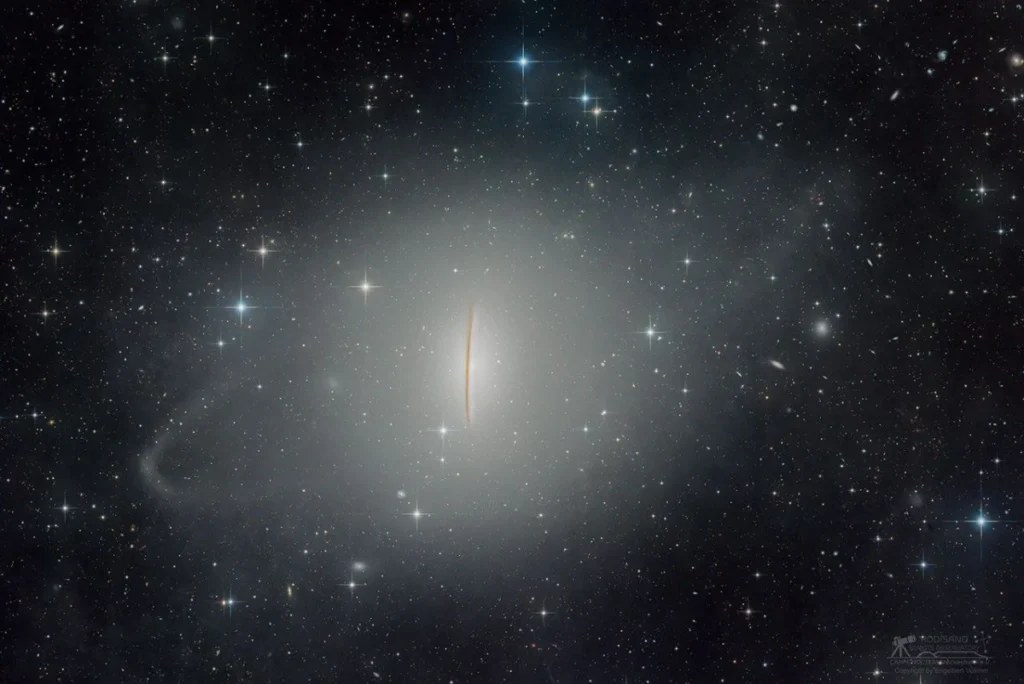
A breathtaking new image of the Sombrero Galaxy, officially designated Messier 104 (M104), has unveiled surprising details about its turbulent history, challenging previous perceptions of this iconic celestial object. Captured over seven days in mid-2026 from the dark skies of Namibia by astronomer Engelbert Vollmer, the deep-field photograph offers an unprecedented view, revealing not only the galaxy’s well-known dark dust lane but also a vast, luminous halo studded with unresolved stars and, remarkably, a distinct diagonal ring structure. This visual evidence strongly suggests that M104 is the product of ancient collisions and mergers with smaller galaxies, painting a vivid picture of a violent cosmic past.
A Deeper Look at a Familiar Neighbor
For decades, the Sombrero Galaxy has captivated astronomers and the public alike. Its name derives from its appearance in shorter exposures, where a prominent, dark band of dust encircling the galactic center creates the illusion of a wide-brimmed hat. This striking feature has made M104 a staple in astronomical photography and educational materials. Located approximately 30 million light-years away in the constellation Virgo, the Sombrero Galaxy is a colossal spiral galaxy, spanning an estimated 150,000 light-years across. Its substantial size and distinct morphology have made it a prime target for astrophysical research.
However, the latest image, a result of an extended exposure period, pierces through the familiar silhouette to expose a more complex and dynamic reality. The "hairy past" alluded to in the image’s description refers to the extensive stellar halo that extends far beyond the galaxy’s central disk. This halo, composed of countless stars that are too distant and faint to be resolved individually in shorter views, is now brought into sharper focus. The sheer scale of this halo suggests that M104 has accumulated a significant amount of stellar material over billions of years, likely through gravitational interactions with its cosmic neighbors.
The Discovery of a Diagonal Ring: A Sign of Galactic Cannibalism
The most startling revelation in Vollmer’s image is the presence of a diagonal ring structure embedded within the stellar halo. This feature, along with other observed tidal streams, provides compelling evidence for M104’s aggressive galactic evolution. Astronomers interpret these structures as the remnants of smaller galaxies that have been gravitationally disrupted and absorbed by the much larger Sombrero Galaxy.
"Galactic mergers are not gentle affairs," explained Dr. Evelyn Reed, a cosmologist specializing in galactic dynamics, who was not involved in the imaging project but reviewed the findings. "When a larger galaxy encounters a smaller one, the immense gravitational forces can tear the smaller galaxy apart, scattering its stars and gas into long tidal tails and, in some cases, forming ring-like structures as material orbits the larger galaxy. The diagonal ring seen in M104 is a clear signature of such a violent event."
The observation of such distinct structures within the halo offers a unique opportunity to study the mechanics of galactic mergers in unprecedented detail. By analyzing the kinematics and distribution of stars within the ring and tidal streams, scientists can reconstruct the history of these past encounters, inferring the size, mass, and trajectory of the accreted galaxies. This could shed light on the processes that have shaped the Milky Way and other galaxies in the universe.
A Deeper Understanding of Galactic Evolution
The implications of this discovery extend beyond the Sombrero Galaxy itself. Understanding how galaxies grow and evolve through mergers and accretion is a fundamental goal of modern astrophysics. M104, with its clearly delineated dust lane and now vividly revealed halo structures, serves as an exceptional laboratory for testing theoretical models of galaxy formation.
"Every major galaxy we see today has a history of mergers," stated Professor Alan Davies, a researcher at the Institute for Advanced Study in Astrophysics. "The Sombrero Galaxy’s halo, with these newly identified features, allows us to see a snapshot of this process frozen in time. It’s like finding a fossil record of galactic evolution. This image will undoubtedly spur new simulations and theoretical work to better understand how these ancient collisions have sculpted M104 into the galaxy we observe today."

The dark dust lane, a defining characteristic of the Sombrero Galaxy, is itself a product of galactic evolution. This dust is believed to be material from the inner disk of M104, possibly enriched by supernovae and stellar winds from generations of stars. Its presence indicates ongoing star formation and stellar activity within the galaxy’s core.
The Technical Achievement of the Image
The remarkable detail in Engelbert Vollmer’s image is a testament to modern astronomical imaging techniques and the dedication of the astronomer. Capturing such deep views of faint celestial objects requires sophisticated equipment and meticulous planning. The use of Namibia’s exceptionally dark skies, known for their low light pollution, provided an ideal environment for this ambitious project.
"The seven-day exposure time is crucial for gathering enough photons from these distant and faint structures," explained Dr. Lena Hanson, an expert in astronomical instrumentation. "Long exposures allow the telescope’s detectors to accumulate light over an extended period, revealing details that would be lost in shorter observations. The fact that this image was taken from a ground-based observatory in Namibia, rather than a space telescope, highlights the advancements in adaptive optics and image processing that have made such deep-field observations possible."
The specific processing techniques employed by Vollmer, likely involving advanced noise reduction and stacking algorithms, would have been essential to bring out the subtle features within the halo and highlight the diagonal ring.
The APOD Program: Inspiring Cosmic Curiosity
This image, featured as the Astronomy Picture of the Day (APOD) on October 5, 2026, is part of a long-standing NASA initiative designed to share the wonders of the universe with the public. Since its inception, APOD has consistently provided stunning astronomical imagery, accompanied by concise explanations written by professional astronomers. This daily feature has played a significant role in fostering public interest in space science and encouraging exploration of our cosmos.
The APOD program’s success lies in its ability to translate complex scientific discoveries into accessible and visually compelling content. By highlighting remarkable images like the one of M104, APOD serves as a powerful educational tool, igniting curiosity and inspiring future generations of scientists and explorers. The inclusion of links to related articles and resources further enhances the learning experience, allowing interested individuals to delve deeper into specific astronomical topics.
Looking Ahead: Future Research and Implications
The discovery of the diagonal ring and the detailed revelation of M104’s stellar halo are expected to stimulate further research into this galaxy. Astronomers will likely use this new imagery to:
- Refine Galactic Merger Models: The data will be used to test and improve computer simulations of how galaxies interact and merge.
- Study Stellar Populations: Analysis of the halo’s stars can provide insights into their ages, chemical compositions, and origins, offering clues about the history of star formation in the Sombrero Galaxy.
- Investigate Galaxy Dynamics: The presence of the ring and tidal streams can help astronomers understand the gravitational forces at play within and around M104.
- Search for Similar Structures: The success in identifying these features in M104 may lead astronomers to re-examine other galaxies for similar signs of past mergers.
The Sombrero Galaxy, once appreciated primarily for its striking "hat-like" appearance, has now revealed a far more dramatic narrative. Engelbert Vollmer’s meticulously captured image serves as a potent reminder that the universe is a dynamic and ever-changing place, with even the most familiar celestial objects holding profound secrets waiting to be uncovered. The ongoing exploration and documentation of our cosmos continue to expand our understanding of our place within it, offering a constant source of awe and scientific discovery.