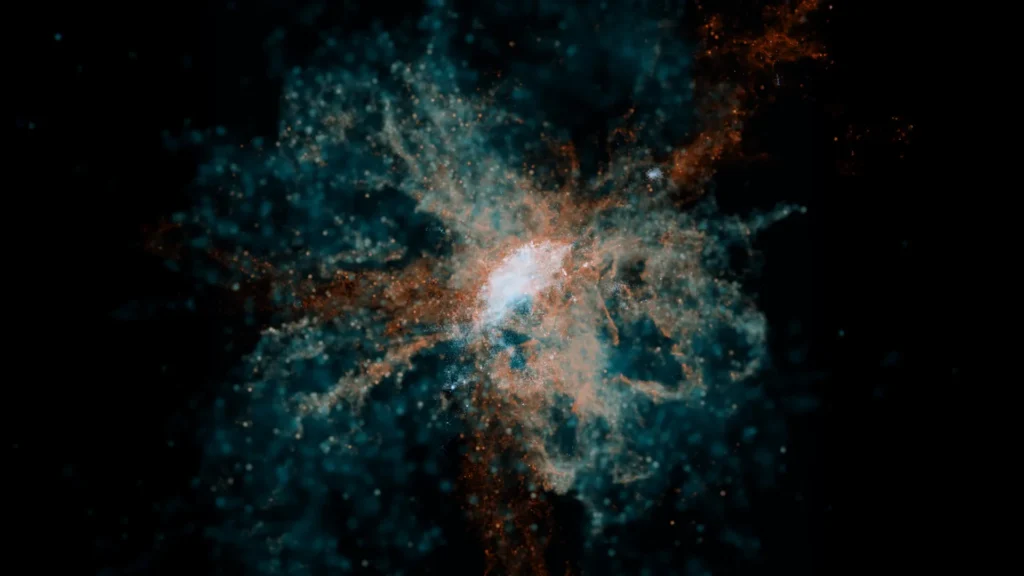
Approximately 500 million years after the cataclysmic Big Bang, a mere 3% of the universe’s current age, the nascent cosmos was beginning to flicker with the light of its first stars and galaxies. For decades, astronomers have operated under the prevailing assumption that the gaseous environments surrounding these primordial stellar nurseries were largely untouched by complexity, composed almost exclusively of hydrogen and helium – the elemental building blocks forged in the immediate aftermath of the universe’s birth. However, groundbreaking new research is challenging this long-held view, suggesting that the universe’s chemical evolution was far more rapid and dynamic in its infancy than previously understood.
A comprehensive study, spearheaded by astronomers at the University of Arizona and recently published in the prestigious journal Nature Astronomy, presents compelling evidence that early galaxies were not merely passive recipients of primordial gas but active producers and disseminators of heavier elements. These elements, such as carbon and oxygen, essential for the formation of planets and, ultimately, life as we know it, were being expelled into the surrounding intergalactic medium much earlier in cosmic history than scientists had anticipated.
"We observed that heavy elements escaped from galaxies very, very early in cosmic time," stated Yongda Zhu, the lead author of the paper and a postdoctoral researcher at the University of Arizona’s Department of Astronomy and Steward Observatory. "Not only were the galaxies producing these elements, but they were also dispersing them, possibly seeding other galaxies." This discovery paints a more intricate picture of the early universe, suggesting a sophisticated cycle of material exchange that began almost immediately after the formation of the first luminous structures.
The Genesis of Heavier Elements: A Stellar Alchemy
The universe’s initial composition was remarkably simple. Following the Big Bang, it consisted almost entirely of hydrogen and helium, the two lightest elements on the periodic table. Under the relentless pull of gravity, this primordial gas began to coalesce into vast, dense clouds. Within these celestial incubators, the immense pressures and temperatures ignited nuclear fusion, the fundamental process that powers stars. It was within the fiery cores of these nascent stars that the first "heavy" elements – those beyond hydrogen and helium – began to be synthesized.
Through a series of complex nuclear reactions, stars like our Sun, and particularly more massive, short-lived stars, transmuted simpler elements into progressively heavier ones, including carbon, nitrogen, oxygen, and even heavier elements like iron. When these stars reached the end of their stellar lives, some met a spectacular demise as supernovae, colossal explosions that blasted their newly forged elemental riches back into the interstellar medium. This ejected material then became the raw ingredients for subsequent generations of stars and planetary systems, a cosmic recycling program that has continued for billions of years. The very carbon atoms that form the backbone of all known life on Earth and the oxygen we breathe were, in fact, forged in the hearts of stars that existed long before our solar system was even a distant possibility.
While the process of stellar nucleosynthesis was understood, a critical unknown remained: the rate at which these heavier elements, once produced, escaped the gravitational confines of the early galaxies and permeated the vastness of intergalactic space. This study directly addresses that gap in our knowledge.
Peering Back Through Cosmic Time with the James Webb Space Telescope
To investigate this early period, Zhu and his team turned their gaze to the most distant reaches of the observable universe, employing the unparalleled capabilities of NASA’s James Webb Space Telescope (JWST). Their focus was on three exceptionally distant galaxies whose light has been traveling towards Earth for over 13 billion years. These observations effectively capture these galaxies as they appeared approximately 500 million years after the Big Bang, a pivotal era in cosmic history known as the Epoch of Reionization.
This epoch was a transformative period during which the universe transitioned from a largely opaque state to the transparent cosmos we observe today. The first generations of stars and galaxies, bathed in intense ultraviolet radiation, began to ionize the ubiquitous hydrogen gas that filled the space between them. This process involved stripping electrons from hydrogen atoms, fundamentally altering the gas’s properties and allowing ultraviolet light to propagate more freely. The Epoch of Reionization effectively marked the end of the universe’s "dark ages," ushering in an era of increasing luminosity.
The research team ingeniously utilized the light from these distant galaxies as cosmic backlights. "We used the galaxies themselves as background light sources," explained Zhu. "As light from the galaxies traveled toward Earth, it passed through surrounding gas, and we were able to look at the light’s absorption patterns to detect specific elements." By analyzing how the light from these galaxies was absorbed by the intervening gas, astronomers could identify the chemical fingerprints of elements present in the gas.
The JWST’s advanced infrared instrumentation was crucial for this endeavor. Its ability to detect faint infrared light allows astronomers to observe objects at extreme distances, effectively looking back in time to the universe’s infancy. The team meticulously analyzed nearly 30 hours of collected JWST data, a significant observational investment, to identify extremely faint absorption features within the spectral data of these distant galaxies.
Evidence of Early Elemental Dispersal
During a dedicated period of analysis, Zhu personally sifted through publicly available JWST spectral data from hundreds of galaxies. His painstaking examination led to the identification of three specific galaxies whose absorption patterns revealed the unmistakable presence of heavier elements, including carbon, oxygen, and silicon.
A critical observation was the "blueshift" of these absorption lines relative to the redshift of the host galaxies. In cosmology, redshift indicates that an object is moving away from us, a consequence of the universe’s expansion. A blueshift, conversely, suggests that the material is moving towards the observer, or in this context, outward from the galaxy. The blueshifted absorption lines indicated that the gas containing these heavy elements was not static but was actively moving away from the galaxies, being expelled into the vast expanse of intergalactic space.
The implications of this finding are profound. The chemical signatures detected in the gas surrounding these infant galaxies bore a striking resemblance to those found in the environments of much more mature galaxies observed billions of years later. This remarkable similarity strongly suggests that, even at this extremely early stage of cosmic evolution, galaxies were not only manufacturing heavy elements through stellar processes but were also efficiently dispersing them into their surroundings.
"Think of these elements, which originated from the galaxies’ stars, as food dye dropped into a cup of water," Zhu elaborated, employing a vivid analogy. "The color begins to spread through the water, and, in a similar fashion, these heavy elements from early galaxies began to escape into space and ‘enrich’ their surroundings." This enrichment process is akin to seeding the early universe with the building blocks necessary for future cosmic structures.
Baryon Cycling: A Fundamental Cosmic Process
Astronomers refer to this exchange of material into and out of galaxies as "baryon cycling." This concept highlights that galaxies are not isolated entities but are intrinsically linked to their cosmic environment, functioning as integral parts of a larger, interconnected galactic ecosystem. Material synthesized within one generation of stars is not confined but is continuously recycled and redistributed, influencing the evolution of subsequent generations of stars and galaxies.
The discovery that baryon cycling was already a robust process so early in the universe’s history may also shed light on a persistent enigma in astrophysics: the nature of Population III stars. These hypothetical stars are believed to represent the very first generation of stars in the universe, formed from pristine gas composed solely of hydrogen and helium before significant quantities of heavier elements had been synthesized and dispersed.
If galaxies were actively enriching their surrounding space with heavy elements as early as 500 million years after the Big Bang, then the availability of truly pristine gas for the formation of subsequent generations of stars, including potentially later Population III stars, would have been significantly diminished. This rapid chemical enrichment could explain why evidence for these primordial stars remains elusive. It is possible that the conditions required for their formation – an environment devoid of heavy elements – disappeared too quickly for them to be readily observed.
"If you start out with pure vanilla ice cream but start mixing in sprinkles soon after, it won’t be long until you can no longer find any pristine, plain, vanilla ice cream," Zhu aptly summarized, illustrating how quickly the primordial conditions could have been altered by the early dispersal of heavy elements.
Broader Implications for Galactic Evolution and Cosmology
This finding has far-reaching implications for our understanding of how galaxies form and evolve. It suggests that the chemical composition of the intergalactic medium, the vast cosmic web of gas and dark matter that permeates the universe, was being influenced by galactic activity from the very beginning. This early enrichment could have played a crucial role in regulating star formation rates in subsequent galaxies, influencing their growth and development over cosmic time.
Furthermore, the early dispersal of heavy elements has implications for the formation of the first planetary systems. The presence of carbon, oxygen, and other elements is essential for the formation of rocky planets and the complex organic molecules that are the precursors to life. If these elements were being distributed so early, it suggests that the potential for planet formation may have existed much earlier in the universe’s history than previously thought.
The study also provides valuable observational constraints for theoretical models of galaxy formation and evolution. Cosmological simulations will need to incorporate these new findings regarding the speed and efficiency of early baryon cycling to accurately represent the universe’s development. Understanding these early processes is fundamental to piecing together the complete narrative of cosmic evolution, from the Big Bang to the complex, star-filled universe we inhabit today. The ongoing observations by the JWST continue to push the boundaries of our knowledge, promising further revelations about the universe’s earliest moments.