In the universe’s earliest moments, an unimaginably hot and dense state of matter, known as quark-gluon plasma (QGP), dominated the cosmos. At temperatures reaching trillions of degrees, quarks and gluons, the fundamental building blocks of matter, roamed freely at near light speed. This primordial soup, existing for mere millionths of a second, was the crucible from which all the particles that constitute our universe today – protons, neutrons, and others – would eventually coalesce as the cosmos rapidly cooled. Now, physicists at CERN’s Large Hadron Collider (LHC) are not only recreating this ancient state but have achieved a groundbreaking observation: they have detected the distinct ‘wakes’ left behind by fast-moving quarks traversing this primordial fluid. This discovery offers the first direct evidence that the quark-gluon plasma behaves as a unified, fluid-like medium, responding to energetic particles with dynamic phenomena such as waves, splashes, and swirls, rather than as a simple collection of independently scattering particles.
The implications of this finding are profound, providing scientists with an unprecedented tool to probe the properties of the universe’s initial moments and the fundamental nature of matter itself.
Recreating the Big Bang’s Aftermath
The quest to understand the universe’s genesis has led scientists to one of the most powerful scientific instruments ever constructed: CERN’s Large Hadron Collider, located near Geneva, Switzerland. Within its vast, 27-kilometer circular tunnel, the LHC accelerates beams of heavy ions, such as lead nuclei, to speeds infinitesimally close to the speed of light. These ions are then smashed together with immense energy. The resulting collisions, though brief, generate conditions that mimic the extreme heat and density of the universe mere microseconds after the Big Bang. In these fleeting moments, the intense energy momentarily strips protons and neutrons of their constituent quarks and gluons, recreating the quark-gluon plasma.
"We are essentially replaying a brief scene from the universe’s infancy," explained Dr. Yen-Jie Lee, a professor of physics at MIT and a leading figure in this research. "By colliding these heavy ions, we create tiny droplets of this primordial material, allowing us to study its properties in a controlled environment."
The quark-gluon plasma, though existing for an infinitesimal fraction of a second – less than a quadrillionth of a second – is a state of matter unlike any found in the universe today. It is characterized by its incredibly high temperature, estimated to be several trillion degrees Celsius, and its remarkably low viscosity. In fact, QGP is often described as a "near-perfect" liquid, meaning it flows with almost no resistance, a property that has puzzled physicists for decades.
The ‘Duck on Water’ Analogy: Observing the Wake
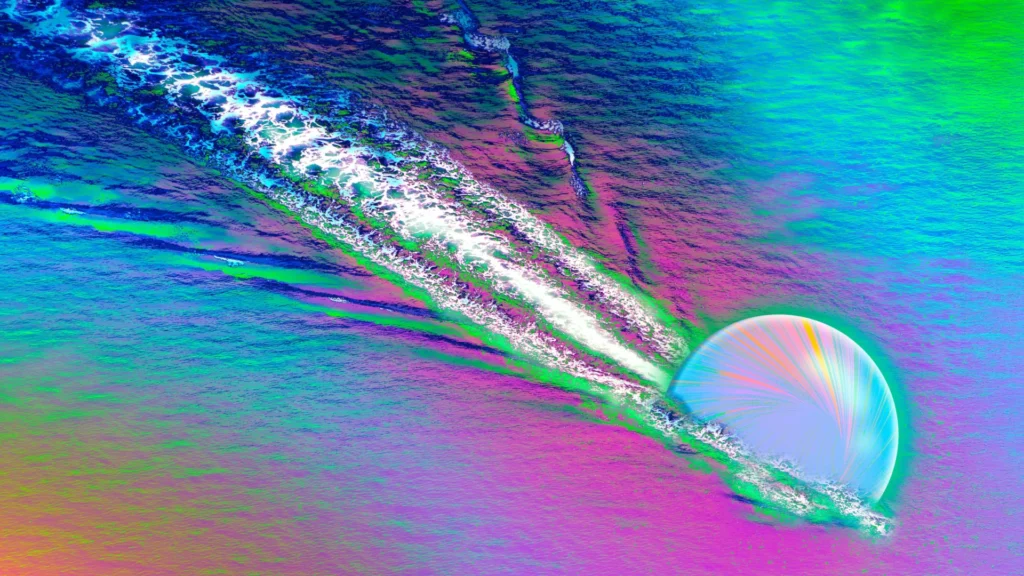
The recent breakthrough, spearheaded by a CERN team with significant contributions from MIT physicists, centers on a novel observation: quarks themselves create discernible ‘wakes’ as they move through the quark-gluon plasma. This phenomenon is strikingly analogous to a duck swimming across a pond, leaving behind a trail of ripples and disturbances in its wake.
"It has been a long debate in our field, on whether the plasma should respond to a quark," stated Professor Lee. "Now we see the plasma is incredibly dense, such that it is able to slow down a quark, and produces splashes and swirls like a liquid. So quark-gluon plasma really is a primordial soup."
This observation provides the first direct experimental confirmation that the QGP is not merely a collection of individual particles interacting randomly, but a cohesive fluid that exhibits collective behavior. The detection of these wakes implies that as a high-energy quark traverses the plasma, it imparts momentum to the surrounding medium, causing it to ripple, splash, and swirl – much like a fast-moving boat disturbing the surface of a lake.
The implications of this fluid-like behavior are far-reaching. It suggests that the fundamental forces and particles present in the early universe were interacting in ways that led to the formation of a cohesive, liquid-like medium, which in turn influenced the subsequent formation of the structures we observe today.
A New Method to Unveil the Invisible
Detecting these subtle ‘wakes’ in the chaotic aftermath of particle collisions presented a formidable challenge. Previous attempts to observe such phenomena often focused on pairs of particles – a quark and its antimatter counterpart, an antiquark – that are produced together. The expectation was that both particles would create wakes, and by studying the combined disturbance, scientists could infer properties of the plasma. However, this approach proved problematic.
"When you have two quarks produced, the problem is that, when the two quarks go in opposite directions, the one quark overshadows the wake of the second quark," explained Professor Lee. This overlapping interference made it difficult to isolate and study the wake of a single quark.
The breakthrough came with the development of a new detection technique, ingeniously designed to isolate the signature of a single quark’s wake. Instead of looking for quark-antiquark pairs, the research team focused on events where a single quark was produced in close proximity to a Z boson.
Z Bosons: The Cleanest of Probes
The Z boson, a neutral elementary particle associated with the weak nuclear force, serves as an exceptionally useful ‘tag’ in this experiment. Z bosons interact very weakly with the surrounding quark-gluon plasma, meaning they can traverse the dense medium with minimal disturbance. This makes them an ideal reference point, a ‘clean’ probe that allows scientists to isolate the effects of other particles.
"In this soup of quark-gluon plasma, there are numerous quarks and gluons passing by and colliding with each other," Professor Lee elaborated. "Sometimes when we are lucky, one of these collisions creates a Z boson and a quark, with high momentum."
When such a collision occurs, the Z boson and the quark are propelled in opposite directions. The quark, as it moves through the QGP, can generate a wake. Meanwhile, the Z boson passes through unimpeded, acting as a marker for the direction and momentum of the recoiling quark. By observing the energy distribution and particle patterns in the plasma on the quark’s side, and comparing it to the undisturbed path of the Z boson, researchers could definitively attribute any observed ripples and swirls to the wake of the single quark.
This sophisticated methodology, developed in collaboration with Professor Yi Chen’s group at Vanderbilt University, allowed researchers to effectively ‘tag’ individual quark wakes.
Billions of Collisions, Thousands of Events, One Groundbreaking Discovery
The team analyzed a colossal dataset from heavy-ion collisions at the LHC, scrutinizing approximately 13 billion individual collision events. Among these, they identified around 2,000 events that produced a Z boson. For each of these rare instances, researchers meticulously mapped the distribution of energy and particles in the fleeting quark-gluon plasma.
The analysis revealed a consistent pattern: in the direction opposite to the Z boson, where the energetic quark had traveled, distinct fluid-like patterns of splashes and swirling motion were repeatedly observed. These patterns precisely matched the predictions of theoretical models, including the influential ‘hybrid model’ developed by Professor Krishna Rajagopal of MIT and his collaborators. This model had long posited that energetic particles traversing the QGP should disturb it like a fluid, leaving behind wakes.
"This is something that many of us have argued must be there for a good many years, and that many experiments have looked for," commented Professor Rajagopal, who was not directly involved in the new study but whose theoretical work provided crucial groundwork. "We’ve gained the first direct evidence that the quark indeed drags more plasma with it as it travels. This will enable us to study the properties and behavior of this exotic fluid in unprecedented detail."
The findings, which appear in the prestigious journal Physics Letters B, were made possible by the collective efforts of the CMS Collaboration, a global consortium of physicists utilizing the Compact Muon Solenoid (CMS) detector at the LHC.
Implications for Cosmology and Particle Physics
The observation of quark wakes in quark-gluon plasma carries significant implications for our understanding of both the early universe and the fundamental nature of matter.
Firstly, it solidifies the understanding of QGP as a liquid, a concept that emerged from numerous experiments and theoretical studies over the past two decades. This ‘perfect’ liquid, with its near-zero viscosity, was the dominant state of matter for a crucial period after the Big Bang, influencing the distribution of matter and the subsequent formation of galaxies and stars. The ability to measure the properties of these wakes – their size, speed, extent, and decay time – will allow scientists to quantify key characteristics of this primordial liquid, such as its viscosity and thermal conductivity.
Secondly, this breakthrough provides a new and powerful tool for cosmology. By studying how these wakes behave, scientists can gain deeper insights into the conditions of the universe during its first microseconds. This could help refine our cosmological models and potentially shed light on unanswered questions about the universe’s evolution, such as the precise mechanisms that led to the dominance of matter over antimatter.
Thirdly, the research advances our understanding of quantum chromodynamics (QCD), the theory that describes the strong nuclear force binding quarks and gluons together. The collective, fluid-like behavior of QGP at high temperatures and densities is a non-perturbative phenomenon that is challenging to model. The direct observation of particle-plasma interactions through wake formation offers vital experimental data to test and improve theoretical predictions in this complex area of physics.
The research was supported, in part, by the U.S. Department of Energy, underscoring the international collaborative nature of fundamental scientific inquiry. As Professor Lee and his colleagues continue to refine their techniques and analyze further data, the universe’s earliest moments are slowly but surely yielding their secrets, one ripple at a time. The ‘primordial soup’ is becoming clearer, revealing the fundamental properties of the universe’s birth and the intricate dance of particles that shaped everything we know.