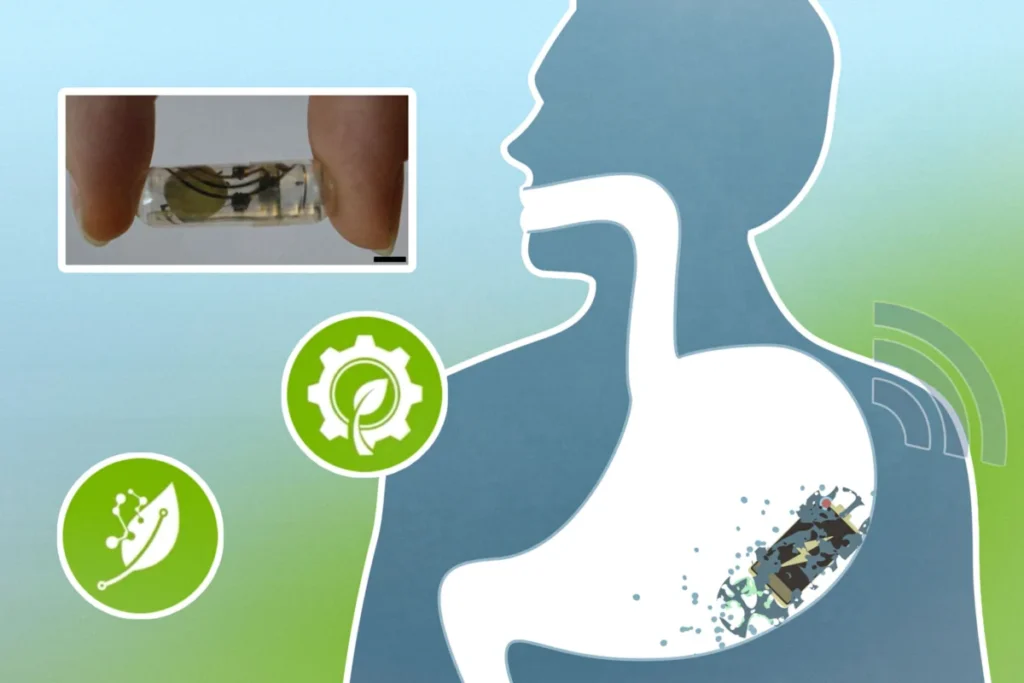
A pioneering team of researchers from MIT, Brigham and Women’s Hospital, and the Broad Institute of MIT and Harvard has unveiled a groundbreaking bioresorbable battery, poised to transform the landscape of ingestible medical devices. This innovative power source, detailed in a recent publication in Nature Chemical Engineering, addresses critical safety and environmental concerns associated with traditional batteries in devices designed to operate within the human body. The development marks a significant leap towards fully self-contained, transient electronic systems that can perform therapeutic or diagnostic functions before safely dissolving, leaving no trace.
The Imperative for Bioresorbable Power
For years, the promise of ingestible electronics—tiny capsules capable of monitoring vital signs, delivering drugs, or detecting specific conditions from within the gastrointestinal (GI) tract—has been tempered by the challenges of safe and sustainable power. Traditional batteries, often containing lithium, silver oxide, or other heavy metals, pose inherent risks. Should their protective coatings be compromised during passage through the digestive system, they could leak toxic materials, leading to adverse health effects. This safety concern has limited the widespread adoption and long-term use of many advanced ingestible systems.
Giovanni Traverso, a professor of mechanical engineering at MIT, a gastroenterologist at Brigham and Women’s Hospital, and an associate member of the Broad Institute of MIT and Harvard, has been at the forefront of this research. "For many of the systems we’re developing, we need power, and we power the system through different ways," Traverso explains, highlighting the existing methods that include wireless power transmission from external sources, energy harvesting from the GI tract’s acidic environment, or the use of small, conventional coin batteries. "Often, we use batteries, so the question here was: Could we develop a battery that was bioresorbable, and then apply that across a range of application areas?" This fundamental question underpinned the multi-year research effort that culminated in the current breakthrough.
The paper’s lead author, former MIT postdoc Mehmet Girayhan Say, worked closely with Traverso, who served as the senior author, to bring this vision to fruition. Their work represents a culmination of a decade of research by Traverso’s lab, which has consistently pushed the boundaries of ingestible technology, developing capsules capable of monitoring vital signs, delivering various drugs, and even detecting opioid overdoses.
Engineering a Safer, Dissolvable Power Source
The core innovation lies in the selection of materials. To overcome the safety hazards of conventional batteries, the research team focused on elements known to be safe for human consumption in small quantities: magnesium and molybdenum trioxide. Magnesium, an essential mineral vital for numerous bodily functions, was chosen for the battery’s anode, while molybdenum trioxide, a compound also considered biocompatible at low concentrations, formed the cathode. Both materials are widely recognized for their low toxicity and ability to be processed by the body.
The battery also incorporates an ionic liquid gel electrolyte, which facilitates the movement of ions between the electrodes. Crucially, the entire system is designed to be bioresorbable, meaning it can be fully broken down and absorbed by the body’s natural processes over time. This eliminates the need for retrieval or concerns about residual components. The researchers developed two primary form factors for their battery: a disc-shaped version measuring 7.5 millimeters in diameter, and a rectangular bar 24 millimeters long, catering to diverse application requirements.
Rigorous Testing and Performance Validation
To ensure the battery’s viability within the harsh environment of the GI tract, the researchers subjected it to stringent tests. Initial experiments involved exposing the batteries to a highly acidic solution mimicking gastric juice. The results were promising: the batteries maintained normal function for approximately three days, a sufficient duration for many acute diagnostic or therapeutic applications. Following this operational period, their performance gradually declined, leading to complete breakdown within a few weeks. This controlled degradation profile is critical, ensuring the device functions as intended before safely disappearing.
Translational Impact: Powering Therapeutic and Diagnostic Devices
The true potential of these bioresorbable batteries was demonstrated through their integration into existing ingestible device prototypes developed by Traverso’s lab.
-
Stimulating Ghrelin for Appetite Regulation: One compelling application involved a degradable device designed to deliver a small electrical current to the lining of the stomach. This device, initially reported in 2023, aims to stimulate endocrine cells in the stomach to produce ghrelin, a hormone known to regulate hunger. The initial version of this therapeutic capsule was powered by two silver oxide coin batteries, similar to those found in other FDA-approved ingestible devices. By replacing these with the new magnesium-molybdenum oxide batteries, the researchers made nearly the entire device bioresorbable, with the exception of a minute printed circuit board. Any non-absorbed components are designed to pass harmlessly through the GI tract.
In the new study, the bioresorbable battery proved robust enough to generate continuous electrical stimulation for up to three days. Animal tests further validated its therapeutic efficacy, showing that just 20 minutes of stomach stimulation could boost ghrelin levels by approximately 50 percent. This has profound implications for treating conditions like cachexia—a severe loss of body mass often associated with cancer and other chronic diseases—where stimulating appetite and combating nausea are crucial. Mehmet Girayhan Say emphasized the significance: "What makes this work exciting is that we were able to show that a bioresorbable battery is not just a concept. It can actually power clinically relevant functions inside the gastrointestinal tract and then simply dissolve."
-
Enhancing Medication Adherence with RFID: Another critical application focused on medication adherence, a global health challenge where patients often struggle to follow prescribed drug regimens. The researchers incorporated the disc-shaped bioresorbable battery into a radio-frequency identification (RFID) device. This ingestible capsule, featuring a bioresorbable RFID tag made from molybdenum and cellulose, is designed to transmit its location from within the GI tract.
This new system builds upon an earlier RFID technology, dubbed SAFARI (Sensing and Actuation for Real-time Ingestible tracking), reported by Traverso’s lab in January. The previous SAFARI system utilized passive RFID tags, which relied on harvested energy from external sources, thereby limiting their communication range and continuous operation. With the new bioresorbable battery, animal tests demonstrated that the device could transmit continuously from within the GI tract, significantly extending its communication range up to 1.5 meters. This continuous, long-range communication capability is vital for real-time monitoring of medication intake and patient adherence, offering a powerful tool for healthcare providers to track compliance and intervene when necessary. The ability to monitor medication adherence with such precision, coupled with the safety of a dissolvable power source, could revolutionize how chronic conditions are managed.
Chronology of Innovation: A Decade of Ingestible Device Evolution
The development of these bioresorbable batteries is not an isolated event but rather the culmination of a systematic and progressive research trajectory in ingestible electronics.
- Early 2010s: Initial research focused on the fundamental feasibility of ingestible sensors and drug delivery systems. Challenges included miniaturization, biocompatibility of materials, and rudimentary power solutions.
- Mid-2010s: Traverso’s lab and others began exploring various power strategies, including external wireless transmission and energy harvesting from the GI tract’s acidic environment. While innovative, these methods often had limitations in terms of power output, duration, or range.
- 2017: A notable milestone for Traverso’s team was the demonstration of harnessing stomach acid to power tiny sensors, showcasing the potential for internal energy sources.
- Late 2010s – Early 2020s: The lab developed increasingly sophisticated ingestible capsules for monitoring vital signs (e.g., temperature), delivering diverse drugs, and detecting specific physiological events like opioid overdoses. These devices often relied on small coin batteries, highlighting the growing need for safer alternatives.
- 2023: The team reported on a degradable ingestible capsule designed to stimulate hunger-regulating hormones, initially powered by silver oxide batteries. This marked a significant step towards therapeutic applications.
- January 2026: The SAFARI system, utilizing passive RFID tags for medication adherence, was unveiled, demonstrating the potential for ingestible communication.
- Today (Publication in Nature Chemical Engineering): The introduction of the bioresorbable magnesium-molybdenum trioxide battery addresses the core power challenge, enabling fully self-contained, safer, and environmentally friendly ingestible devices. This represents a paradigm shift from conventional power sources to truly transient electronics.
Broader Impact and Implications
The implications of bioresorbable batteries extend far beyond individual medical devices. This technology paves the way for a new generation of transient electronics, not just in medicine but potentially in environmental monitoring or consumer health.
- Enhanced Patient Safety: By eliminating the risks associated with traditional battery components, these bioresorbable power sources dramatically improve the safety profile of ingestible devices, making them suitable for broader clinical use and potentially longer-term applications where continuous monitoring is beneficial. This is particularly crucial for vulnerable patient populations, such as children or the elderly, where device retrieval or adverse reactions are major concerns.
- Reduced Environmental Footprint: The environmental benefits are substantial. Billions of batteries are produced globally each year, many of which end up in landfills or sewage systems, leaching heavy metals and toxic chemicals into the environment. Bioresorbable batteries, designed to degrade harmlessly, offer a sustainable alternative, particularly for single-use medical applications. As Traverso notes, "The benefits are twofold: one, the ability to be bioresorbable, but also the potential to minimize environmental impact because the materials will be degraded in the environment as well." This aligns with a growing global imperative for sustainable technology development.
- New Therapeutic Avenues: The ability to safely and continuously power internal devices opens up novel therapeutic possibilities. Beyond ghrelin stimulation, one can envision transient devices that deliver precise electrical stimulation for pain management, regulate hormone release for endocrine disorders, or provide targeted diagnostics over several days without requiring intervention for removal.
- Improved Medication Adherence: Medication non-adherence is a major public health issue, contributing to billions in healthcare costs and preventable adverse events. Systems like the battery-powered SAFARI device offer a powerful tool to monitor and improve adherence rates, leading to better patient outcomes and more efficient healthcare delivery. The global market for medication adherence systems is projected to grow significantly, and bioresorbable solutions could capture a substantial share due to their inherent safety and ease of use.
- Advancements in Remote Monitoring: The extended communication range afforded by powered RFID tags enables more robust remote monitoring capabilities. Patients could be monitored from their homes, reducing the need for frequent clinic visits and empowering them to manage their health more effectively. This is especially relevant in an era where telehealth and remote care are becoming increasingly important.
The Road Ahead: Clinical Trials and Future Development
The research team is not resting on its laurels. Plans are already underway for a clinical trial for the SAFARI system, which is anticipated to commence within approximately two years. This crucial step will evaluate the system’s safety and efficacy in human subjects, paving the way for potential regulatory approval and widespread adoption. The successful transition from laboratory to clinic would mark a monumental achievement in medical device innovation.
Looking further ahead, the principles established by this work could be applied to a wider array of implantable or ingestible devices, extending beyond the GI tract. Researchers might explore similar bioresorbable power solutions for temporary cardiac sensors, nerve stimulators, or drug delivery systems in other parts of the body, where long-term implants are undesirable or problematic. The material science and engineering insights gained from this project could also inform the design of other transient electronic components, leading to entirely dissolvable electronic systems.
The development of these bioresorbable batteries was made possible through significant collaborative effort and funding. Key support came from Novo Nordisk, the Karl van Tassel Career Development Professorship, MIT’s Department of Mechanical Engineering, the Brigham and Women’s Hospital Division of Gastroenterology, and the U.S. Advanced Research Projects Agency for Health (ARPA-H). This diverse funding base underscores the broad recognition of the project’s potential impact on public health and technological advancement.
In conclusion, the bioresorbable battery represents a pivotal innovation in medical technology. By addressing the long-standing challenge of safe and sustainable power for ingestible devices, this breakthrough not only enhances patient safety and environmental responsibility but also unlocks new frontiers in diagnostics, therapeutics, and remote patient management, promising a healthier and more sustainable future for medical care.