Scientific progress is rarely a sudden flash of illumination; it is more often a slow, deliberate climb, with researchers and engineers meticulously building upon decades of incremental advancements. What was once the realm of theoretical physics gradually transforms into tangible reality, eventually becoming an everyday tool. Now, scientists appear to be on the cusp of such a turning point, demonstrating a groundbreaking method for 3D printing intricate tubular structures with an internal geometry that can suppress vibrations in ways previously thought impossible in natural materials.
This pioneering work, a collaboration between researchers at the University of Michigan and the Air Force Research Laboratory (AFRL), centers on mechanical metamaterials. These are not substances defined by their chemical composition, but rather by their meticulously engineered design. The ability to precisely control the internal structure of these materials has unlocked novel mechanical properties, chief among them an unprecedented capacity for vibration isolation. The findings, detailed in the prestigious journal Physical Review Applied, represent a significant leap from theoretical modeling and computer simulations to the creation of functional, real-world components.
"The realization that we can actually fabricate these structures is where the true novelty lies," stated James McInerney, a research associate at AFRL, who was a postdoctoral fellow at the University of Michigan working under Professor Xiaoming Mao, a leading figure in physics and co-author of the study. "We are optimistic that these advancements can be applied for beneficial purposes, and in this instance, it’s vibration isolation." The research received crucial support from agencies like the Defense Advanced Research Projects Agency (DARPA) and the Office of Naval Research, alongside the U.S. National Research Council Research Associateship Program.
The Geometry of Inertia: A New Paradigm in Material Science
For millennia, humanity’s approach to material improvement has predominantly focused on altering chemical compositions – refining metals, synthesizing polymers, or creating alloys. The University of Michigan and AFRL team, however, is championing a different path: one where geometry, not chemistry, dictates extraordinary mechanical capabilities. This paradigm shift is the cornerstone of metamaterials research.
Professor Xiaoming Mao explained, "Our work builds on the field of metamaterials, where it is geometry—rather than chemistry—that gives rise to unusual and useful properties. These geometric principles can apply from the nanoscale to the macroscale, giving us extraordinary robustness." This approach draws inspiration from nature itself. The intricate internal structures of human bones, for example, provide remarkable strength and resilience from relatively simple calcium compounds. Similarly, the shells of microscopic plankton utilize complex geometries to withstand immense pressures. By harnessing advanced manufacturing techniques like 3D printing, scientists can now replicate and even enhance these natural design principles in a wide array of materials, including metals and polymers, to achieve effects previously unattainable.
"The vision is that we’re going to be able to create very specifically architectured materials, and the question we’re asking is, ‘What can we do with that? How can we create new materials that are different from what we’re used to using?’" McInerney elaborated. "There’s a real probability that we’re going to be able to manufacture materials from the ground up with crazy precision." This is not about replacing established materials like steel and plastics, but about using them more effectively through intelligent design.
A Historical Echo: From Maxwell’s Lattices to Topological Phases
While the current breakthroughs are firmly rooted in cutting-edge technology, their intellectual foundations stretch back to foundational scientific discoveries. One significant historical precursor is the work of 19th-century physicist James Clerk Maxwell. Though renowned for his contributions to electromagnetism and thermodynamics, Maxwell also explored mechanics, developing principles for designing stable structures composed of repeating subunits, now known as Maxwell lattices. These lattices, characterized by their specific geometric arrangements, laid early groundwork for understanding how interconnected elements can distribute forces and resist deformation.
Another pivotal concept emerged in the latter half of the 20th century with the development of topology, a branch of mathematics that studies properties of space that are preserved under continuous deformations. Physicists discovered that peculiar and counterintuitive behaviors often arise at the edges and boundaries of materials, a phenomenon that topology began to explain. This field continues to be highly active, seeking to understand and harness these boundary effects for practical applications.
A seminal publication approximately a decade ago revealed that Maxwell lattices could exhibit a "topological phase." This finding sparked renewed interest in the interplay between geometric structure, mechanical properties, and topological phenomena. McInerney and his colleagues have spent several years exploring the implications of this research specifically for vibration isolation. They developed a theoretical model explaining how these topological properties could be leveraged to design structures that actively disrupt vibrations. The recent 3D printing achievement represents the culmination of this theoretical work, demonstrating the tangible realization of their model in a physical object.
Kagome Tubes: The Architecture of Silence
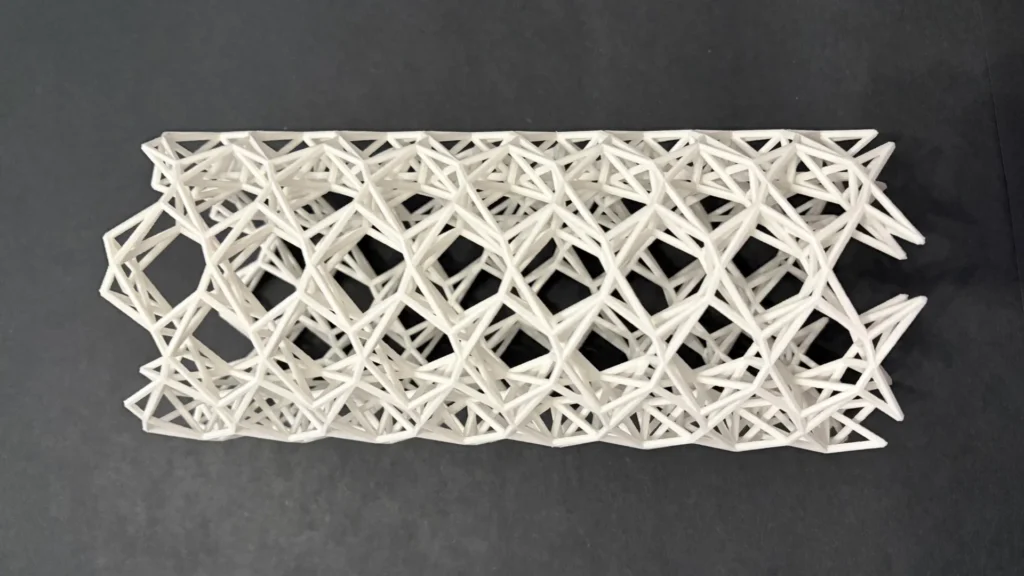
The structures developed by the U-M and AFRL team are visually striking and functionally sophisticated. A cursory examination reveals a complex internal architecture that resembles a chain-link fence folded and rolled into a tube, featuring interconnected inner and outer layers. Physicists refer to these as "kagome tubes," a nod to the intricate patterns found in traditional Japanese basket weaving.
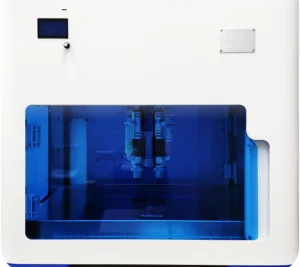
The ability to fabricate these kagome tubes with high precision is a direct result of advancements in 3D printing technology. This additive manufacturing process allows for the creation of geometries that are incredibly difficult, if not impossible, to produce using traditional subtractive methods. The intricate, repeating patterns inherent in the kagome structure are crucial for its vibration-dampening capabilities. When a vibration wave encounters this specifically designed internal geometry, its energy is dispersed and absorbed through a complex interplay of structural resonance and wave scattering, effectively silencing the disturbance.
Data and Supporting Evidence: Quantifying the Breakthrough
While the initial publication in Physical Review Applied details the qualitative demonstration of vibration suppression, further research will be necessary to quantify the precise performance metrics. However, the underlying principles of topological phononics, which this work leverages, suggest significant potential. Studies in related metamaterial research have shown that carefully designed lattices can exhibit "band gaps"—frequency ranges where vibrations are not allowed to propagate. For example, theoretical models for acoustic metamaterials have predicted band gaps that can attenuate sound waves by over 50 decibels, representing a reduction in intensity by a factor of 100,000. While direct experimental data for these specific kagome tubes is pending, the scientific literature on topological phononics provides a strong basis for expecting substantial vibration suppression.
Furthermore, the robustness of such structures is often a key advantage. Unlike materials that rely on damping through energy dissipation (which can degrade over time), metamaterials like these function through their inherent structure, offering long-term, passive vibration control. The ability to tune the band gap frequencies by altering the geometric parameters of the kagome lattice opens up possibilities for targeted vibration isolation across a wide spectrum of frequencies, from the low-frequency rumble of heavy machinery to the high-frequency vibrations experienced in sensitive electronic equipment.
Implications and Future Directions: Navigating Trade-offs and New Frontiers
The potential applications for this technology are vast and span numerous critical industries. In transportation, these vibration-suppressing materials could lead to quieter, smoother rides in aircraft, trains, and automobiles, enhancing passenger comfort and reducing fatigue on structural components. In construction, they could be integrated into buildings and bridges to mitigate the impact of seismic activity or traffic-induced vibrations, improving structural integrity and safety. The aerospace and defense sectors, already significant funders of this research, could benefit from lighter, more resilient components that can withstand extreme operational environments.
However, the path forward is not without its challenges. McInerney pointed out a critical trade-off: "The better a structure is at suppressing vibrations, the less weight it can support." This inherent compromise between vibration isolation performance and load-bearing capacity is a significant hurdle that requires further investigation. The team is actively exploring ways to optimize designs to mitigate this limitation, potentially through hybrid material approaches or by tailoring the lattice geometry for specific load requirements.
The development of these novel structures also necessitates the creation of new methodologies for testing and characterization. "Because we have such new behaviors, we’re still uncovering not just the models, but the way that we would test them, the conclusions we would draw from the tests, and how we would implement those conclusions into a design process," McInerney remarked. This presents an exciting frontier for materials science and engineering, requiring the development of new standards, advanced simulation tools, and innovative experimental setups to fully understand and exploit the capabilities of these engineered materials.
Official Reactions and Broader Impact
While direct statements from funding agencies like DARPA and the Office of Naval Research are typically not released for individual research projects, the continued investment in metamaterials research underscores the strategic importance placed on such advancements. These agencies are keenly interested in technologies that can provide a strategic advantage, whether through enhanced performance, increased survivability, or reduced operational costs. The potential for these vibration-suppressing structures to contribute to quieter, more efficient, and more resilient systems aligns perfectly with these objectives.
The broader impact of this research extends beyond immediate applications. It signifies a paradigm shift in how we conceptualize and engineer materials. By moving beyond traditional material science, which has largely focused on chemistry, this work opens up a new era where design and geometry are primary drivers of material properties. This could lead to a renaissance in material innovation, enabling the creation of entirely new classes of functional materials with tailored performance characteristics for a wide range of societal needs.
The journey from theoretical concept to practical application is often long and arduous, marked by incremental progress and persistent challenges. The work by the University of Michigan and AFRL teams on 3D-printed kagome tubes represents a significant milestone in this journey, demonstrating that the once-abstract principles of mechanical metamaterials can indeed be translated into tangible, high-performance components, ushering in a new era of geometrically engineered materials.