The landscape of Australia’s advanced manufacturing sector has been significantly strengthened with the announcement that Edith Cowan University (ECU) has become the twelfth university to join the Additive Manufacturing Cooperative Research Centre (AMCRC). This expansion marks a pivotal moment for the AMCRC, often referred to as "Australia Makes," as it continues its mission to accelerate the adoption and proliferation of 3D printing technologies across the nation. The integration of ECU, a prominent institution in Western Australia, is expected to inject vital research capabilities and industry connections into the AMCRC’s growing ecosystem, particularly in sectors crucial to the Australian economy.
Strengthening Australia’s Additive Manufacturing Capabilities
The AMCRC operates with a clear objective: to forge a robust national network that bridges the gap between manufacturers and the essential expertise, skills, and infrastructure required to embrace additive manufacturing (AM). This collaborative approach aims to unlock the transformative potential of 3D printing for Australian industries. Susan Jeanes, Chair of the AMCRC, articulated the strategic importance of ECU’s inclusion. "ECU’s strong research capability and industry links make it a valuable addition to our partnership," Jeanes stated. "Particularly as Western Australia continues to develop significant opportunities across defence, mining and resources. Additive manufacturing has the potential to transform how these sectors design, produce and maintain critical components."
Jeanes further emphasized the critical need for workforce development and knowledge transfer. "Building the workforce, knowledge and industry capability required to realise that opportunity will be essential, and ECU will play an important role in that effort," she added. "At a time of growing global uncertainty, strengthening Australia’s sovereign manufacturing capability has never been more important. Together, we are building the skills, knowledge and industrial capability needed to support more resilient supply chains and a stronger manufacturing future." This sentiment underscores the AMCRC’s role in enhancing Australia’s self-sufficiency and economic resilience in an increasingly volatile global environment.
ECU’s Strategic Contribution to the AMCRC
Professor Wei Ni, from ECU’s School of Engineering, highlighted the mutual benefits of the partnership. "Joining AMCRC will enable ECU to work directly with manufacturers to develop and commercialise solutions that improve productivity, resilience and global competitiveness," Professor Ni explained. "The partnership creates opportunities to translate research into industry outcomes and support technology adoption across start-ups, small and medium-sized enterprises, government, community organisations and major companies, including those operating in Western Australia’s resources sector."
The university’s commitment extends to fostering a future-ready workforce. "By combining ECU’s research expertise with the AMCRC’s national industry network, we can help businesses solve complex challenges, build a future-ready workforce and unlock new opportunities for Western Australia and the world," Professor Ni concluded. This collaborative synergy is poised to accelerate the practical application of AM technologies, moving beyond theoretical research to tangible industrial advancements.
Western Australia: A Hub for Innovation and Resources
Edith Cowan University’s presence in Perth and Bunbury, Western Australia, places it at the heart of a region rich in natural resources and with a burgeoning industrial sector. Western Australia is renowned for its vast mineral wealth, playing a significant role in the global supply of commodities like iron ore, gold, and lithium. This economic backbone has historically driven innovation and adaptation within its key industries, making it a fertile ground for the adoption of advanced manufacturing technologies like additive manufacturing.
The sheer scale of Western Australia, being 4.6 times the size of France or 3.7 times the size of Texas, presents unique logistical challenges that AM can directly address. With a population of approximately 3 million, heavily concentrated in Perth, the region’s dispersed industrial sites and vast distances make efficient maintenance, repair, and operations (MRO) and the rapid deployment of spare parts critical. AMCRC’s expansion into this region, with ECU as a key partner, is strategically aligned to tackle these very challenges.
ECU’s Advanced Manufacturing Infrastructure
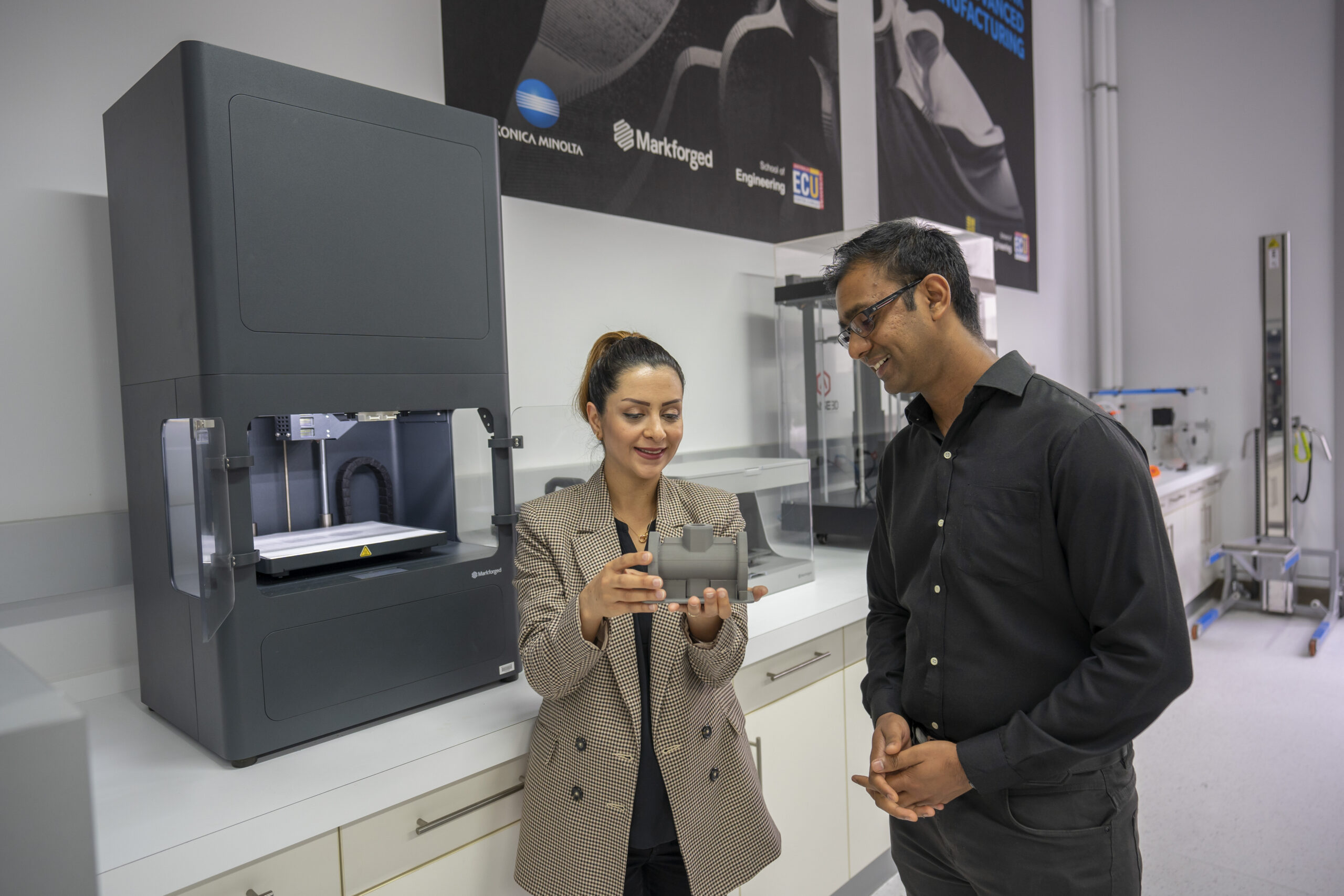
ECU’s commitment to additive manufacturing is evident in its dedicated research facilities. The university houses a Center for Advanced Materials and Manufacturing (CAMM), equipped with advanced technologies including metal 3D printers and scanning electron microscopes. CAMM’s research portfolio spans critical areas such as the development of bone replacement materials for medical implants, advanced water filtration systems, and the application of Laser Powder Bed Fusion (LPBF) technology. The center also engages with cutting-edge materials like Refractory High-Entropy Alloys (RHEAs), pushing the boundaries of material science for AM applications.
Furthermore, ECU hosts an Advanced Manufacturing Hub that offers comprehensive support for industry adoption of AM. This hub provides training in Design for Additive Manufacturing (DfAM), assists in selecting suitable parts for AM, develops business cases for technology implementation, facilitates new product introductions, and offers reverse engineering services. The university’s interdisciplinary approach is further demonstrated by its Nutrition and Health Innovation Research Institute and Digital Gastronomy Lab, which also utilize food 3D printers, showcasing the broad applicability of AM across diverse sectors.
The Broader Implications for Australia’s Manufacturing Future
As the AMCRC continues to grow and integrate leading research institutions like ECU, it is positioning itself at the forefront of Australia’s 3D printing journey. The nation’s vast geography and its inherent remoteness present a compelling case for widespread adoption of additive manufacturing. Australia possesses abundant raw materials suitable for 3D printing, yet historically, investment in this sector has been relatively limited. The current strategic push by the AMCRC, with government backing and university participation, aims to rectify this imbalance.
The potential for AM to revolutionize MRO operations in Australia is substantial. The ability to print spare parts on demand, particularly for critical infrastructure, remote operations, and the defense sector, can significantly reduce lead times, lower inventory costs, and enhance operational uptime. For a country of Australia’s size, the capability to distribute manufacturing capabilities across its vast expanse could create a highly versatile and resilient industrial base, capable of rapid adaptation and self-sufficiency.
A Strategic Investment in Sovereign Capability
The current global geopolitical climate underscores the importance of strengthening sovereign manufacturing capabilities. In this context, Australia’s investment in additive manufacturing through initiatives like the AMCRC and the integration of universities like ECU represents a forward-thinking strategy. It aims to build a skilled workforce, foster innovation, and establish resilient supply chains that are less susceptible to international disruptions.
The expansion of the AMCRC signifies a national commitment to harnessing the power of 3D printing. By fostering collaboration between academia and industry, the AMCRC is not only driving technological advancement but also cultivating the human capital and industrial infrastructure necessary for Australia to thrive in the evolving global manufacturing landscape. The strategic inclusion of ECU is a testament to the ongoing efforts to build a more robust, innovative, and self-reliant Australian manufacturing future.