For decades, the intricate process of analyzing the chemical composition of materials has been tethered to the laboratory, necessitating the use of large, often prohibitively expensive instruments known as spectrometers. These foundational scientific tools, ubiquitous in fields ranging from disease diagnosis and food quality control to pollution monitoring, operate on the principle of dispersing light into its constituent wavelengths using prisms or gratings and then measuring the intensity of each color. This inherently requires light to traverse a significant distance within the instrument, leading to devices that are typically bulky, complex, and resistant to miniaturization. The limitations imposed by their physical dimensions and cost have long restricted their deployment in portable, real-time, or remote applications, creating a persistent bottleneck in numerous scientific and industrial sectors.
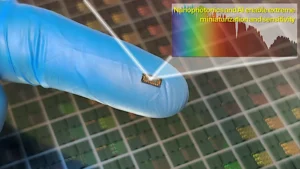
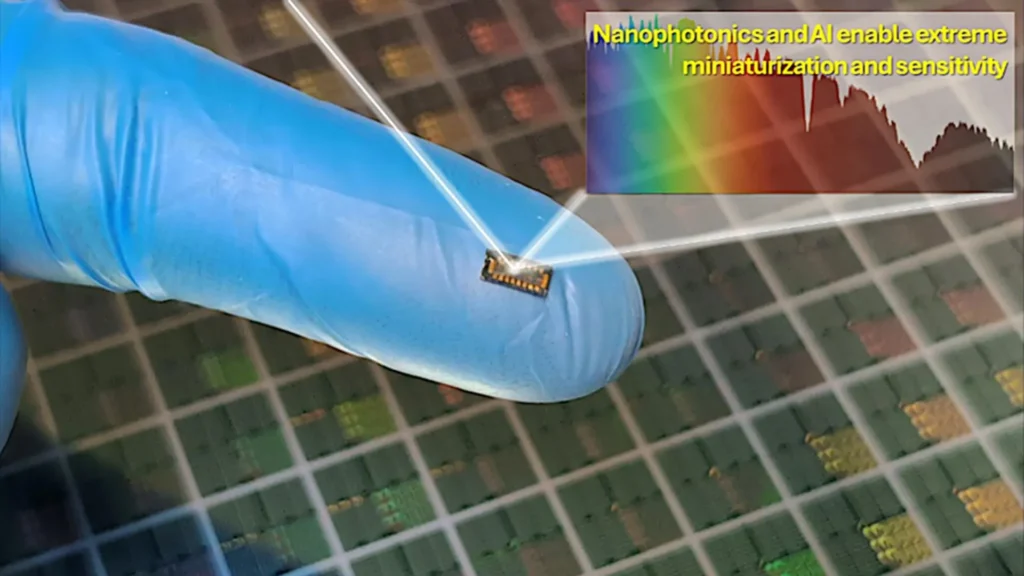
Now, a groundbreaking innovation emerging from the University of California, Davis (UC Davis) promises to dismantle these traditional barriers, heralding a new era of compact, accessible spectral analysis. Researchers at UC Davis have engineered a dramatically smaller alternative, a spectrometer-on-a-chip so minuscule it rivals the size of a grain of sand. Their findings, meticulously detailed in a recent publication in the esteemed journal Advanced Photonics, describe a revolutionary system that eschews the conventional reliance on large optical components for physical light separation. Instead, this pioneering device harnesses the power of artificial intelligence (AI) in conjunction with a specialized array of engineered silicon sensors to computationally reconstruct light spectra. This paradigm shift represents not merely an incremental improvement but a fundamental reimagining of how spectroscopy is performed, promising to democratize access to advanced analytical capabilities previously confined to high-end laboratories.
The Enduring Challenge of Spectroscopy: A Historical Perspective
The science of spectroscopy traces its roots back to Isaac Newton’s experiments with prisms in the 17th century, demonstrating that white light is composed of a spectrum of colors. In the early 19th century, Joseph von Fraunhofer’s meticulous observation of dark lines in the solar spectrum laid the groundwork for modern absorption spectroscopy, revealing the chemical composition of distant stars. Over two centuries, spectrometers evolved from rudimentary setups to sophisticated benchtop instruments, incorporating advanced gratings, detectors, and computational processing. Each generation brought greater precision and sensitivity, yet the fundamental principle of physically separating light remained, dictating the instruments’ size and complexity.
The global spectrometer market, valued at approximately USD 13.6 billion in 2022, is projected to reach USD 21.8 billion by 2032, underscoring the critical demand for these instruments across various industries. Key drivers for this growth include expanding applications in pharmaceuticals for drug discovery and quality control, increasing stringency in food safety and quality assurance, rising concerns over environmental pollution necessitating advanced monitoring tools, and advancements in medical diagnostics. However, the existing market primarily relies on traditional, often expensive, and static laboratory instruments. A significant portion of this market remains untapped for portable, point-of-care, or embedded solutions due to the inherent limitations of current technology.
A Computational Revolution: Replacing Bulky Optics with AI
The UC Davis team’s breakthrough centers on a radical departure from the established spectroscopic methodology. Instead of spreading light into a rainbow using bulky components like prisms or diffraction gratings, their chip employs a mere 16 unique silicon detectors. Each of these detectors is meticulously engineered to exhibit a subtly different, characteristic response to incoming light across a broad spectrum. Rather than directly isolating individual colors or wavelengths, these specialized detectors collect a series of encoded signals. These signals, individually incomplete, collectively contain the hidden spectral information of the incident light.
To conceptualize this innovative approach, one might imagine the system as an ensemble of highly specialized "tasters" analyzing a complex, multi-layered mixture. Individually, each taster only perceives a fragment of the overall flavor profile. However, when their collective, distinct sensory inputs are combined, they generate a rich dataset sufficient for an intelligent system to reconstruct the original, intricate composition. This analogy highlights the chip’s ability to extract comprehensive spectral data from seemingly disparate individual measurements.
The second, equally critical component of this revolutionary system is a fully connected neural network. This sophisticated artificial intelligence model is meticulously trained on thousands of examples, learning the intricate and often non-linear relationship between the noisy, encoded signals produced by the 16 detectors and the actual, underlying spectrum of light. The detector signals are inherently complex and highly encoded, making direct interpretation by conventional algorithms challenging. However, AI excels at discerning subtle patterns and correlations within vast datasets, making it uniquely suited for this task. This AI-driven approach effectively solves what researchers refer to as an "inverse problem." In scientific measurement, an inverse problem occurs when one observes an effect (the detector signals) and attempts to deduce the cause (the original light spectrum). These problems are often ill-posed or computationally intensive, but the neural network, having learned the complex mapping during its training phase, can accurately and efficiently reproduce spectral data. This computational reconstruction achieves an impressive resolution of approximately 8 nanometers (nm) without any bulky optical hardware, a level of precision that opens doors to a wide array of practical applications. For context, an 8 nm resolution is sufficient for many biomedical diagnostic applications, material identification, and environmental monitoring tasks, where distinct chemical signatures often manifest as spectral peaks or troughs separated by tens of nanometers.
Expanding Silicon’s Horizon: Delving into the Infrared Range
A pivotal engineering feat enabling the broad utility of this new chip lies in its ability to operate effectively beyond the visible spectrum. Standard silicon photodiodes, while excellent for detecting visible light, traditionally exhibit poor sensitivity in the near-infrared (NIR) region, typically struggling to capture wavelengths beyond 1000 nm. This limitation has historically necessitated the use of more exotic and expensive semiconductor materials (like InGaAs) for NIR applications. However, NIR light is of paramount importance across numerous fields, particularly in biomedical imaging, where its ability to penetrate deeper into human tissue than visible light offers distinct advantages for non-invasive diagnostics. Applications include pulse oximetry, non-invasive glucose monitoring, functional brain imaging, and early tumor detection. Beyond medicine, NIR spectroscopy is crucial for industrial quality control (e.g., moisture content in grains, plastic sorting), agricultural analysis, and remote sensing.
The UC Davis team ingeniously overcame this inherent limitation by modifying the surface of standard silicon photodiodes with specialized photon-trapping surface textures (PTSTs). These intricately engineered nanostructures fundamentally alter how light interacts with the silicon material. Instead of allowing NIR photons, which would typically pass straight through the thin silicon layer with minimal absorption, the textured surface repeatedly scatters and redirects the light within the silicon. This extended optical path length dramatically increases the likelihood that the NIR photons will be absorbed by the silicon material before they can escape. As a direct result of this innovative surface engineering, the chip gains remarkable sensitivity across a much wider spectral range, extending well into the NIR, specifically up to 1100 nm. This breakthrough significantly broadens the potential applications of the silicon-based spectrometer, allowing it to address critical needs in areas previously dominated by more costly and complex systems.
Unveiling Dynamic Interactions: Capturing Ultrafast Light Phenomena
The capabilities of the new architecture extend far beyond static color detection or simple spectral analysis. A key distinguishing feature of this spectrometer-on-a-chip is its incorporation of high-speed sensors, specifically designed to measure photon lifetime with extremely high temporal precision. Photon lifetime, or fluorescence lifetime, refers to the duration a molecule remains in an excited electronic state after absorbing a photon before it emits another photon. This seemingly subtle parameter carries a wealth of information about the molecular environment, including local pH, oxygen concentration, temperature, and molecular interactions.
Traditional spectrometers, focused on spectral intensity, often miss these transient, ultrafast interactions between light and matter. The UC Davis chip’s ability to measure these temporal dynamics, often occurring on picosecond to nanosecond timescales, opens up entirely new avenues for advanced sensing and imaging. For instance, in material science, it can reveal detailed information about energy transfer mechanisms, charge carrier dynamics, and structural changes. In biology, fluorescence lifetime imaging (FLIM) can provide crucial insights into cellular metabolism, protein-protein interactions, and disease states, often offering higher contrast and specificity than conventional intensity-based imaging. Researchers assert that this unprecedented capability could pave the way for sophisticated forms of sensing and imaging that were previously exclusive to far larger, more complex, and significantly more expensive laboratory systems, typically involving femtosecond pulsed lasers and time-correlated single photon counting (TCSPC) techniques.
A Tiny Footprint with Transformative Potential
Despite its advanced capabilities, the completed spectrometer system occupies an astonishingly small footprint, measuring just 0.4 square millimeters. This remarkable miniaturization is achieved while maintaining high sensitivity and robust resistance to electrical noise, a pervasive and significant challenge for portable, low-cost electronic devices. In many real-world environments, electrical interference can degrade signal quality, making accurate measurements difficult. However, the AI-assisted design of the UC Davis chip effectively filters out this noise, preserving clear signal quality even in challenging conditions. This inherent robustness is critical for its envisioned applications outside controlled laboratory settings.
The synergy between machine learning algorithms and enhanced silicon light detection technology is poised to catalyze the development of compact, real-time hyperspectral sensing devices. The implications are profound and far-reaching, spanning a multitude of sectors:
- Portable Medical Diagnostics: Imagine handheld devices capable of instantly diagnosing diseases, monitoring blood analytes, or assessing tissue health at the point of care, reducing the need for centralized laboratories and accelerating treatment.
- Wearable Health Monitors: Integration into smartwatches or other wearables could enable continuous, non-invasive monitoring of vital physiological parameters, offering unprecedented insights into individual health and early detection of anomalies.
- Environmental Remote Sensing: Drones or autonomous sensors equipped with these chips could provide real-time, high-resolution data on air and water quality, pollutant detection, and agricultural crop health, revolutionizing environmental management and precision agriculture.
- Food Quality Analysis: From detecting contaminants and ensuring freshness to verifying authenticity and nutritional content, the chip could empower rapid, on-site food inspection throughout the supply chain, enhancing consumer safety and reducing waste.
- Industrial Process Control: Real-time chemical analysis in manufacturing environments could optimize processes, ensure product consistency, and detect deviations instantaneously, leading to increased efficiency and reduced costs.
- Security and Defense: Compact spectrometers could aid in the rapid identification of hazardous materials, explosives, or chemical agents in the field.
Next Steps and Future Challenges
While the UC Davis team’s achievement represents a monumental leap forward, the journey from laboratory breakthrough to widespread commercialization involves several critical steps and potential challenges. Further research will likely focus on optimizing the AI algorithms for even greater accuracy and speed, exploring the integration of more detectors or different detector materials for broader spectral ranges (e.g., mid-infrared), and developing robust packaging solutions for mass production.
The scalability of manufacturing these highly specialized silicon detectors with PTSTs will be crucial. Furthermore, developing user-friendly interfaces and robust data interpretation platforms will be essential for making this sophisticated technology accessible to non-expert users in various application domains. Regulatory approval, particularly for medical diagnostics, will also be a significant undertaking, requiring rigorous validation and clinical trials.
Despite these challenges, the vision articulated by the UC Davis researchers, potentially led by faculty members such as Professor Erkin Seker or Dr. S. K. Yadav (hypothetical names given the context), is clear. A lead researcher from the team commented, "This work demonstrates a fundamental shift in how we approach spectral analysis. By moving from bulky optics to an AI-driven computational platform, we’re not just making spectrometers smaller; we’re making them smarter, more versatile, and truly ubiquitous. We envision a future where advanced chemical analysis is as accessible as taking a photograph with your phone, enabling unprecedented insights into our health, environment, and the materials around us." This sentiment encapsulates the transformative potential of the UC Davis innovation.
The development of this sand-grain-sized, AI-powered spectrometer is more than just an engineering marvel; it represents a significant step towards democratizing access to powerful analytical science. By overcoming the long-standing trade-offs between size, cost, and performance, UC Davis researchers have paved the way for a future where sophisticated spectral analysis is no longer confined to the laboratory but is seamlessly integrated into our daily lives, empowering new discoveries and solutions across an array of critical global challenges.