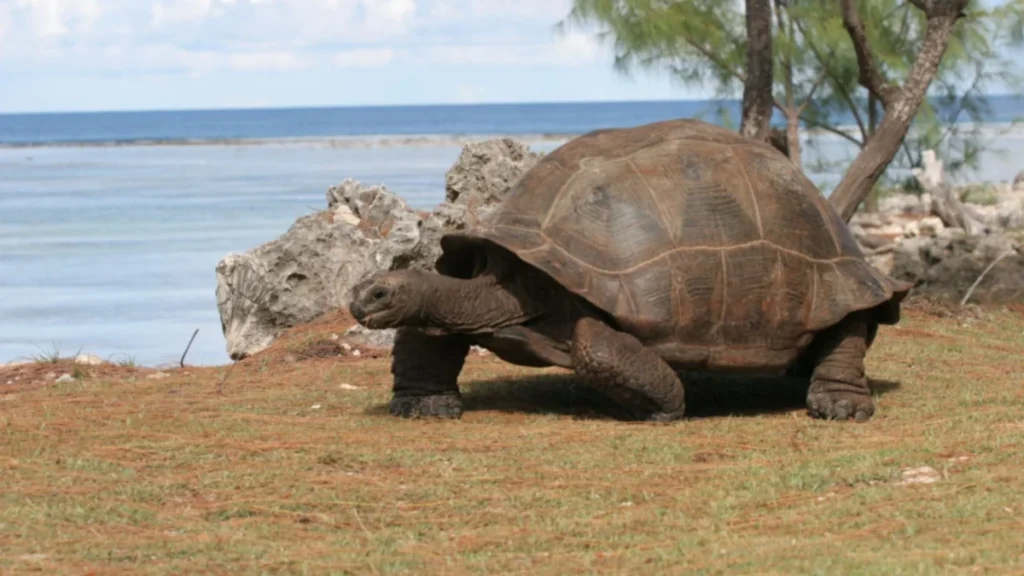
A monumental achievement in global conservation has been unveiled in the Seychelles, where a new comprehensive survey has revealed a thriving population of approximately 183,000 Aldabra giant tortoises (Aldabrachelys gigantea). This unprecedented figure, meticulously documented by a collaborative effort between the Seychelles Islands Foundation (SIF) and the University of Exeter, represents the highest count ever recorded for this iconic species, offering a powerful testament to decades of dedicated conservation efforts in the Indian Ocean. Far from a sudden population boom, this new estimate, derived from advanced statistical methodologies, suggests the species has maintained a robust and secure presence, previously underestimated due to challenges in surveying their complex habitat.
A Legacy Reclaimed: From the Brink of Extinction to a Resurgent Future
The story of the Aldabra giant tortoise is one of remarkable resilience and recovery, a dramatic turnaround from a harrowing past that saw the species teetering on the precipice of extinction. Throughout the 18th and 19th centuries, these gentle giants faced relentless exploitation. Sailors, whalers, and settlers viewed them as a convenient, long-lasting food source for arduous sea voyages, often collecting thousands at a time. Their shells were also prized, further fueling their decline. This rampant hunting, coupled with widespread habitat degradation across their range, decimated populations, leaving fewer than 1,000 individuals clinging to survival on the remote Aldabra Atoll by the late 19th century. Many other giant tortoise species across the Indian Ocean, including those on Seychelles’ granitic islands and Mauritius, were driven to complete extinction during this period, making Aldabra’s surviving population critically important.
The isolated nature of Aldabra Atoll, a UNESCO World Heritage site since 1982, proved to be both a curse and a blessing. While its remoteness initially protected a remnant population from the most intense human pressures found on more accessible islands, the subsequent introduction of invasive species, such as feral goats, compounded the threats. These goats competed with the tortoises for vegetation and dramatically altered the delicate ecosystem.
However, a pivotal shift occurred in the latter half of the 20th century. Growing awareness of the unique biodiversity of Aldabra and the dire situation of its tortoises spurred significant conservation action. In 1981, Aldabra was officially designated a strict nature reserve, providing a crucial layer of legal protection against further exploitation and uncontrolled human interference. This was swiftly followed by its inscription as a UNESCO World Heritage site in 1982, recognizing its "outstanding universal value" as one of the largest raised coral atolls in the world, harboring a diverse and relatively undisturbed ecosystem, including the largest population of giant tortoises globally. These designations laid the groundwork for the rigorous protective measures that followed.
A significant milestone in the recovery timeline was the successful eradication of invasive feral goats from the atoll in 2012. These herbivores, introduced decades earlier, had severely degraded the native vegetation, competing directly with the tortoises for food and disrupting the natural balance of the ecosystem. Their removal allowed for the regeneration of vital plant species, significantly increasing the availability of forage and improving habitat quality for the tortoises. This decisive intervention, combined with sustained legal protection, created an environment where the Aldabra giant tortoise population could not only survive but truly flourish.
Unveiling the True Scope: The Science Behind the New Census
Accurately counting a population of slow-moving, yet remarkably elusive, reptiles spread across a vast and challenging landscape like Aldabra Atoll presents considerable logistical and methodological hurdles. Previous surveys, often relying on raw headcounts, struggled to provide a definitive figure, frequently underestimating the true population size. Estimates from the late 1990s, for instance, suggested around 100,000 individuals, a figure that, while impressive, likely missed tens of thousands of hidden animals.
The landscape of Aldabra is characterized by razor-sharp coral rock formations, dense, tangled scrubland, and intricate mangrove forests. Tortoises, despite their size, are adept at vanishing from sight, seeking refuge under thick bushes, retreating into the cool shade of mangroves, or sheltering from the scorching equatorial sun in crevices. These behaviors, combined with the sheer scale and ruggedness of the atoll, made traditional census methods insufficient for a truly accurate assessment.
Recognizing these limitations, the Seychelles Islands Foundation (SIF) partnered with statistical experts from the University of Exeter to embark on an ambitious, nearly five-year-long field monitoring project. The researchers employed a sophisticated statistical technique known as Bayesian hierarchical distance sampling. This advanced method moves beyond simple headcounts by modeling "missing data" – essentially, mathematically correcting for the individuals that were undoubtedly present but remained unseen during surveys.
Here’s how it works: Researchers conduct systematic transect surveys, recording the distance of observed tortoises from their survey path. Bayesian hierarchical distance sampling then uses these observations, combined with information about the habitat type (e.g., open "tortoise turf" grasslands versus impenetrable scrubland) and the probability of detection in different environments, to generate a statistically robust estimate of the total population. This approach allows scientists to account for the varying visibility and detection probabilities across Aldabra’s diverse habitats, providing a far more accurate and reliable baseline figure than ever before.
Dr. Nancy Bunbury, one of the study’s co-authors, emphasized the significance of this methodological leap: "By modeling what we didn’t see, as well as what we did, we’ve produced the most reliable baseline yet for this iconic Seychelles species, establishing a benchmark we can use to track the population for decades to come." This scientific rigor not only provides a precise current figure but also establishes a robust framework for future monitoring, enabling conservationists to track population trends with greater confidence and adapt management strategies as needed. The findings of this landmark study were formally published in the esteemed journal Ecology and Evolution, underscoring its scientific validity and contribution to the field.
Voices from the Field: Affirmation and Aspiration
The announcement has been met with profound satisfaction and renewed optimism within the conservation community, particularly from those directly involved in the Aldabra project. Dr. Frauke Fleischer-Dogley, CEO of the Seychelles Islands Foundation, articulated the deep commitment and long-term vision that underpins this success. "The monitoring data in this study were collected by SIF staff living and working on the atoll, year after year," she stated. "More than 180,000 giant tortoises roaming freely on our atoll is proof of what long-term commitment to conservation can achieve. This is wonderful news for Seychelles, for the world, and for everyone who has worked to protect Aldabra." Her statement highlights the crucial role of dedicated, on-the-ground conservationists whose sustained efforts often go unseen but are fundamental to such triumphs.
The broader scientific community and international conservation organizations are likely to echo this sentiment, recognizing Aldabra as a beacon of hope. This achievement demonstrates that with concerted effort, scientific expertise, robust legal frameworks, and long-term funding, even species brought to the brink can recover. It serves as a powerful counter-narrative to the often-depressing news of biodiversity loss, offering tangible proof of what is possible when conservation is prioritized.
Broader Implications and Persistent Challenges
The success story of the Aldabra giant tortoise carries significant implications, both locally and globally. It offers a compelling case study for ecosystem restoration and species recovery, demonstrating the effectiveness of integrated conservation strategies that combine legal protection, invasive species management, and rigorous scientific monitoring. For the Seychelles, it reinforces its reputation as a leader in marine and terrestrial conservation, bolstering its commitment to protecting its unique natural heritage. The tortoises, as "ecosystem engineers," play a vital role in shaping the atoll’s vegetation, dispersing seeds, and creating pathways, thereby supporting the health and biodiversity of the entire ecosystem. Their thriving numbers indicate a healthy and resilient Aldabra.
However, despite this encouraging news, scientists are quick to emphasize that vigilance and continued protective measures remain absolutely essential. The fragile ecosystem of Aldabra Atoll faces a new generation of serious environmental threats, primarily driven by the escalating impacts of climate change.
- Rising Sea Levels: As a low-lying coral atoll, Aldabra is exceptionally vulnerable to rising sea levels. Even small increases can lead to the inundation of critical low-lying habitats where tortoises forage and nest. The erosion of coastlines and saltwater intrusion into freshwater lenses further threaten the delicate balance of the ecosystem.
- Increasingly Severe Droughts: Climate change is also projected to bring more frequent and intense droughts to the region. These prolonged dry spells threaten to deplete vital food sources and reduce the availability of shade, both critical for the survival of tortoises, particularly vulnerable hatchlings and juveniles.
- Persistent Invasive Species: While feral goats have been eradicated, other invasive species continue to pose a threat. Invasive rats and cats, though smaller, are formidable predators of vulnerable tortoise eggs and hatchlings. Ongoing efforts to eradicate these remaining invasive mammals are crucial to ensuring the long-term success of the tortoise population.
These interconnected threats underscore that conservation is an ongoing battle, not a singular victory. The baseline population figure established by the new survey will be invaluable in tracking how the tortoise population responds to these emerging environmental pressures, enabling conservationists to adapt their strategies proactively. The Aldabra model offers lessons for other island nations grappling with similar challenges, highlighting the importance of understanding complex ecological dynamics and implementing adaptive management plans.
Looking ahead, the commitment to safeguard Aldabra’s unique biodiversity remains unwavering. Plans to eradicate the remaining invasive mammals are already underway, demonstrating a proactive approach to mitigating known threats. The Aldabra Atoll, with its thriving giant tortoise population, stands as a rare and inspiring narrative of hope in a world facing unprecedented ecological crises. It showcases a landscape where nature, given the chance and supported by human dedication, can rebound from near collapse, allowing these ancient reptiles to reclaim their rightful place in their ancestral home, inspiring conservation efforts worldwide.