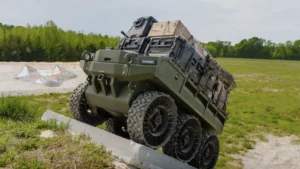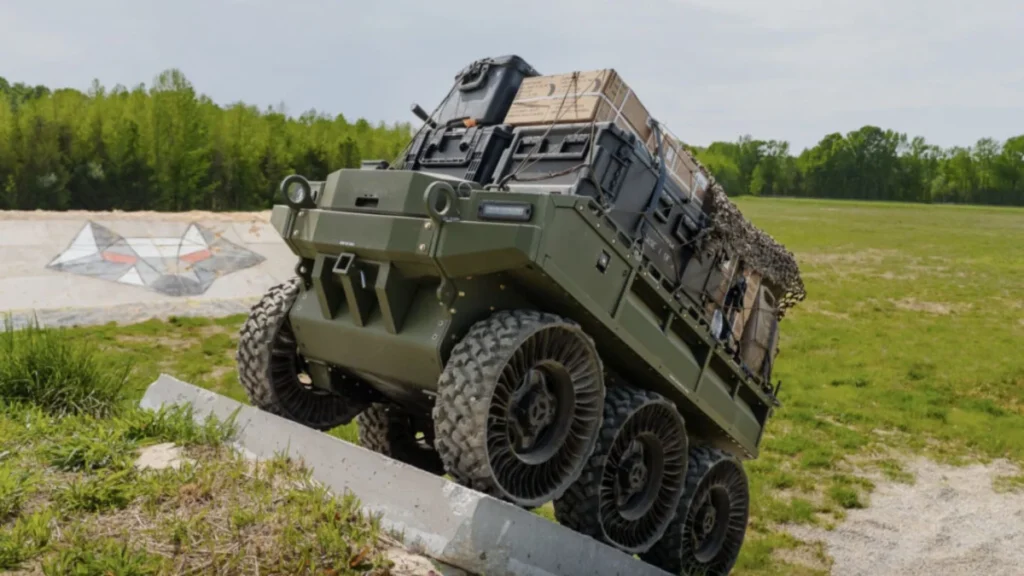
A new era of battlefield robotics is taking shape as the Hunter WOLF multi-mission unmanned ground vehicle (UGV), distinguished by its superior payload capacity and robust design, has been selected to advance to Phase II of the GroundBreaker 1 unmanned ground vehicle demonstration. This significant milestone positions the Hunter WOLF as a frontrunner in the Department of War’s strategic push to integrate advanced autonomous systems into military operations, promising to redefine tactical logistics, intelligence gathering, and soldier safety on the modern battlefield.
Developed by BLADE, an entity operating as HDT Robotics, LLC, the Hunter WOLF is engineered with a primary objective: to reduce the physical and cognitive workload on soldiers, extend their operational reach into contested environments, and crucially, keep personnel farther from inherently dangerous tasks. Its adaptable architecture is a cornerstone of its design, enabling seamless configuration for a diverse array of missions, including but not limited to tactical logistics, sophisticated intelligence, surveillance, and reconnaissance (ISR) operations, critical casualty evacuation (CASEVAC), and resilient communications support, alongside other mission-critical applications that demand robust and reliable robotic assistance.
The Strategic Imperative: GroundBreaker 1 and the Future of Warfare
The GroundBreaker 1 demonstration program is a pivotal initiative by the Department of War, meticulously designed to rigorously evaluate cutting-edge UGV technologies. Its overarching goal is to identify platforms with the highest potential for employment across a spectrum of tactical and non-tactical missions, thereby accelerating the integration of robotics into the military’s operational framework. This program directly reflects a broader strategic shift within the Department of War, which is placing an increasing and urgent emphasis on rapidly fielding autonomous and robotic systems capable of operating seamlessly alongside warfighters in complex, dynamic environments.
The current geopolitical landscape, characterized by peer and near-peer competition, demands innovative solutions to traditional military challenges. Modern conflicts often involve urban warfare, distributed operations, and sophisticated adversary capabilities, all of which amplify risks to human personnel and complicate logistics. UGVs offer a compelling solution by providing a persistent presence, enhancing situational awareness without exposing soldiers, and alleviating the immense physical burden associated with carrying heavy loads of equipment, ammunition, and supplies over arduous terrain. The selection of the Hunter WOLF for GroundBreaker 1 Phase II underscores its alignment with these critical strategic imperatives, marking it as a potentially transformative asset for future military engagements.
Hunter WOLF: A Mature and Mission-Ready Platform Forged in Real-World Scenarios
BLADE’s confidence in the Hunter WOLF is profound, rooted in extensive development and rigorous testing. "Hunter WOLF was built for exactly this kind of challenge," affirmed Tom Van Doren, President, Robotics Sector at BLADE. "This is a mature, mission-ready platform that has been tested alongside warfighters in demanding environments. GroundBreaker 1 gives us the opportunity to demonstrate why the Hunter WOLF is ready to support the warfighter now." Van Doren’s statement highlights not only the technical prowess of the UGV but also its proven reliability under the most arduous conditions, a testament to its design philosophy and the iterative refinement process it has undergone.
The platform’s maturity is not merely theoretical; it has been forged through practical application and real-world insights. The Hunter WOLF has undergone extensive evaluation through numerous military exercises and training events, simulating a wide range of operational scenarios and environmental challenges. Crucially, the system has also supported operational use in Ukraine, a high-intensity conflict zone that has provided invaluable, real-time feedback. This unprecedented operational experience has furnished BLADE with critical insights into the evolving requirements for unmanned ground systems, informing design improvements and ensuring the Hunter WOLF remains at the forefront of UGV technology. The harsh realities of the Ukrainian battlefield – from extreme weather to sophisticated electronic warfare and ever-present threats – have served as an unparalleled proving ground, demonstrating the system’s resilience and adaptability.
Unpacking Hunter WOLF’s Core Capabilities: Payload, Mobility, and Autonomy
The Hunter WOLF’s design philosophy centers on a robust combination of high payload capacity, exceptional off-road mobility, substantial onboard power generation, and advanced autonomous and remote-control capabilities. These features collectively enable the UGV to tackle complex and austere environments where traditional logistics or human-centric operations would be severely challenged.
High Payload Capacity: One of the most critical distinguishing features of the Hunter WOLF is its superior payload capacity. While specific figures are often classified, the emphasis on "higher payload" suggests it can transport substantially more equipment, ammunition, water, food, and specialized sensor packages than many smaller, lighter UGVs. This capability is vital for sustained operations in remote areas, reducing the number of human-carried loads, and enabling rapid resupply of forward-deployed units. For tactical logistics, this translates directly into increased operational tempo and reduced fatigue for dismounted soldiers. For specialized missions, it means the ability to carry heavier, more sophisticated ISR equipment or even weapon systems, significantly expanding its utility.
Exceptional Off-Road Mobility: Designed for the unpredictability of battlefields, the Hunter WOLF boasts formidable off-road mobility. This capability is essential for traversing diverse and challenging terrains, including dense forests, rocky landscapes, sandy deserts, muddy fields, and urban rubble. Its engineering likely incorporates advanced suspension systems, high-torque drivetrains, and robust track or wheel configurations that ensure stability and traction across uneven surfaces. The ability to navigate difficult terrain autonomously or remotely means that critical supplies and support can reach areas inaccessible or too dangerous for conventional vehicles or personnel.
Onboard Power: The provision of substantial onboard power is a game-changer for extended operations. This not only powers the UGV’s propulsion and control systems but also enables it to act as a mobile power source for soldier-worn equipment, communication devices, and specialized sensors. In situations where traditional power grids are non-existent or compromised, the Hunter WOLF can become a vital node for recharging essential gear, thereby extending the operational endurance of small units in the field. This capability supports the concept of distributed operations, where units operate independently for longer periods.
Autonomous and Remote-Control Capabilities: The Hunter WOLF offers a spectrum of control modes, from direct remote operation to increasingly sophisticated autonomous functions. Teleoperation allows human operators to guide the UGV from a safe distance, invaluable in high-threat environments. Semi-autonomous modes likely include features such as "follow-me" capabilities, where the UGV trails a designated soldier or vehicle; waypoint navigation, allowing pre-programmed routes; and advanced obstacle avoidance, using integrated sensors to detect and circumvent hazards. The future trajectory for such platforms includes increasingly autonomous decision-making within defined parameters, further reducing operator workload and enhancing efficiency. The focus on human-machine teaming ensures that soldiers retain ultimate control while leveraging the UGV’s robotic capabilities.
The GroundBreaker 1 Evaluation: A Rigorous Assessment at Camp Grafton
During Phase II of the GroundBreaker 1 demonstration, Government evaluators will undertake a comprehensive assessment of the Hunter WOLF’s capabilities. This evaluation will concentrate on three critical dimensions: technology maturity, operational readiness, and cross-domain interoperability. The assessments are expected to take place at Camp Grafton, a military training facility known for its diverse terrain and robust testing infrastructure, providing an ideal environment to push the UGV to its limits.
Technology Maturity: This aspect of the evaluation will scrutinize the UGV’s fundamental design, component reliability, and overall system robustness. Evaluators will assess whether the technologies integrated into the Hunter WOLF are sufficiently developed and proven to withstand the rigors of military deployment. This includes assessing the reliability of its propulsion system, sensor suite, control software, and power management. A high level of technology maturity indicates that the platform is not merely a prototype but a robust system ready for potential acquisition and deployment.
Operational Readiness: This criterion focuses on the practical aspects of deploying and operating the UGV in the field. Evaluators will assess the ease of operation, the training requirements for soldiers, the logistical footprint (e.g., maintenance, fuel/power requirements, spare parts), and its reliability under sustained operational conditions. The Hunter WOLF’s proven track record in military exercises and its operational use in Ukraine will undoubtedly lend significant weight to this assessment, providing real-world data points on its readiness for demanding tasks.
Cross-Domain Interoperability: In modern warfare, no system operates in isolation. Cross-domain interoperability is paramount, evaluating how effectively the Hunter WOLF can integrate with existing military systems, other unmanned platforms (aerial drones, other UGVs), and the broader command and control networks, such as the Joint All-Domain Command and Control (JADC2) concept. This includes its ability to share data, receive commands, and coordinate actions within a networked environment. Seamless integration is crucial for maximizing the UGV’s force-multiplying potential and ensuring it can contribute effectively to multi-domain operations.
Broader Implications and the Road Ahead
The selection of BLADE’s Hunter WOLF for GroundBreaker 1 Phase II carries significant implications for the future of military robotics, the defense industry, and the tactical doctrines of armed forces globally.
Impact on Military Doctrine and Tactics: The successful integration of high-payload, multi-mission UGVs like the Hunter WOLF will fundamentally alter military doctrine and tactics. It enables concepts such as "robotic wingmen," where UGVs accompany dismounted patrols, carrying heavy loads and providing an immediate tactical advantage. It facilitates sustained reconnaissance without human exposure and rapid, autonomous casualty evacuation, potentially saving lives by reducing response times in hazardous zones. These platforms will allow human forces to concentrate on tasks requiring complex cognitive decision-making, while the robots handle the "3 D’s": dull, dirty, and dangerous tasks.
Force Multiplier Effect: UGVs serve as significant force multipliers. A smaller human contingent, supported by a fleet of versatile robots, can achieve operational effects previously requiring a larger human footprint. This is particularly relevant in an era where manpower resources are often constrained, and precision operations are prioritized. The ability to deploy multiple UGVs for various tasks simultaneously, from logistics to ISR, enhances the overall combat power and operational flexibility of military units.
Economic and Industrial Impact: For BLADE, advancing to Phase II signifies a major validation of their technological leadership and strategic direction. Success in GroundBreaker 1 could lead to substantial Prototype Other Transaction Authority (OTA) awards in Phase III, a flexible contracting mechanism designed to expedite the development and fielding of critical technologies by bypassing traditional, often lengthy, procurement processes. This not only fuels innovation within the defense robotics sector but also positions BLADE as a key player in a rapidly expanding market. The broader defense industry will likely see increased investment in UGV research and development, fostering competition and accelerating technological advancements in areas like AI, sensor fusion, battery technology, and ruggedized computing.
Challenges and Ethical Considerations: While the benefits are clear, the widespread adoption of advanced autonomous systems also presents ongoing challenges and ethical considerations. Ensuring robust cybersecurity against sophisticated adversaries, maintaining resilient communication links in contested electromagnetic environments, and developing clear rules of engagement for semi-autonomous or autonomous systems are paramount. The discussion around human-on-the-loop versus human-out-of-the-loop control for lethal autonomous weapons systems remains a critical area of debate, although platforms like Hunter WOLF are primarily focused on support roles rather than direct lethal engagement. The Department of War and its partners are committed to addressing these complex issues through rigorous testing, policy development, and international dialogue.
The Road to Phase III and Beyond: Following Phase II, companies whose demonstrations are successfully evaluated may be invited to Phase III, where they will submit a full proposal for a Prototype Other Transaction Authority (OTA) award. This final phase aims to transition promising technologies from demonstration to rapid prototyping and potential fielding. For the Hunter WOLF, this would mean the opportunity to move closer to widespread adoption across various branches of the military, fulfilling its promise to transform how soldiers operate in an increasingly complex and dangerous world. The journey through GroundBreaker 1 represents a critical pathway for BLADE and the Department of War to jointly shape the future of ground robotics, ensuring that warfighters are equipped with the most advanced tools to accomplish their missions effectively and safely.