Cambridge, MA – Nine years after a powerful demonstration on an MIT stage captivated an audience and ignited a spark of hope, a groundbreaking wearable device designed to mitigate tremors has received 510(k) clearance from the U.S. Food and Drug Administration (FDA). Developed by Encora Therapeutics, a company born from an MIT student project, this innovative wristband offers a non-invasive therapeutic option for adults living with essential tremor, marking a significant milestone in the journey from academic ingenuity to commercialized medical solution. The clearance, announced in February of this year, validates a near decade-long pursuit by a dedicated team, promising improved quality of life for millions grappling with debilitating involuntary movements.
The origins of Encora Therapeutics trace back to a compelling moment in 2017 within the hallowed Kresge Auditorium at MIT. During the final presentations for 2.009, a renowned product engineering processes course, a man identified only as Michael stepped onto the stage. Michael, living with Parkinson’s disease, attempted a common diagnostic test: drawing a spiral. His severe tremors made the task profoundly difficult, a poignant illustration of the daily challenges faced by individuals with such conditions. What followed was a turning point. Michael donned a prototype wristband, the creation of a team of MIT seniors. With a press of a button, the device emitted a subtle vibration. Within moments, Michael’s tremors visibly subsided, enabling him to draw the spiral with remarkable precision. The auditorium erupted in a roaring ovation, a collective acknowledgment of a potentially transformative technology. Michael’s emotional testimony, "When this device is turned on, I feel like I used to feel when I didn’t have Parkinson’s disease. It’s an amazing, amazing feeling," underscored the profound impact of the prototype. The immediate aftermath saw an outpouring of inquiries from audience members, eager to acquire the device for their loved ones. However, the students had to clarify that only one prototype existed, for the time being.
From Academic Concept to Entrepreneurial Drive
This singular, impactful demonstration catalyzed a relentless entrepreneurial journey. The students, comprising Daniel Carballo ’18, SM ’20, Allison Davanzo ’18, and Kyle Pina ’18 – who remain the core founders of Encora Therapeutics – recognized the immense potential and unmet need. Their initial concept for the device emerged during a brainstorming session for 2.009. Carballo, drawing on his studies in robotics and neural control of movement, proposed a wearable device utilizing mechanical vibration to interact with the body’s control systems and feedback loops to alleviate pathological movement. He initially viewed it as a "far-fetched" idea, even casting the sole dissenting vote against its selection by his team. "I tried to explain to the team that this was so far-fetched that there was no way, in one semester, we would be able to make anything," Carballo recounted. "Thankfully, I got outvoted."
Despite Carballo’s early skepticism, which seemed justified as the team initially lagged behind other projects, the encounter with Michael just a week before final presentations provided the critical impetus. Michael, a home renovator whose early-onset Parkinson’s had severely impaired his ability to perform everyday tasks like using tools or filling out paperwork, became the first real-world test subject. The team’s prototype, described by Carballo as "a foamcore box with a Raspberry Pi chip and some wires coming out," delivered an immediate and dramatic reduction in his tremors. "It was like a light switch turned on and his tremors stopped," Carballo recalled, noting the emotional reaction of Michael’s wife and daughter. This visceral experience solidified the team’s resolve to push beyond the classroom.
The transition from a student project to a viable medical device company was facilitated by MIT’s robust entrepreneurial ecosystem. Resources such as MIT Sandbox, which provides seed funding and mentorship; MIT FUSE, an accelerator program; and the MIT Venture Mentoring Service (VMS), which connects aspiring entrepreneurs with experienced mentors, played crucial roles. These programs offered the necessary guidance, financial support, and networking opportunities to navigate the complex landscape of medical device development and commercialization. In 2020, the student team officially incorporated as Encora Therapeutics, marking the formal commencement of their mission to bring the device to market.
Understanding Tremors: Essential Tremor vs. Parkinson’s Disease
Initially, Encora’s focus was on Parkinson’s disease (PD), a progressive neurological disorder affecting millions globally, characterized by tremors, rigidity, bradykinesia (slowness of movement), and postural instability. While PD remains a significant area of research for Encora, the company soon identified a greater unmet need in essential tremor (ET). Essential tremor is one of the most common movement disorders, affecting an estimated 10 million Americans and hundreds of millions worldwide. Unlike Parkinson’s, ET is primarily characterized by involuntary, rhythmic shaking, most commonly affecting the hands, but also capable of impacting the head, voice, legs, and trunk. While often less severe than PD tremors, ET can be equally debilitating, severely impacting daily activities such as eating, drinking, writing, and dressing.
Current treatments for ET include pharmacological interventions like beta-blockers (e.g., propranolol) and anti-seizure medications (e.g., primidone), which often come with side effects and varying degrees of efficacy. For severe, medication-refractory cases, surgical options exist, such as deep brain stimulation (DBS) or focused ultrasound thalamotomy. DBS involves implanting electrodes in specific brain regions to deliver electrical impulses, while focused ultrasound uses high-intensity sound waves to ablate a small area of the brain. Both are invasive procedures with associated risks and recovery periods. The prevalence of ET and the limitations of existing treatments underscored the urgent need for innovative, less invasive solutions. "There are a lot of drugs being developed for Parkinson’s disease, but essential tremor hasn’t experienced that same innovation," Carballo explained, highlighting the strategic shift in focus.
Scientists now understand that tremors, whether from Parkinson’s or essential tremor, arise from malfunctioning signals in the brain regions responsible for interpreting sensory input and coordinating movement. Specifically, neurotransmitter deficiencies lead to pulsed signaling, which manifests as "pulsed motor outputs" or tremors. Encora’s approach directly targets these pathological signals, but through an entirely non-invasive mechanism.
The Science Behind Encora’s Non-Invasive Neuromodulation
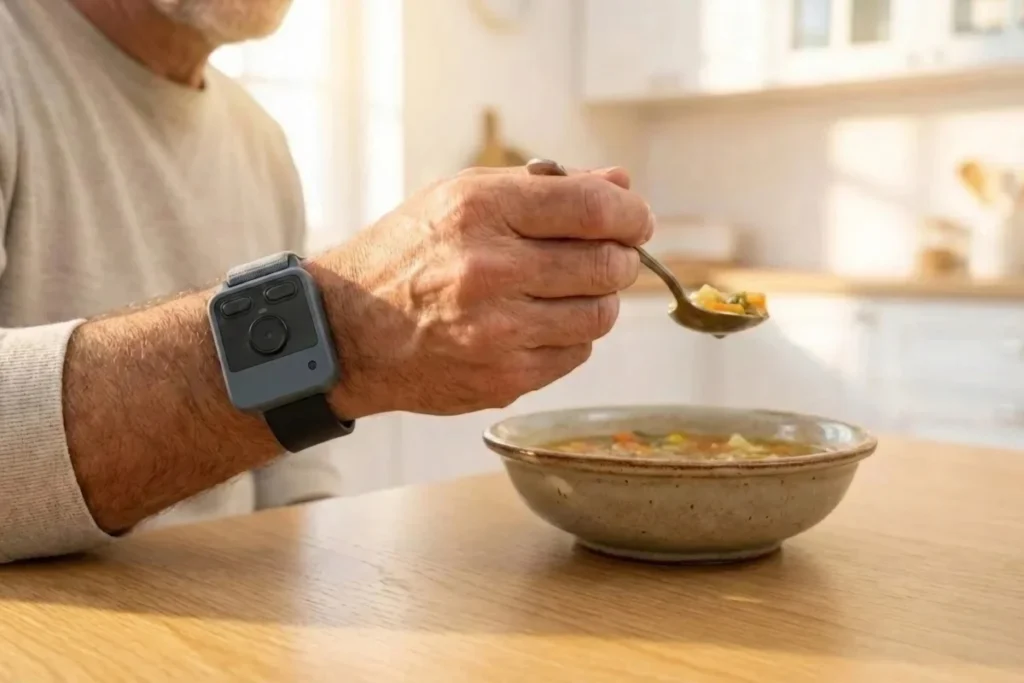
Encora’s device, a watch-like wristband, employs mechanical vibrations to modulate neural activity. Carballo elaborated on the mechanism: "We’re applying mechanical stimulus, basically vibration, to stretch receptors in the wrist, which tell your body where it is in space." These stretch receptors, known as mechanoreceptors, are sensory neurons embedded in muscles, tendons, and joints. When activated by the patterned vibration from the device, they send signals along peripheral nerves in the wrist. These signals then travel through the peripheral nervous system and into the central nervous system, ultimately reaching the same brain regions targeted by invasive surgical procedures like DBS for tremor control. By delivering precise, patterned sensory input, the device aims to "re-calibrate" or normalize the errant neural signals responsible for tremors.
This non-invasive neuromodulation represents a paradigm shift from traditional surgical interventions. While DBS requires drilling holes in the skull and implanting electrodes, Encora’s device offers a completely external, user-controlled solution. This dramatically reduces risks, eliminates recovery time, and significantly improves accessibility for patients who might not be candidates for or prefer to avoid surgery. The concept of using sensory input to influence motor control is rooted in neurophysiology, where afferent (sensory) pathways play a critical role in motor learning and coordination. Encora’s innovation leverages this inherent biological feedback system to provide therapeutic relief.
Rigorous Validation: Clinical Trials and FDA Clearance
The path from a functional prototype to an FDA-cleared medical device is long and arduous, requiring extensive testing and validation. After numerous hardware iterations, Encora Therapeutics embarked on a series of clinical trials to demonstrate the safety and efficacy of their device.
In 2022, the company conducted its first clinical trial, involving 20 Parkinson’s patients, in collaboration with MassGeneral Brigham. While this trial provided valuable insights, the subsequent strategic focus shifted more towards essential tremor.
A significant step was a 59-person trial conducted last year, where patients used the device at home for an extended period. This real-world usage study provided crucial data on usability, patient compliance, and long-term effectiveness in a natural environment. The results were compelling, with over 70 percent of patients reporting meaningful improvement in their tremor symptoms.
This was followed by a randomized controlled trial in 2024, involving 47 patients with essential tremor. Randomized controlled trials are considered the gold standard in clinical research, providing robust evidence of a treatment’s effectiveness compared to a control. Again, more than 70 percent of patients in the active treatment group experienced meaningful improvement. In another trial referenced in the original article, 78 percent of patients reported benefits after 90 days of home use, showcasing consistent positive outcomes.
These promising results formed the basis for Encora’s submission to the FDA for 510(k) clearance. The 510(k) pathway is for medical devices that are substantially equivalent to a legally marketed predicate device. This clearance signifies that the FDA has determined the device is safe and effective for its intended use, clearing the way for its commercial distribution. The February 2024 clearance for essential tremor marks the culmination of years of dedicated research, development, and clinical validation. "It’s been a long and difficult — very difficult — journey, but also very rewarding, especially when we get feedback from patients," stated Daniel Carballo, reflecting on the arduous process. "We hear stories from patients about how they’ve struggled with their condition and how much they benefit from this. It reminds us why we keep going."
Transforming Lives: Patient Impact and Future Outlook
The impact of Encora’s device on patients has been described as profound. Many users experience rapid benefits, often within moments of activating the device. Patient testimonials consistently highlight the life-changing nature of the technology, enabling them to regain the ability to perform tasks they had been unable to do for years. Simple actions like eating, drinking from a cup, writing, or engaging in hobbies that require fine motor control become possible again. The device empowers patients to reclaim independence and improve their overall quality of life. Some patients have reported using the device for extended periods, up to 12 to 14 hours a day, underscoring its utility and comfort.
With FDA clearance secured, Encora Therapeutics is now focused on scaling its operations to bring the device to a wider patient population. Immediate priorities include building a national sales force and working to secure coverage from insurance providers, which is a critical step in making any new medical technology accessible and affordable for patients. As production ramps up, the device will finally become available for patients who qualify, fulfilling the promise first glimpsed on the MIT stage.
Looking ahead, Encora Therapeutics envisions a broader application for its platform technology. The company intends to fulfill its original mission of helping patients with Parkinson’s disease manage their tremors. Furthermore, Carballo believes the approach holds promise for a "surprisingly long list of diseases," particularly other neurological movement disorders. The field of wearable neuromodulation is rapidly expanding, with research demonstrating therapeutic benefits across a diverse range of conditions. Encora’s success in essential tremor positions it as a leader in this burgeoning field, with the potential to develop solutions for myriad neurological challenges.
Broader Implications: A Platform for Neuromodulation and MIT’s Enduring Legacy
The journey of Encora Therapeutics from a classroom project to an FDA-cleared medical device underscores several broader implications for healthcare innovation, academic entrepreneurship, and the future of neuromodulation.
Firstly, it highlights the immense potential of academic institutions like MIT as incubators for disruptive technologies. The 2.009 course, designed to push students to develop functional prototypes, served as a crucial launchpad. The subsequent support from MIT’s entrepreneurial ecosystem demonstrates the critical role universities can play in bridging the gap between scientific discovery and real-world application. This model of innovation, where students are empowered to translate their ideas into tangible solutions, is vital for addressing complex societal challenges.
Secondly, Encora’s device represents a significant advancement in non-invasive neuromodulation. As the medical community increasingly seeks alternatives to pharmacological treatments with systemic side effects and invasive surgical procedures, external neuromodulation offers a compelling pathway. The ability to precisely target neural circuits through peripheral sensory stimulation, without the need for surgery, opens up new avenues for treating a wide array of neurological and psychiatric disorders. This approach could significantly reduce healthcare costs, improve patient compliance, and expand access to effective therapies.
Thirdly, the success with essential tremor provides a strong foundation for future research and development. The "platform technology" vision articulated by Carballo suggests that the underlying principles of patterned mechanical vibration could be adapted and optimized for various conditions, each with its unique neurological signature. This could include other forms of tremor, dystonia, or even conditions beyond movement disorders where neural circuit dysfunction plays a role.
The story of Encora Therapeutics is a testament to perseverance, scientific ingenuity, and the profound impact that dedicated individuals can have on human health. What began as a challenging classroom assignment, met with initial skepticism, has blossomed into a company poised to transform the lives of millions, reaffirming MIT’s legacy of fostering innovations that matter. The roaring ovation Michael received in 2017 now resonates with the quiet relief and renewed independence felt by patients worldwide, enabled by a simple, yet revolutionary, wristband.