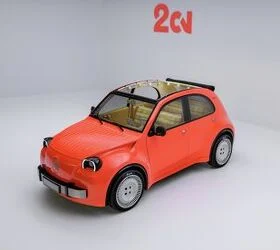
Citroën has reignited the spirit of a motoring legend, unveiling a concept that pays homage to the beloved 2CV, with plans for a production model to grace the European market by 2028. This modern interpretation, envisioned with a starting Manufacturer’s Suggested Retail Price (MSRP) of €15,000 (approximately $16,800 USD), aims to capture the essence of its predecessor while embracing the future of electric mobility.
The original Citroën 2CV, first introduced in 1948, was conceived in the post-World War II era as a solution for affordable and accessible transportation for a continent in recovery. Its utilitarian design, characterized by simplicity and robust engineering, made it an instant classic. Production of the 2CV continued for over four decades, with more than five million units rolling off assembly lines before production ceased in 1990. Its legendary status is cemented by its reputation for being exceptionally easy to repair, even with basic tools, and its remarkable ability to traverse rough terrain without compromising passenger comfort. Early models were powered by a modest air-cooled, 375cc flat-twin engine producing a mere 9 horsepower, a testament to its focus on economy and utility over performance.
The resurrected 2CV concept, while retaining the instantly recognizable and charming exterior silhouette, marks a significant departure in its powertrain. Moving away from its analog roots, the new 2CV is envisioned as an all-electric vehicle. However, it appears to be carefully preserving several key characteristics that defined its predecessor. These include a retractable cloth roof, offering an open-air driving experience reminiscent of the original, and a hinged panel at the base of the windscreen, designed to allow for natural ventilation.
A core tenet of the original 2CV was its lightweight construction, and Citroën aims to carry this philosophy forward. The company has set a target weight of just 1,000 kilograms (approximately 2,205 pounds) for the production model. This is an exceptionally low figure for contemporary vehicles, and it is particularly noteworthy for an electric vehicle, where battery weight often contributes significantly to the overall mass.
This emphasis on lightness inevitably raises questions regarding battery size and achievable range. It is anticipated that the 2CV will feature a smaller battery pack compared to Citroën’s current entry-level electric offering, the C3 crossover. Consequently, the electric 2CV is expected to deliver a maximum output substantially below 100 horsepower and a peak driving range that falls short of the C3’s 190-mile maximum capacity.
Concerns have been raised that the new 2CV might inadvertently become a more refined version of the Citroën Ami, a vehicle currently classified as a light quadricycle. The Ami, priced around €8,000, has a top speed of approximately 45 km/h (28 mph) and a claimed range of about 70 kilometers (45 miles) under ideal conditions. When fully occupied and laden with luggage, its practical range is estimated to be closer to 50 kilometers (30 miles), positioning it primarily as a novelty city car for short-distance urban travel.
For the resurrected 2CV to herald a genuine shift in electric mobility, it would ideally need to surpass the original model’s top speed of 64 km/h (40 mph). A more ambitious target would be to match the 112 km/h (70 mph) capability of later 2CV models equipped with the larger 602cc engine.
Achieving the original 2CV’s impressive range, however, appears to be an unlikely prospect. Despite its diminutive fuel tank, the original model could typically cover at least 480 kilometers (300 miles) on a single fill-up. Reports suggest that the concept EV is targeting a WLTP-rated range of approximately 160 kilometers (100 miles). Given the inherent optimism in WLTP figures, the real-world range in markets like the United States, which often see a 20% reduction, could be closer to 128 kilometers (80 miles). Such a range would likely confine the 2CV to a role as a local commuter vehicle, limiting its utility for longer journeys.
Citroën CEO Xavier Chardon articulated the brand’s vision for the new 2CV, stating, "Reinventing the 2CV isn’t about replicating a car from the past; it’s about reinventing what made it unique: its simplicity, its accessibility and the freedom it offered. With the 2CV Concept, we’re bringing that spirit into today’s world to make electric mobility simpler, more human and more desirable. The world has changed. But the idea remains the same: to make life more beautiful with Citroën."
While the design of the concept is widely praised, and the intention to offer an affordable vehicle that eschews excessive modern technology is commendable, the question remains whether simply reviving the 2CV’s aesthetic is sufficient. The aspiration to make "life more beautiful" is a noble pursuit, but there is a palpable demand for genuinely practical and affordable automobiles, rather than EVs that lean heavily on nostalgia.
The Volkswagen ID. Buzz serves as a cautionary tale. Modeled after the iconic Microbus, its high price point and perceived impracticality limited its appeal. Buyers expecting a family road trip vehicle were disappointed by a range that, at $61,500 starting price, was deemed insufficient at just over 370 kilometers (230 miles) between charges.
The new 2CV could face a similar challenge if Citroën fails to deliver a vehicle that caters to a broader range of needs. The current automotive landscape presents a paradox: manufacturers acknowledge the desire for inexpensive cars, yet often restrict access to this segment through exclusively electric vehicles with limited operational capabilities.
Alternatively, the 2CV could find success as a secondary vehicle for households that already possess a more capable car for extended travel. However, this would inherently restrict its market appeal and likely prevent it from achieving the sales figures of its illustrious predecessor.
Historical Context and Evolution of the 2CV
The genesis of the original 2CV can be traced back to a directive from Pierre Michelin in the 1930s, aiming to create a "umbrella on four wheels" for French farmers. The objective was to design a vehicle that could transport two farmers and a sack of potatoes at 60 km/h (37 mph) across a ploughed field without breaking the eggs in a basket. Development was interrupted by World War II, but the prototype, codenamed "TPV" (Toute Petite Voiture – Very Small Car), was hidden from the occupying forces. Post-war, the project was revived, and the 2CV was officially launched at the Paris Motor Show in 1948.
The 2CV’s design was revolutionary for its time. Its independent suspension, using long-travel coil springs, allowed for a remarkably smooth ride over uneven surfaces. The body panels were designed to be easily replaced, and the simple mechanics meant that many repairs could be performed by owners with minimal mechanical knowledge. Over its lifespan, the 2CV evolved through various iterations, with engine sizes increasing from the initial 375cc to 425cc and eventually the 602cc unit found in the final models.
Key Features of the Electric Concept
The modern 2CV concept aims to capture the spirit of its predecessor through several key design elements:
- Retractable Cloth Roof: A defining feature that offers an open-air driving experience.
- Hinged Windscreen Panel: Allowing for natural ventilation, harkening back to the original’s simplicity.
- Lightweight Construction: Targeting a curb weight of approximately 1,000 kg (2,205 lbs).
- Compact Dimensions: The concept measures a mere 375 cm (148 inches) in length, making it significantly smaller than most current vehicles.
Analysis of Implications and Market Position
The success of the electric 2CV hinges on its ability to strike a delicate balance between affordability, practicality, and nostalgic appeal. While the low projected price point is a significant draw, the limited projected range could be a substantial impediment, particularly in markets where longer journeys are commonplace.
The automotive industry is at a critical juncture regarding electric vehicle adoption. While advancements in battery technology are ongoing, the cost and range limitations of current EVs continue to be significant barriers for many consumers seeking affordable transportation. The 2CV, by aiming for a sub-€15,000 price point, has the potential to democratize electric mobility. However, if its practical range falls too far short of consumer expectations, it risks becoming a niche product, similar to the Ami, rather than a mass-market success.
The comparison to the Volkswagen ID. Buzz highlights the importance of aligning product features with consumer expectations and market demand. A vehicle designed for family road trips needs to offer sufficient range and practicality, regardless of its iconic heritage. Similarly, for the 2CV to succeed, it must offer more than just retro styling and a low entry price.
The potential for the 2CV to become an ideal secondary vehicle for households is a plausible scenario. For urban commuters or those with predictable, short daily drives, a limited range might be acceptable, especially if coupled with the convenience of home charging. However, this segmentation of the market will undoubtedly impact its overall sales volume and its ability to truly rival the original 2CV’s widespread adoption.
The Electric vs. Internal Combustion Debate
A recurring theme in discussions surrounding the new 2CV is the question of powertrain choice. One cannot help but wonder if a gasoline or hybrid variant, while potentially increasing the price by a few thousand euros, might have offered a more compelling value proposition in terms of range and versatility. Such a powertrain could have leveraged the 2CV’s design and heritage to compete effectively with affordable hybrid models like the Toyota Yaris Hybrid, offering attractive styling, unique features, and diminutive size.
However, the industry’s trajectory, particularly in Europe, is firmly set towards electrification. Citroën’s commitment to an electric 2CV suggests that the company views this as the most viable path to market by the projected 2028 launch date. The concept appears to be more than just a design exercise, signaling a near-production reality.
Looking Ahead: The Paris Motor Show and Beyond
The debut of the 2CV concept is widely believed to be a strategic move to generate anticipation ahead of the Paris Motor Show, suggesting that more detailed information about the vehicle will likely be revealed soon. As the official launch approaches, the automotive world will be keenly observing Citroën’s forthcoming announcements regarding specifications, final pricing, and market availability. The success of this iconic revival will ultimately depend on Citroën’s ability to translate nostalgic charm into practical, desirable, and truly accessible electric mobility for the modern era.
While the prospect of a new 2CV is exciting, and its design is undoubtedly appealing, the critical factor will be its real-world utility. The automotive industry has a clear mandate to produce more affordable and practical EVs, and the 2CV has the potential to be a significant contributor to this movement. However, the challenge lies in balancing the legacy of simplicity with the demands of modern electric vehicle technology. The world waits to see if Citroën can deliver on the promise of reinventing a legend for a new generation.