For over a century, the universe’s most energetic particles, known as cosmic rays, have captivated and confounded scientists. These incredibly powerful particles traverse the cosmos at extreme energies, far surpassing anything achievable in terrestrial accelerators. Despite extensive research spanning decades, fundamental questions about their origins, the mechanisms that accelerate them to such colossal speeds, and their propagation through interstellar space have largely remained enigmatic. Now, a significant breakthrough by researchers utilizing the Dark Matter Particle Explorer (DAMPE) space telescope has unveiled a crucial new clue. Their findings, meticulously detailed in the prestigious scientific journal Nature, reveal a universal feature shared by various types of primary cosmic ray nuclei, a discovery poised to profoundly enhance scientific understanding of these mysterious messengers from the deep universe.
The Enduring Mystery of Cosmic Rays: A Century of Exploration
Cosmic rays represent the highest energy particles ever observed in nature, carrying magnitudes more energy than those generated by even the most sophisticated particle accelerators on Earth, such as the Large Hadron Collider. Their extreme energies suggest they are forged in some of the most violent and cataclysmic events in the universe. Leading candidates for these cosmic accelerators include the shockwaves from supernova explosions, the powerful relativistic jets emanating from supermassive black holes at the centers of galaxies, and rapidly spinning neutron stars known as pulsars. Pinpointing the exact sources and the precise mechanisms of acceleration, however, has been an extraordinary challenge.
The journey to understand cosmic rays began in the early 20th century. In 1912, Austrian physicist Victor Hess made groundbreaking balloon flights, demonstrating that ionizing radiation increased with altitude, leading to the conclusion that a significant portion of this radiation originated from space. He termed this phenomenon "Höhenstrahlung," or "radiation from above," later renamed cosmic rays. Since then, an international scientific endeavor has sought to decipher their secrets, utilizing ground-based detectors, high-altitude balloons, and, increasingly, sophisticated space-based observatories. The primary difficulty in tracing their origins lies in their charged nature; as they travel through the galaxy, their paths are bent and distorted by interstellar magnetic fields, effectively erasing their directional memory and making it impossible to point back to their original sources directly. This necessitates indirect methods, such as studying their energy spectra and composition.
The DAMPE Mission: A Dedicated Explorer in Orbit
Launched on December 17, 2015, from the Jiuquan Satellite Launch Center in China, the DAMPE space telescope, also known by its Chinese name "Wukong" (after the mythical Monkey King), was specifically designed to address these profound questions. The mission’s primary objectives include investigating the nature of high-energy cosmic rays, searching for potential signatures of dark matter annihilation or decay, and precisely measuring the spectra of electrons, protons, and nuclei. DAMPE operates in a sun-synchronous orbit at an altitude of approximately 500 kilometers, continuously scanning the cosmos for these elusive particles.
The DAMPE collaboration is a significant international undertaking, with major contributions from various institutions. While primarily led by the Chinese Academy of Sciences, European partners, including the astrophysics group at the Department of Nuclear and Particle Physics (DPNC) at the University of Geneva (UNIGE), have played a pivotal role in its success. The telescope itself is a marvel of engineering, comprising four main detectors: a Plastic Scintillator Detector (PSD) for charge measurement and anti-coincidence, a Silicon-Tungsten Tracker (STK) for precise trajectory measurement and charge determination, a Bismuth Germanate (BGO) calorimeter for energy measurement, and a Neutron Detector (ND) for hadron-electron discrimination. This suite of instruments allows DAMPE to achieve unprecedented precision in measuring the energy and charge of incoming cosmic ray particles.
Unveiling a Universal Pattern: The "Spectral Softening"
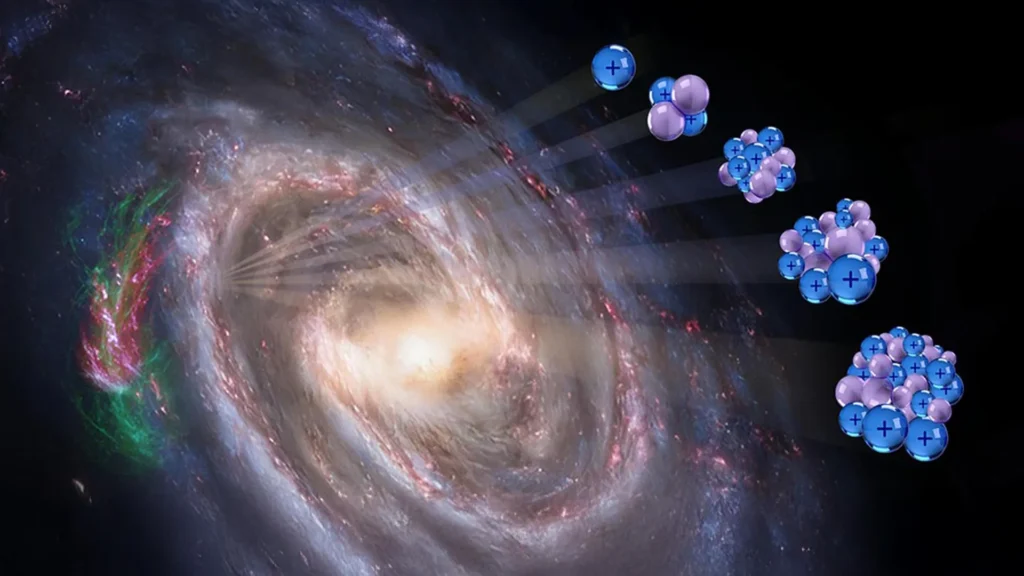
Through meticulous analysis of the highly precise data collected by DAMPE, researchers have uncovered a profound and universal pattern in the energy spectra of primary cosmic ray nuclei. This pattern extends across a wide range of nuclei, from the lightest protons (hydrogen nuclei) to the much heavier iron nuclei. The discovery centers on an effect termed "spectral softening."
Normally, the abundance of cosmic rays decreases as their energy increases – higher-energy particles are generally rarer. However, the DAMPE observations revealed that for every type of nucleus studied, the number of particles begins dropping significantly faster after reaching a specific energy threshold. This dramatic steepening of the decline, the "softening" of the spectrum, occurs consistently beyond a rigidity of approximately 15 TV (teraelectron-volts).
To understand the significance of "rigidity," it’s crucial to differentiate it from simple energy. Rigidity is defined as a particle’s momentum per unit charge (P/Z) and describes how strongly a particle’s path resists being bent by magnetic fields. In simpler terms, for a given magnetic field, a particle with higher rigidity will follow a straighter path than a particle with lower rigidity. This parameter is fundamental in theories of cosmic ray acceleration and propagation because magnetic fields permeate interstellar and intergalactic space, profoundly influencing the trajectories of charged particles.
"Cosmic rays are primarily composed of protons, but also of helium, carbon, oxygen, and iron nuclei," explains Andrii Tykhonov, associate professor at the DPNC in the Faculty of Science at UNIGE, and a co-author of the study. "These particles are also categorised according to their energy: low, up to a few billion electron-volts; intermediate, from a few billion to several hundred billion electron-volts; and high, from 1,000 billion electron-volts and beyond." The DAMPE findings indicate that this spectral softening isn’t tied to the absolute energy of the particle, nor to its energy per nucleon (energy divided by the number of protons and neutrons), but rather to its rigidity.
Ruling Out Alternatives with High Confidence
The observation that this same rigidity-dependent feature appears consistently across many different types of cosmic ray nuclei provides compelling evidence that the mechanisms governing cosmic ray acceleration and their subsequent movement through space are primarily controlled by rigidity. This finding strongly supports theoretical models that predict such a dependence.
Crucially, the DAMPE data largely rules out competing explanations that are based on energy per nucleon. For decades, some models proposed that the maximum energy achievable by cosmic rays, or the way they escape their acceleration sites, might depend on the energy per nucleon. However, the consistent spectral softening at a fixed rigidity across various nuclei contradicts these models. According to the researchers, the confidence level against these alternative, energy-per-nucleon-based models reaches an impressive 99.999%, effectively sidelining them in favor of rigidity-dependent theories. This level of statistical certainty underscores the robustness of the DAMPE discovery.
Geneva’s Pivotal Role: AI and Advanced Detector Technology
The University of Geneva’s astrophysics group, particularly the Department of Nuclear and Particle Physics (DPNC), played a crucial role in this groundbreaking discovery. Their contributions spanned several critical areas, showcasing their expertise in both data analysis and instrument development.
One key area of contribution involved the development of sophisticated artificial intelligence (AI) methods. The sheer volume and complexity of data collected by the DAMPE telescope necessitate advanced computational techniques to extract meaningful information. The Geneva team developed cutting-edge AI algorithms to reconstruct particle events detected by the telescope. These algorithms are essential for accurately identifying different types of particles, determining their incoming trajectories, and precisely measuring their energies, even amidst background noise and detector limitations. This computational prowess was fundamental to discerning the subtle, yet universal, pattern in the cosmic ray spectra.
Beyond algorithmic development, the Geneva group made significant contributions to the analysis of specific cosmic ray fluxes. They were instrumental in important measurements involving proton and helium fluxes, which constitute the most abundant components of cosmic rays. Furthermore, their expertise extended to the analysis of carbon nuclei data, expanding the scope of the universal pattern observation.
Perhaps one of the most tangible contributions from the Geneva group was their leadership in the development of a core instrument aboard DAMPE: the Silicon-Tungsten Tracker (STK). This detector is absolutely essential for the mission’s precision measurements. The STK is responsible for accurately tracing the paths of incoming cosmic ray particles as they pass through the telescope. By meticulously tracking these paths, scientists can determine the particle’s trajectory and, crucially, its electrical charge. The charge information is vital for identifying the type of nucleus (e.g., proton, helium, carbon, iron) and for calculating its rigidity. The STK’s high resolution and robust performance, largely attributable to the Geneva team’s efforts, were indispensable for achieving the precision required to uncover the spectral softening phenomenon.
Broader Impact and Astrophysical Implications
This discovery marks a significant advance in our century-long quest to understand how cosmic rays are created and how they propagate through the vast expanse of the galaxy. The new results place much tighter limits on existing models of particle acceleration in astrophysical sources.
Refining Acceleration Models: The observed rigidity-dependent spectral softening strongly suggests that the maximum energy to which particles can be accelerated in cosmic sources, or their escape from these sources, is fundamentally limited by their rigidity. In scenarios like diffusive shock acceleration (DSA) in supernova remnants, particles gain energy by repeatedly crossing the shock front. The maximum energy they can attain is often limited by the size of the acceleration region and the strength of the magnetic fields within it. Particles with higher rigidity are less confined by these fields and can more easily escape the acceleration zone. This could explain why the spectrum softens at a specific rigidity: particles exceeding this rigidity simply leak out of the accelerator before gaining more energy, or the acceleration mechanism itself becomes less efficient for them.
Understanding Galactic Propagation: The findings also improve our understanding of how these high-energy particles move through interstellar space. The Milky Way is permeated by complex magnetic fields. The rigidity of a cosmic ray particle dictates how it interacts with these fields. Particles with lower rigidity are scattered more frequently and effectively trapped within the galaxy for longer periods, undergoing more interactions. Higher rigidity particles, however, follow straighter paths and can escape the galaxy more readily. The observed softening could also be related to the "leakage" of cosmic rays from the galaxy itself. If particles above a certain rigidity can escape the galactic magnetic confinement more easily, their observed flux would naturally decrease more steeply.
Connecting to the Cosmic Ray "Knee": This discovery could also provide a crucial link to the well-known "knee" feature in the all-particle cosmic ray spectrum, an even more dramatic drop in flux observed at much higher energies, around a few PeV (petaelectron-volts). While the DAMPE softening is observed at 15 TV for individual nuclei, it offers a fundamental rigidity-dependent mechanism that could underlie or influence the higher-energy "knee." It suggests a common, rigidity-dependent physical process that limits the maximum energy of cosmic rays across various sources and compositions.
Implications for Dark Matter Searches: While not directly a dark matter discovery, a precise understanding of the cosmic ray background is absolutely critical for indirect dark matter searches. These searches look for anomalous signals in cosmic ray spectra (e.g., excesses of positrons, antiprotons, or gamma rays) that could be attributed to the annihilation or decay of dark matter particles. By better characterizing the astrophysical foreground of standard cosmic rays, scientists can more accurately identify potential dark matter signals, reducing uncertainties and improving the sensitivity of future experiments.
Future Outlook and Remaining Questions
This significant step forward opens new avenues for theoretical modeling and further observational studies. While the DAMPE results strongly advocate for rigidity-dependent mechanisms, the precise physical cause of the spectral softening still needs to be fully elucidated. Is it primarily a limit imposed by the acceleration process within the astrophysical sources, or is it predominantly a consequence of cosmic ray propagation and escape from the Milky Way’s magnetic confinement, or a combination of both?
Future missions and ongoing analyses from other high-energy observatories, such as the Alpha Magnetic Spectrometer (AMS-02) on the International Space Station, the Cherenkov Telescope Array (CTA), the Pierre Auger Observatory, and IceCube, will continue to build upon DAMPE’s findings. By combining data from different instruments and energy ranges, scientists hope to construct a more comprehensive picture of the cosmic ray ecosystem. The journey to fully unravel the century-old mystery of cosmic rays is far from over, but the DAMPE space telescope has undeniably provided one of the most compelling clues to date, bringing humanity closer to understanding the universe’s most powerful particles.