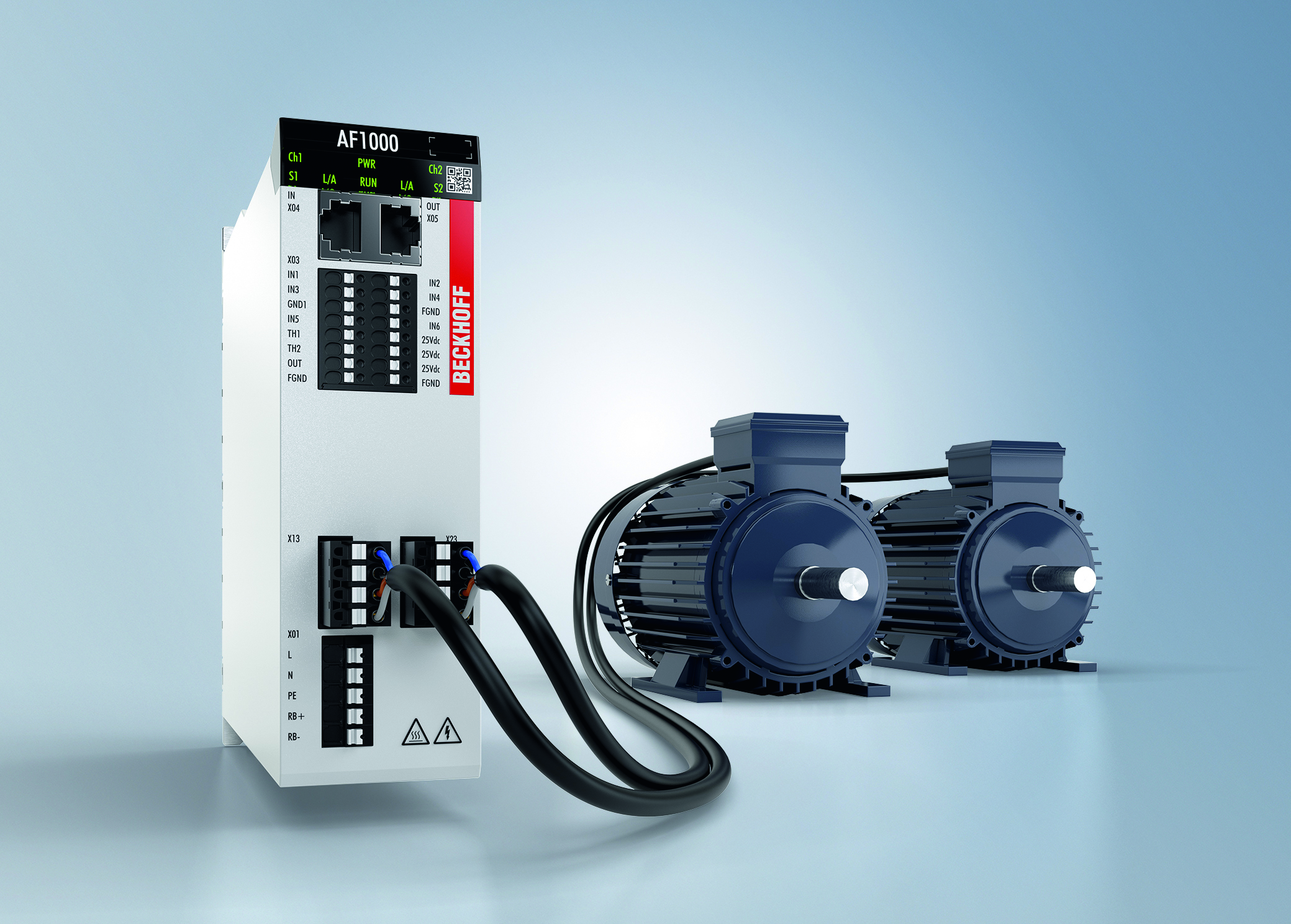
In a significant expansion of its motion control portfolio, Beckhoff Automation has unveiled the AF1000 variable frequency drive (VFD), a new solution specifically engineered to address the growing demand for cost-effective and highly integrated control in basic drive applications. This introduction marks a strategic move by Beckhoff to extend its renowned PC-based control philosophy and EtherCAT ecosystem to a broader spectrum of industrial tasks, offering a unified platform from high-performance servo control to fundamental motor regulation. The AF1000 is designed for applications such as conveyor systems, pumps, and fans, integrating seamlessly with the overarching TwinCAT automation system through EtherCAT, and crucially, incorporating the same advanced commissioning and diagnostic functions found in Beckhoff’s more sophisticated servo drive products.
A Unified Approach to Drive Technology: The AF1000’s Core Offering
The AF1000 represents Beckhoff’s commitment to providing scalable and holistic automation solutions. By integrating the new VFD into the TwinCAT environment via EtherCAT, the company ensures that users can manage diverse motion control needs—from complex multi-axis synchronization to simple speed and torque regulation—within a single, familiar software interface. This approach not only streamlines engineering workflows but also reduces the learning curve for operators already proficient in Beckhoff systems, fostering efficiency and consistency across an entire plant.
The drive’s design focuses on practical functionality and robust performance for its target applications. Variable frequency drives are essential components in modern industrial operations, primarily responsible for controlling the speed and torque of AC motors by varying the frequency and voltage of their power supply. This capability translates directly into significant energy savings, improved process control, reduced mechanical stress on equipment, and enhanced operational flexibility. For basic applications like those targeted by the AF1000, these benefits are paramount, contributing to lower operating costs and increased equipment longevity.
Technical Specifications and Versatility
The AF1000 is offered in two distinct versions, catering to different power supply configurations and application demands. The first version is designed for single-phase 240 V AC supply, providing a power range from 0.37 kW to 1.5 kW. This variant is particularly suitable for smaller-scale operations or regions where single-phase industrial power is more prevalent. The second, more powerful version, accommodates a three-phase supply up to 480 V AC, with a broader power range spanning from 0.37 kW up to 5.5 kW. This three-phase option is ideal for more demanding industrial environments and larger equipment where higher power output is required.
Both versions boast an impressive array of integrated components, signifying a compact and efficient design. These include an integrated control power supply, DC link capacitors, and a ballast circuit. The integrated control power supply is a crucial feature, eliminating the need for an external power source for the drive’s internal electronics. Instead, the control voltage is generated directly from the DC link, which is the rectified intermediate circuit voltage derived from the main power supply. DC link capacitors play a vital role in smoothing the DC voltage and storing energy, providing stability during transient load changes and enhancing the drive’s overall robustness. The inclusion of a ballast circuit, also known as a braking chopper or braking resistor, is particularly noteworthy. This component is designed to dissipate excess regenerative energy generated by the motor during deceleration, preventing overvoltage conditions in the DC link and allowing for controlled braking, thereby extending the life of the drive and connected machinery.
Further enhancing its versatility, the AF1000 is available as either a single-axis module or a two-axis module. The two-axis configuration offers a compact and cost-effective solution for controlling two independent motors from a single drive unit, which can be particularly advantageous in applications like multi-stage conveyor systems or synchronized pump operations. The drive supports a wide range of motor types without requiring feedback encoders, simplifying installation and reducing overall system cost. These include synchronous servomotors, asynchronous motors, and reluctance motors. The flexibility to operate these motors in either UF (Volts per Hertz) mode or with sensorless vector control allows users to choose the optimal control strategy based on their application’s precision and dynamic requirements. UF mode is typically simpler and suitable for applications where precise speed regulation under varying loads is not critical, while vector control offers better dynamic response and speed accuracy, even without a motor encoder.
The TwinCAT Advantage: Simplified Commissioning and Diagnostics
A cornerstone of Beckhoff’s automation philosophy is the TwinCAT software suite, which serves as the central engineering and runtime environment for all its control components. The AF1000 drive is commissioned using TwinCAT Drive Manager 2, the identical engineering tool utilized for Beckhoff’s high-performance servo drives. This commonality provides a significant advantage for users, as it eliminates the need to learn new software tools or adapt to different programming paradigms when integrating basic VFDs alongside more complex motion control solutions.
This unified engineering environment offers several benefits:
- Reduced Learning Curve: Engineers familiar with Beckhoff’s servo drives can seamlessly transition to configuring the AF1000, minimizing training time and deployment effort.
- Consistent Workflow: A standardized commissioning process ensures consistency across different machine types and automation tasks, enhancing reliability and reducing potential errors.
- Centralized Diagnostics: The integration allows for comprehensive diagnostic functions to be accessed and managed from a single point within TwinCAT. This capability provides real-time insights into drive performance, motor status, and potential issues, enabling proactive maintenance and minimizing downtime. This level of integrated diagnostics, often reserved for higher-end drives, is a significant differentiator for the AF1000 in the basic VFD market.
- Scalability: The ability to manage both basic and advanced motion tasks within the same software framework provides unparalleled scalability for system designers, allowing them to build automation solutions that can easily adapt to future requirements without overhauling their entire control architecture.
Beckhoff’s Strategic Expansion in the Industrial Automation Landscape
The introduction of the AF1000 is not merely a product launch; it signifies a strategic move by Beckhoff Automation to solidify its position as a comprehensive provider of industrial automation solutions. Beckhoff has long been recognized as a pioneer in PC-based control technology and the developer of EtherCAT, a high-performance, real-time Ethernet fieldbus system. Their existing product range excels in complex, high-precision motion control applications, often involving robotics, machine tools, and intricate manufacturing processes.
However, a substantial segment of the industrial market comprises "basic" applications where the full capabilities of advanced servo drives might be overkill, both technically and financially. Historically, Beckhoff customers requiring VFDs for these simpler tasks might have turned to third-party providers, leading to fragmented control architectures and potential integration challenges. The AF1000 directly addresses this gap, offering a Beckhoff-native solution that aligns with the company’s core principles of openness, scalability, and integration.
A spokesperson for Beckhoff, in an inferred statement reflecting the company’s philosophy, might emphasize: "Our commitment at Beckhoff has always been to provide a unified, scalable platform for all automation tasks. With the AF1000, we are extending the benefits of our PC-based control and EtherCAT ecosystem to basic drive applications, ensuring that our customers can achieve optimal performance and efficiency across their entire operation, from the most complex servo movements to fundamental conveyor systems, all managed within the familiar TwinCAT environment."
This expansion positions Beckhoff to capture a larger share of the global VFD market, which continues to grow due to increasing industrialization, demand for energy efficiency, and the ongoing adoption of Industry 4.0 principles. According to various market reports, the global VFD market is projected to reach significant valuations in the coming years, driven by factors such as stricter energy efficiency regulations, the modernization of industrial infrastructure, and the expansion of manufacturing capabilities worldwide. By offering a product like the AF1000, Beckhoff is directly tapping into this growth, providing an integrated solution that meets both performance and cost criteria.
Broader Impact and Implications for Industry 4.0
The AF1000’s introduction holds significant implications for the broader industrial automation landscape and the ongoing push towards Industry 4.0. The concept of the "smart factory" relies heavily on seamless connectivity, real-time data exchange, and integrated control across all levels of production.
- Enhanced Connectivity and Data Flow: EtherCAT’s real-time capabilities ensure that the AF1000 can participate fully in a networked automation environment. This means that data from basic applications (motor speed, current, fault conditions) can be seamlessly integrated into higher-level control systems, SCADA, or even cloud-based analytics platforms. This robust data flow is critical for predictive maintenance, process optimization, and overall operational transparency—key tenets of Industry 4.0.
- Simplified System Architecture: By offering an integrated VFD that speaks the same "language" (EtherCAT) and uses the same engineering tools (TwinCAT) as other Beckhoff components, system integrators can design more cohesive and less complex architectures. This reduces wiring, configuration time, and potential points of failure, leading to more robust and easier-to-maintain systems.
- Energy Efficiency and Sustainability: VFDs are fundamental to energy conservation in industrial settings. By precisely controlling motor speed, they eliminate the energy waste associated with running motors at full speed when not required. The AF1000, by making advanced control accessible for basic applications, will contribute to broader energy savings across various industries, aligning with global sustainability goals and regulatory pressures for reduced energy consumption.
- Cost-Effectiveness and Accessibility: For small to medium-sized enterprises (SMEs) or facilities with budget constraints, the AF1000 offers an economical path to modernizing their basic drive applications. Its integrated features and streamlined commissioning process mean that these businesses can implement advanced control without incurring the high costs or complexity typically associated with high-end motion systems. This democratization of advanced control capabilities is vital for the widespread adoption of smart manufacturing practices.
- Future-Proofing Automation Systems: Investing in a system based on an open, real-time communication standard like EtherCAT and a unified software platform like TwinCAT provides a degree of future-proofing. As technology evolves, systems built on such foundations are better positioned to integrate new functionalities, sensors, and AI-driven analytics without requiring complete overhauls.
Timeline and Chronology of Beckhoff’s Motion Control Evolution
Beckhoff’s journey in motion control has been characterized by continuous innovation and a commitment to integrated, PC-based solutions.
- Early 2000s: Beckhoff pioneered PC-based control, moving away from proprietary PLC hardware towards open, industrial PCs running TwinCAT. This laid the groundwork for software-driven automation.
- 2003: The introduction of EtherCAT revolutionized industrial communication, providing a real-time, high-performance Ethernet solution that significantly enhanced motion control synchronization and distributed I/O capabilities.
- Mid-2000s onwards: Beckhoff steadily expanded its range of servo drives and motors, leveraging EtherCAT to offer highly dynamic and precise motion solutions for complex machinery. This included the AX5000 and AX8000 series servo drives, renowned for their performance and integration with TwinCAT.
- Present Day (AF1000 Launch): The unveiling of the AF1000 VFD represents a natural evolution, extending the proven benefits of the Beckhoff ecosystem to the foundational layer of industrial motion control. This fills a crucial gap in their product line, ensuring that Beckhoff can now offer an integrated solution for virtually any drive application, from the simplest to the most demanding. This launch underscores the company’s strategy to provide a single, consistent automation platform for all industry needs.
Concluding Thoughts
The Beckhoff AF1000 variable frequency drive is more than just a new product; it is a testament to Beckhoff’s enduring vision for integrated industrial automation. By bringing the sophistication of TwinCAT and the performance of EtherCAT to basic drive applications, Beckhoff is empowering industries to achieve higher levels of efficiency, reliability, and intelligence across their entire operational footprint. The AF1000 ensures that even the most fundamental motion tasks can be seamlessly incorporated into a unified, smart factory environment, contributing significantly to energy conservation, reduced operational costs, and the accelerated adoption of Industry 4.0 principles worldwide. This strategic move solidifies Beckhoff’s position as a holistic provider in the competitive global automation market, offering scalable solutions that cater to the diverse and evolving needs of modern manufacturing and process industries.