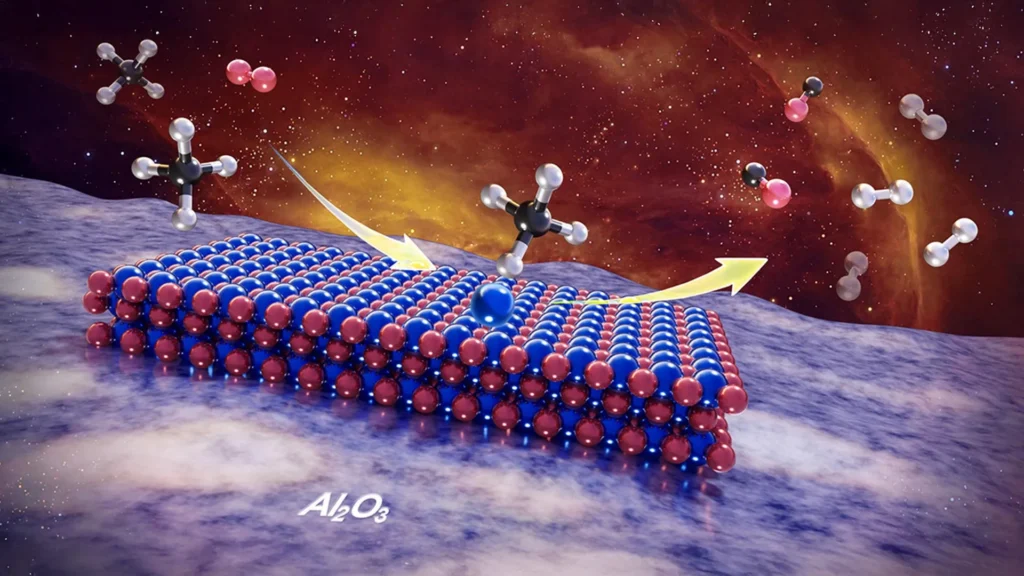
The partial oxidation of methane (POM) has long been recognized as a highly promising industrial pathway for the synthesis of syngas, a crucial mixture of carbon monoxide (CO) and hydrogen (H₂) that forms the fundamental building block for countless fuels and chemicals. For decades, the scientific community has operated under the assumption that metallic nickel (Ni) nanoparticles were the primary active centers driving this vital reaction. However, this widely held belief harbored a significant and persistent unresolved question: the metallic nickel observed after a reaction could merely be a secondary formation, a consequence of nickel oxide being reduced by syngas itself at the high temperatures inherent to the process, rather than representing the true catalytic species responsible for initiating the transformation. This ambiguity presented a major hurdle in optimizing catalysts for efficiency and durability, hindering the full potential of POM as a sustainable industrial process.
The Quest for Syngas: A Global Industrial Imperative
Syngas, short for synthesis gas, is an indispensable commodity in modern industrial chemistry. Its applications span a vast array of sectors, from the production of methanol, a versatile chemical intermediate and fuel, to the synthesis of ammonia for fertilizers, and the generation of hydrogen, a clean energy carrier. Furthermore, syngas is the cornerstone of the Fischer-Tropsch process, which converts gas into liquid fuels, offering a pathway to diversify energy sources. The global demand for syngas continues to rise, driven by population growth, industrial expansion, and the increasing need for cleaner energy solutions.
Currently, the dominant industrial methods for syngas production include Steam Methane Reforming (SMR) and Dry Methane Reforming (DMR). While effective, these processes are highly endothermic, requiring substantial energy input and operating at extremely high temperatures (typically 700-1000 °C), making them energy-intensive and costly. SMR also produces significant amounts of CO₂, contributing to greenhouse gas emissions. POM, in contrast, is an exothermic reaction, meaning it releases heat rather than consuming it, and operates at somewhat lower temperatures, offering a potentially more energy-efficient and environmentally favorable alternative. The primary challenge for POM, however, has been the development of stable, highly active, and selective catalysts that can withstand the harsh reaction conditions without deactivation, particularly from carbon deposition (coking), and whose true active sites are fully understood.
Nickel: A Double-Edged Sword in Catalysis
Nickel catalysts have historically been favored for methane reforming reactions due to their relatively low cost, abundance, and initial high activity compared to precious metals like platinum or rhodium. However, their industrial application in POM has been plagued by issues of stability and selectivity, often leading to rapid deactivation. A major part of this challenge stemmed from the enigmatic nature of nickel’s active state under the dynamic, high-temperature redox conditions characteristic of POM.
The catalyst environment during POM is far from static. Nickel can undergo significant transformations, changing both its oxidation state (e.g., from metallic Ni to nickel oxide, NiO, and vice-versa) and its atomic arrangement (structure) as it interacts with the reactant gases (methane and oxygen) and product gases (syngas). These dynamic changes, occurring simultaneously and rapidly, have historically been exceedingly difficult to track in detail using conventional ex situ (after reaction) characterization techniques. Such methods provide only a snapshot of the catalyst’s state after it has been removed from the reaction environment, potentially missing the actual active structure that exists only during the catalysis. This limitation has made it incredibly challenging to definitively determine the true structure responsible for the desired syngas production, leaving catalyst design largely a process of trial and error rather than rational engineering.
A Pivotal Discovery: Dynamic Reconstruction During Reaction
The long-standing mystery surrounding nickel’s active state in POM has finally been elucidated by a groundbreaking study published recently in the prestigious journal Nature Catalysis. This research provides unprecedented atomic-scale insight into the catalytic process, revealing that highly active structures are not pre-existing stable entities but rather form in situ – meaning directly within the reaction environment – as the surface of nickel oxide undergoes reconstruction during the POM reaction. This revelation underscores the critical importance of observing catalysts while they are actively operating under realistic reaction conditions, a methodology known as operando or in situ characterization.
The pioneering research was a collaborative effort, spearheaded by a team of distinguished scientists. Profs. Tao Zhang, Aiqin Wang, and Xiaoyan Liu from the Dalian Institute of Chemical Physics (DICP) of the Chinese Academy of Sciences (CAS) led the investigation. They were joined by Prof. Wei Liu, also from DICP, Prof. Tao Yang from Xi’an Jiaotong University, and Prof. Graham J. Hutchings, a world-renowned expert in catalysis from Cardiff University. Their combined expertise in materials science, catalysis, and advanced characterization techniques was instrumental in achieving this significant breakthrough.
To investigate the intricate process of POM, the team meticulously prepared a novel Ni/Al₂O₃ catalyst. A key aspect of its design was its remarkably low nickel content, containing only 0.8 weight percent (wt%) Ni. This was achieved using a sophisticated microemulsion method, a technique known for its ability to produce highly dispersed, uniformly sized nanoparticles, which are crucial for maximizing catalytic efficiency even with minimal active material. Despite its comparatively minuscule nickel loading, the catalyst exhibited an exceptionally strong performance during the POM reaction. It achieved an impressive 92% conversion of methane, while simultaneously maintaining high selectivities for CO and H₂ at 87.0%. Crucially, the H₂/CO molar ratio remained remarkably stable at approximately 2.0, which is the ideal stoichiometric ratio for many downstream syngas applications, such as methanol synthesis. This initial performance data immediately signaled that something unique was at play with this low-loading catalyst.
Engineering Efficiency: The Microemulsion Advantage
The selection and preparation method of the catalyst proved to be a critical factor in the success of this study. The microemulsion method, unlike conventional impregnation techniques, allows for the precise control over the size and dispersion of metal nanoparticles within a support material, such as alumina (Al₂O₃). In this method, a stable mixture of oil, water, and surfactant creates nanoscale "microreactors" where metal precursors can be reduced to form ultrafine, highly uniform nanoparticles. This superior dispersion ensures that a maximum number of active sites are exposed to the reactants, leading to enhanced catalytic activity per unit of metal. For a resource like nickel, while abundant, minimizing its usage has economic and environmental benefits, especially when considering the overall lifecycle of catalyst production and disposal.
The 0.8 wt% Ni/Al₂O₃ catalyst, prepared via this advanced microemulsion route, showcased an unexpected level of activity. The high methane conversion and syngas selectivity at a stable H₂/CO ratio are direct indicators of an efficient and well-controlled catalytic process. Such performance at low metal loading challenges conventional wisdom that often correlates higher metal content with higher activity. It suggested that the intrinsic activity of each nickel atom, or rather the specific atomic arrangements formed, was exceptionally high.
Dispelling Myths: Performance Beyond Expectations
One of the most striking and counter-intuitive findings from the study was the almost complete absence of detectable metallic Ni in the catalyst after the reaction had concluded. This observation directly contradicted the long-held assumption that metallic nickel was the primary active site. Despite this lack of post-reaction metallic Ni, the catalyst’s overall performance was not only robust but also remarkably comparable to that of an 8.0 wt% Ni/Al₂O₃ catalyst produced through the more traditional impregnation method. This comparison is profound, as the microemulsion catalyst achieved similar results with only one-tenth the amount of nickel, representing a significant leap in resource efficiency and cost reduction.
To further validate their findings and pinpoint the unique attributes of their catalyst, the researchers conducted several crucial comparative experiments. They evaluated another 0.8 wt% Ni/Al₂O₃ material, but this time prepared using the same impregnation method as the 8.0 wt% catalyst. Under identical reaction conditions, this impregnated low-loading catalyst failed to effectively carry out the desired POM reaction, instead exhibiting only methane combustion activity, producing CO₂ and H₂O – an undesired outcome for syngas production. This stark contrast unequivocally demonstrated that the preparation method and the resulting catalyst morphology, not just the nickel content, were paramount in determining the catalytic pathway.
Furthermore, the team observed that even if metallic Ni nanoparticles were present at the beginning of the reaction in their microemulsion catalyst, they were quickly oxidized into the NiO phase under the high-temperature, oxidative POM conditions. This provided additional evidence against the persistent metallic Ni active site hypothesis. Yet, the puzzle was not fully solved by simply identifying NiO. A pre-formed pure-phase NiO catalyst, when tested under the same conditions, showed no POM activity whatsoever. Instead, it exclusively catalyzed the complete oxidation of methane, again leading to unwanted CO₂ and H₂O. These comparative results were critical: neither metallic nickel alone, nor bulk nickel oxide alone, was the answer. The true active site had to be something more subtle, something dynamic, and specifically generated under the reaction conditions.
Atomic Revelations: The [Ni1O4Ni4] Structural Unit
The breakthrough came with a closer examination of the catalyst surface during the actual reaction using advanced in situ characterization techniques. These sophisticated methods allowed the researchers to observe the catalyst’s atomic structure as it was actively transforming methane into syngas. During the reaction, they successfully captured the in situ formation of a specific, reconstructed structural unit on the NiO(100) surface. This novel motif was identified as a [Ni1O4Ni4] unit, indicating a precise arrangement of nickel and oxygen atoms that forms dynamically on the surface of the nickel oxide lattice.
To understand how this newly formed structure facilitated catalysis, the team employed Density Functional Theory (DFT) calculations. DFT is a powerful computational quantum mechanical method used in physics and chemistry to investigate the electronic structure (or nuclear structure) of many-body systems, particularly atoms, molecules, and condensed phases. These calculations provided atomistic-level insights into the reaction mechanism. The DFT results indicated that this reconstructed [Ni1O4Ni4] motif significantly lowers the energy barrier required to break the C-H bonds in methane, which is widely recognized as one of the most energetically demanding and rate-limiting steps in activating the methane molecule for subsequent reactions. The calculated activation barrier for this critical step on the reconstructed surface was found to be a remarkably low 12.5 kcal·mol⁻¹.
This value stood in stark contrast to the activation barrier calculated for the intact, unreconstructed NiO(100) surface, which was a much higher 38.5 kcal·mol⁻¹. Even more compelling, the barrier for the metallic Ni(111) surface, previously thought to be the active site, was calculated at 15.7 kcal·mol⁻¹, still considerably higher than that of the newly identified reconstructed NiO structure. This substantial kinetic advantage – meaning the reaction proceeds much faster and more easily on the reconstructed surface – provided compelling theoretical support for the experimental observations. It strongly reinforced the conclusion that this dynamically formed, reconstructed [Ni1O4Ni4] structural unit is, in fact, the true active center responsible for driving the partial oxidation of methane.
Expert Perspectives and Broader Implications
The combined weight of experimental observations and theoretical calculations paints a clear picture: the catalytic activity for POM does not simply arise from bulk metallic nickel or ordinary, static nickel oxide. Instead, it emerges from a specific, dynamically formed atomic structure that is only present and active while the reaction is taking place. This paradigm shift in understanding has profound implications for the field of catalysis.
Prof. Liu, a lead researcher on the study, encapsulated the significance of their findings: "Our study highlights the critical role of in situ characterization in identifying dynamic active structures under reaction conditions. Dynamic reconstruction enables low-loading catalysts to achieve high performance, offering new opportunities for the rational design of efficient catalysts while reducing reliance on high metal loadings." This statement underscores not only the scientific breakthrough but also its practical ramifications.
The implications for industrial syngas production are substantial. By identifying the true active site, researchers and engineers can now develop more targeted and efficient nickel-based catalysts. This understanding paves the way for designing catalysts that actively promote the formation and stabilization of these reconstructed NiO surfaces, rather than focusing on metallic nickel content. The ability to achieve high performance with significantly lower nickel loadings translates directly into several tangible benefits:
- Cost Reduction: Nickel, while cheaper than noble metals, still contributes significantly to catalyst manufacturing costs. Reducing the required amount of nickel by a factor of ten offers substantial economic savings for industrial processes.
- Resource Efficiency: Lower metal usage aligns with principles of green chemistry and sustainable resource management, reducing the overall environmental footprint of catalyst production.
- Enhanced Stability and Durability: A clearer understanding of the active site can lead to catalysts that are less prone to deactivation mechanisms like coking or sintering, leading to longer operational lifetimes and reduced downtime for industrial plants.
- Improved Selectivity: By fine-tuning the catalyst to favor the formation of the [Ni1O4Ni4] structure, it may be possible to further enhance the selectivity towards syngas, minimizing the production of undesirable byproducts like CO₂.
- Greener Processes: More efficient catalysts contribute to overall process optimization, potentially leading to lower energy consumption and reduced emissions in the syngas production chain.
Beyond the specific application to POM, this research champions a broader philosophical shift in catalyst design. The emphasis moves from static, pre-defined active sites to understanding dynamic, operando structures that emerge under reaction conditions. This approach will undoubtedly influence research across various catalytic systems, particularly those involving redox reactions or those operating under harsh, fluctuating environments. It underscores the necessity of employing advanced in situ spectroscopic and microscopic techniques to capture these fleeting but critical intermediate structures. The success of this study will likely spur further investment and innovation in operando characterization methodologies, pushing the boundaries of what is observable at the atomic scale during catalysis.
Conclusion: A New Era for Catalyst Science
The revelation of the dynamic [Ni1O4Ni4] structural unit as the true active center in the partial oxidation of methane marks a significant milestone in catalysis research. By definitively answering a long-standing scientific puzzle, the Dalian and Cardiff teams have not only deepened our fundamental understanding of nickel catalysis but have also provided a clear pathway for the rational design of more efficient, cost-effective, and sustainable catalysts for syngas production. This breakthrough promises to usher in a new era for industrial chemistry, where process optimization is driven by atomic-level insights into dynamic catalytic phenomena, ultimately contributing to a more sustainable and resource-efficient future. The implications extend far beyond methane oxidation, setting a new standard for how researchers approach the complex and often mysterious world of catalytic reactions.