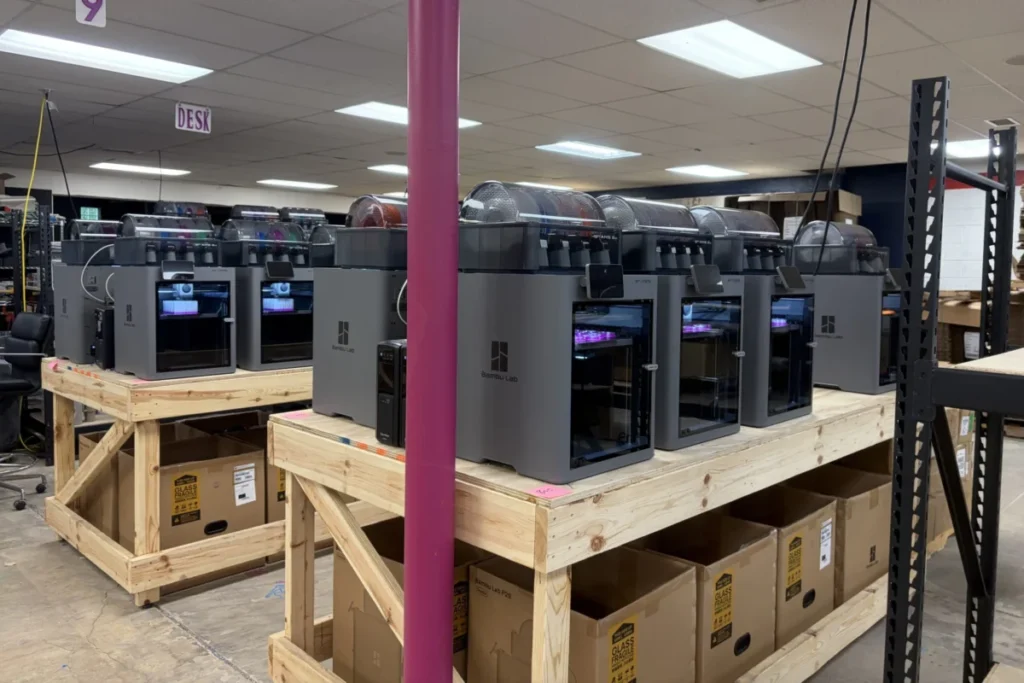
The journey of Daisy Makes, a burgeoning cake pop tool manufacturer based in Kent, Ohio, is a compelling narrative of entrepreneurial innovation, leveraging cutting-edge 3D printing technology to disrupt a niche market. What began as a personal endeavor to streamline a home-based cake pop business has blossomed into a significant operation, housing an impressive fleet of over 200 3D printers, with 173 currently in full production and an additional 60 undergoing installation. This remarkable expansion underscores the transformative power of additive manufacturing in empowering small businesses and redefining production processes.
The genesis of Daisy Makes can be traced back to Amy Mucha’s passion for baking. In 2016, Mucha, a high school math teacher with a flair for confectionery, started Daisy Pops from her home kitchen, creating and selling meticulously crafted cake pops to friends, neighbors, and her students. The delectable treats quickly gained popularity within her local community, prompting the formal establishment of Daisy Pops in 2018. As demand surged, Mucha enlisted the help of friends, family, and former students to manage the increasing volume of bulk orders for various events and holidays.
The turning point for Daisy Pops, and subsequently for the creation of Daisy Makes, arrived in 2021. By this time, the business had achieved nationwide reach, allowing Mucha to transition from her teaching career to focus on the bakery full-time. She actively participated in baking conferences, harboring aspirations of opening her own brick-and-mortar bakery. As the scale of nationwide orders grew, Mucha and her team began exploring innovative methods to enhance production efficiency. It was during this period that her husband, Nate Mucha, a dedicated 3D printing enthusiast, conceived the idea of creating custom molds using his own Bambu Lab 3D printer.

The initial prototypes were designed from hand-drawn sketches using Autodesk Fusion software and subsequently 3D printed with food-grade PLA+ filament via Bambu Studio Slicer. These 3D-printed molds proved to be a game-changer. Instead of the time-consuming process of manually rolling and shaping dough, the Daisy Pops team could now achieve their desired cake pop shapes with unprecedented speed and consistency. Building upon this success, Amy and Nate Mucha further refined their 3D printing applications by designing and producing "poppers." These innovative tools, used in conjunction with the molds, allowed the team to fill them with soft dough and then push it through the molds, eliminating the need for individual shaping. The scope of 3D-printed production quickly expanded to include other essential tools such as trays for organized storage and display stands for finished products.
The Evolution of Daisy Makes: From Niche Tool to Industry Leader
The year 2023 marked another significant milestone with the opening of the first Daisy Pops bakery in Kent. Concurrently, Mucha began to recognize a broader market demand for her innovative cake pop tools. She started selling starter kits online, each containing a selection of molds in various sizes, a miniature rolling pin, and a multi-sided tray. The overwhelming success of these kits solidified Mucha’s realization that a substantial gap existed in the baking market for specialized cake pop molds. Leveraging her background as a geometry teacher, she meticulously designed and 3D printed a diverse array of unique molds, catering to seasonal themes and holidays, such as Halloween ghosts and Thanksgiving turkeys.
The enthusiastic reception of these uniquely shaped molds from her audience led to a pivotal business decision. The sale of molds began to outpace that of cake pops, signaling a clear shift in market demand. In response, Mucha established Daisy Makes in 2024 as a dedicated manufacturer of cake pop tools, separating it from the original cake pop business. This strategic move paved the way for further expansion, culminating in the relocation of Daisy Makes to its own dedicated production facility in 2025.

A Sophisticated Print Farm: The Engine of Innovation
The current Daisy Makes facility in Kent represents a significant upgrade from Mucha’s home-based operations. While larger, faster, and equipped with a more substantial workforce and advanced machinery, the core production principles remain consistent: an entirely online ordering system, in-house packaging, an efficient 7-8 day shipping turnaround, unique designs originating from hand sketches, and, crucially, fused filament fabrication (FFF) 3D printing.
The heart of the Daisy Makes operation is its impressive print farm, comprising over 200 Bambu Lab PS2 and H2D 3D printers. These machines are augmented with AMS 2 Pro automatic material systems, enabling seamless switching between a spectrum of colored filaments. This multi-color capability is instrumental in the product line, as standard molds are now offered in four distinct sizes, each identified by a specific color: orange, purple, blue, and green. Importantly, each size is engineered to maintain a consistent volume capacity.
This sophisticated 3D printing infrastructure empowers Daisy Makes to fulfill "print-to-order" custom mold requests for individual customers. While standard mold sizes are produced in bulk, custom orders are meticulously printed using white filament, with each design and production run tailored to the specific requirements of the client.

The design process itself is a testament to collaborative innovation. Designs are either born from collaborations with other cake pop businesses or are the creative output of Nate Mucha, now the lead designer at Daisy Makes, originating from his hand-drawn sketches. These 2D concepts are then digitized using Adobe Illustrator before being translated into 3D models within Autodesk Fusion. Subsequently, Bambu Studio Slicer is employed to convert these 3D models into printable presets, which also provide crucial estimates for printing time and filament consumption per run. The facility currently operates one to two printing cycles per day, with each cycle spanning approximately 8 to 10 hours. A single build plate is optimized to accommodate eight molds and six to seven trays, resulting in an estimated daily output of around 720 molds.
Maintaining such a large and complex fleet of printers requires dedicated internal expertise. Daisy Makes manages all printer maintenance and refurbishment in-house, with a specialized team of employees consistently working to keep the machines in optimal condition. Furthermore, Amy Mucha maintains an additional 54 Bambu Lab printers at her residence, actively utilized for the development of new products and for undertaking specialized projects.
Following the printing process, every cake pop tool undergoes a rigorous manual inspection and cleaning within the facility. Dedicated areas are designated for filament storage, individual packaging (also performed by hand), and shipping logistics, managed in partnership with UPS. The facility also houses two substantial refrigerators stocked with Daisy Makes’ own dough, chocolate, and other baking ingredients, a product line introduced to their website in 2025, further solidifying their "one-stop shop" offering.
A Trajectory of Exponential Growth and Future Aspirations

As of August 2026, Daisy Makes has proudly fulfilled its 100,000th order, a significant milestone that underscores its consistent and impressive growth trajectory since its inception in 2024. Looking ahead, Mucha harbors ambitious plans for Daisy Makes, including the aspiration to become an independent filament distributor. This strategic objective is being pursued through active engagement and discussions with local filament suppliers and additive manufacturing companies. Beyond this, Daisy Makes is also exploring avenues for expanding its current facility and securing physical retail placements for its cake pop tools in home and appliance stores.
Mucha remains committed to sustaining the company’s robust online presence and fostering ongoing collaborations with other bakeries and social media influencers. Concurrently, she is actively involved in her third entrepreneurial venture, the fourth annual "What’s Popping Con." This unique event is specifically curated for cake pop artists, aspiring bakers, and small business owners, providing a platform for knowledge sharing, skill development in areas such as baking, decoration, and social media marketing, and fostering a collaborative community within the cake pop industry. The success of Daisy Makes serves as a powerful testament to how entrepreneurial vision, coupled with the strategic adoption of advanced manufacturing technologies like 3D printing, can lead to remarkable business growth and innovation.