In the spring of 2024, Manu Srivastava, a doctoral candidate at the Massachusetts Institute of Technology (MIT), received an unsolicited email that would eventually bridge the gap between high-level theoretical physics and secondary education. The message came from a group of ambitious high school students in India who sought technical guidance for an international science competition. While graduate students at prestigious institutions like MIT are frequently inundated with requests for mentorship—often through commercial agencies—this specific inquiry stood out for its sincerity and intellectual depth. The students were aiming to enter the 13th annual Beamline for Schools (BL4S) competition, an elite global contest organized by CERN, the European Organization for Nuclear Research.
Months of rigorous collaboration followed that initial contact. Under Srivastava’s mentorship, the students, organized as "Team attoPION," successfully navigated a selection process that saw them emerge as one of only five winning teams from a record-breaking field of 712 entries. Representing 89 countries and involving more than 4,500 students, the competition is widely regarded as the most prestigious of its kind in the world. For Team attoPION, the victory resulted in a two-week residency at CERN’s headquarters in Geneva, Switzerland, where they were granted the rare opportunity to utilize a professional particle accelerator beamline to conduct original research.
The Genesis of Team attoPION and the Role of Mentorship
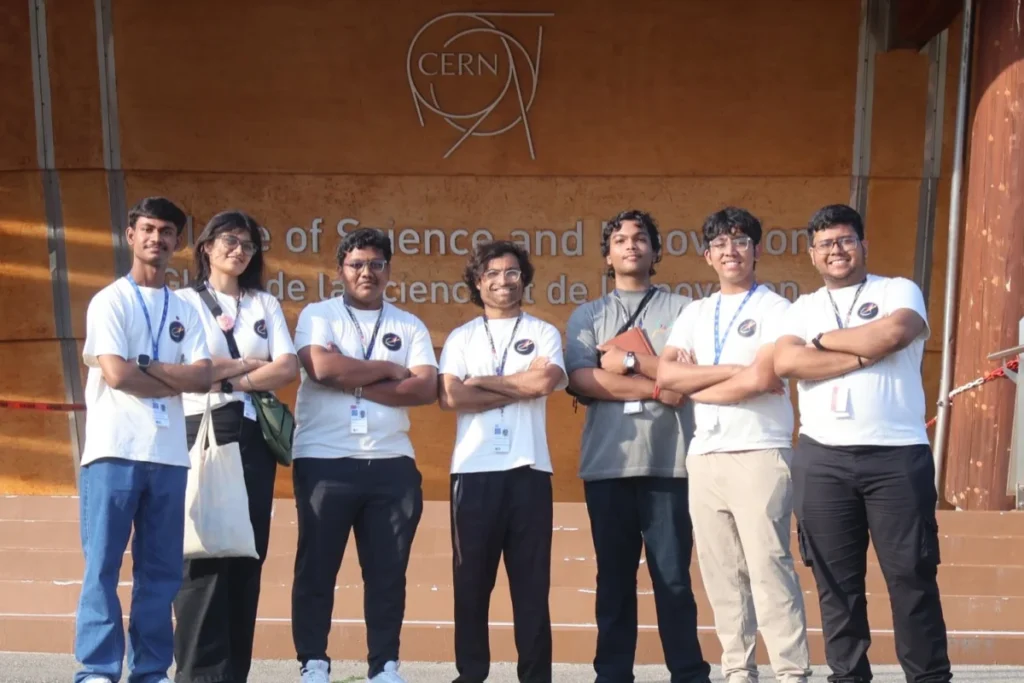
Team attoPION is a collective of six high school students hailing from four different cities across India. Despite the geographical distance between them, the students united through their shared participation in various national science competitions and a mutual interest in fundamental physics. Recognizing the complexity of designing an experiment suitable for a particle accelerator, they reached out to Srivastava, who currently conducts research in quantum gravity at the MIT Center for Theoretical Physics—a part of the Leinweber Institute—under the supervision of Professor Hong Liu.
Srivastava’s decision to mentor the group was driven by a sense of professional empathy. Reflecting on his own early career, he noted that "cold-emailing" established scientists is a common but often fruitless endeavor for young researchers. However, the intellectual curiosity displayed by the Indian students convinced him to provide the guidance necessary to refine their proposal. His primary role was not to dictate the experiment, but to act as a scientific sounding board, helping the students transition from abstract ideas to a feasible experimental design that met the rigorous standards of CERN’s evaluators.
Scientific Objective: Measuring Pion Charge Exchange
The core of Team attoPION’s proposal focuses on a specific subatomic interaction known as pion charge exchange. Pions, or pi-mesons, are short-lived particles that play a crucial role in the strong nuclear force, which binds protons and neutrons together within an atomic nucleus. These particles can carry a positive, negative, or neutral electric charge.
The students designed an experiment to observe and characterize the process in which a positively charged pion ($ pi^+ $) interacts with a neutron ($ n $) within a target material. This interaction results in the production of a neutral pion ($ pi^0 $) and a positively charged proton ($ p $). The primary goal of the experiment was to measure the cross-section—essentially the probability of this specific reaction occurring—under controlled beamline conditions.
Srivastava recognized that this measurement was not merely an academic exercise for high schoolers but held genuine scientific value for the international physics community. Specifically, the data collected by Team attoPION could contribute to the Deep Underground Neutrino Experiment (DUNE), one of the most significant long-term projects in contemporary particle physics.
Implications for the Deep Underground Neutrino Experiment (DUNE)
DUNE is a massive international collaboration led by Fermilab in the United States, involving over 1,000 scientists from 30 countries. The experiment aims to study neutrino oscillations to answer fundamental questions about the nature of matter and the origin of the universe. To achieve this, DUNE utilizes massive detectors filled with liquid argon to capture neutrino interactions.
According to Dave Newbold, a co-spokesperson for the DUNE collaboration and a prominent physicist, Team attoPION’s focus on pion charge exchange is highly relevant to DUNE’s success. When neutrinos interact with argon nuclei in a detector, they often produce pions. These pions can undergo further interactions, such as charge exchange, before they are detected. If researchers do not have precise data on how often these pion interactions occur, it introduces "systematic uncertainty" into their measurements.
"Understanding how pions interact with matter helps researchers quantify uncertainties in DUNE’s measurements," Newbold explained. Specifically, these interactions can skew the estimation of a neutrino’s "flavor" and its energy levels. Accurate energy reconstruction is vital for DUNE to determine if it has observed new physical phenomena or if the results fall within the Standard Model of particle physics. Newbold emphasized that the students’ proposal was "real experimental particle physics," far exceeding the complexity of standard high school curricula.
From Proposal to Practice: The CERN Residency
After being selected as winners, Team attoPION traveled to Geneva to execute their experiment at the CERN East Hall, which houses the T9 beamline. This facility provides a secondary beam of particles derived from the Proton Synchrotron, one of the older but still vital components of CERN’s accelerator complex.
The transition from a theoretical proposal to a physical experiment involved a steep learning curve. The students worked closely with Berare Göktürk, a support scientist for the Beamline for Schools program. One of the primary technical challenges identified during the preparation phase was the rarity of the charge-exchange process. Because neutral pions decay almost instantly into two photons, the team had to calibrate sophisticated detectors to identify these "decay signatures" amidst a background of other particle interactions.
During their 12 days of beam time, the students were responsible for:
- Detector Configuration: Setting up scintillators and calorimeters to track particle paths and energy deposits.
- Data Acquisition (DAQ): Monitoring the real-time flow of digital information from the detectors to the computer servers.
- Data Analysis: Using software tools to filter through millions of particle events to find the rare instances of pion charge exchange.
- Collaboration: Attending seminars and interacting with CERN staff to troubleshoot hardware malfunctions and software bugs.
Göktürk noted that the goal of the residency was to provide a realistic experience of the scientific method. This included navigating the "uncertainty" and "humility" required when dealing with complex machinery and rare physical events. The objective was for the students to understand that science is often a process of overcoming technical hurdles rather than a series of immediate breakthroughs.
Broader Impact on STEM Education and International Collaboration
The success of Team attoPION serves as a testament to the importance of mentorship and the globalization of scientific research. For Manu Srivastava, the experience was a way to give back to his home country. Growing up in India, he recalled that opportunities to interact with institutions like CERN were virtually non-existent for high school students. He noted that the caliber of the students he mentored represents a shift in the accessibility of high-level science for the next generation of researchers in developing nations.
The Beamline for Schools competition continues to grow in scale and impact. By providing students with the same tools used by Nobel Prize-winning physicists, CERN aims to inspire careers in Science, Technology, Engineering, and Mathematics (STEM). The 2024 edition’s record participation suggests a burgeoning interest in particle physics among youth worldwide.
Furthermore, the potential for a publishable result from a high school experiment highlights a shift in how "citizen science" and educational outreach are viewed by the professional community. If Team attoPION’s data is sufficiently robust, it may be used by the DUNE collaboration to refine their simulation models, marking a rare instance where secondary school students contribute directly to the infrastructure of a multi-billion dollar physics project.
Conclusion and Future Outlook
The journey of Team attoPION—from a hopeful cold email to the laboratories of Geneva—illustrates the power of academic mentorship and the intellectual potential of young scientists when provided with the right resources. Under the guidance of MIT’s Manu Srivastava and the support of CERN’s technical staff, these six students from India have demonstrated that the boundaries between educational exercises and professional research are increasingly fluid.
As they return to their respective schools in India, the members of Team attoPION carry with them not only the data from their experiment but also a firsthand understanding of the collaborative nature of modern science. Meanwhile, the physics community awaits the final analysis of their pion charge-exchange data, which may soon find its way into the technical documentation of the world’s most advanced neutrino experiments. The success of this collaboration underscores a vital message for the scientific community: some of the most promising advancements in physics may begin with the simple act of answering an email.