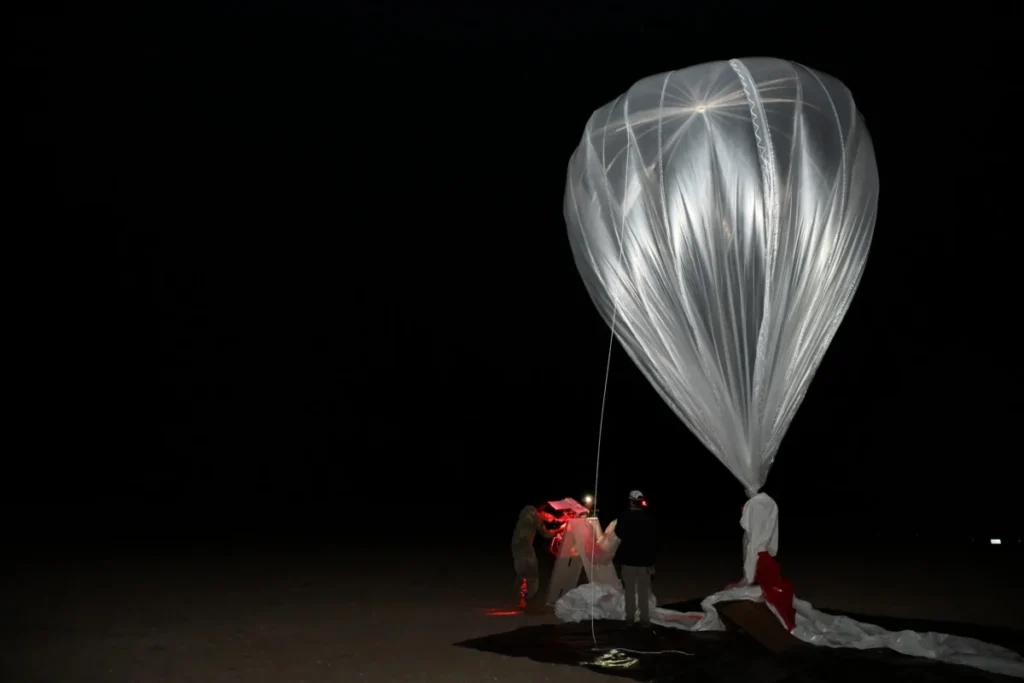
WASHINGTON, D.C. – The U.S. Army is significantly expanding its strategic focus on space operations, with a pronounced emphasis on the stratosphere and the development of high-altitude balloon technology over the coming year. Command leaders revealed this ambitious pivot at the Association of the U.S. Army’s (AUSA) annual conference, signaling a deliberate move to harness the unique capabilities of this underutilized atmospheric layer.
Lt. Gen. John Rafferty, commander of the Army’s Space and Missile Defense Command (SMDC), expressed a profound shift in his perspective on stratospheric operations. "I went from nowhere to a huge believer very quickly once I saw [high-altitude balloons] in action," Rafferty stated to reporters gathered at the conference. His enthusiastic endorsement underscores the transformative potential SMDC sees in these platforms. "We’re really excited about this next year, about what we’re going to do to further the program for high-altitude balloons and stratospheric operations," he added, hinting at accelerated research, development, and experimental deployment.
This strategic directive aligns directly with the Army’s forward-looking vision, as outlined in the "Army Space Vision document released in 2024." Col. Joseph Mroszczyk, head of the Transformation Integration Directorate for Space Superiority within SMDC, confirmed that stratospheric operations are a cornerstone of this comprehensive strategy. The stratosphere, an atmospheric region situated between approximately 60,000 and 100,000 feet above the Earth’s surface, is increasingly viewed by military strategists as a critical nexus. Mroszczyk described it as "a transition point between what is normally considered the aerial layer and the space domain." This unique position offers a compelling operational advantage, bridging the gap between traditional air power and the vastness of space.
Harnessing the Stratosphere: A New Frontier for Military Operations
The Army’s interest in the stratosphere stems from its ability to provide persistent, wide-area coverage with payloads akin to those deployed in space, but with distinct advantages. "Operating at these altitudes allows some persistence and broad coverage in an area where you can deliver space-like capabilities in terms of payloads, but then also take advantage of the deep access that you get from a stratospheric ballooning," Mroszczyk explained. This dual benefit – the payload capacity of space-based assets combined with the accessibility and adaptability of atmospheric platforms – is what makes the stratosphere so attractive.
The potential applications are diverse and far-reaching. Mroszczyk highlighted "sensing and communications and extension of the launched effects portfolio" as key capabilities that can be effectively deployed from stratospheric altitudes. This could translate into advanced intelligence, surveillance, and reconnaissance (ISR) capabilities, secure and resilient communication networks that can operate above contested airspace, and novel ways to project effects or deploy other assets. "That is a way that we can help exploit the stratosphere," Mroszczyk emphasized, "and we’ll do that throughout multiple experiments over the course of the coming year." This commitment to iterative experimentation suggests a phased approach to integrating these capabilities into the Army’s operational doctrine.
Beyond high-altitude balloons, the command is also exploring other long-endurance, stratospheric platforms. According to a press kit shared at the AUSA conference, SMDC is keenly interested in "long-endurance, unmanned solar-powered aircraft." These platforms, often referred to as High-Altitude Pseudo-Satellites (HAPS), offer a compelling alternative or complementary capability to balloons, providing sustained presence and operational flexibility in the upper atmosphere.
The Strategic Rationale: Filling Gaps and Enhancing Capabilities
The Army’s intensified focus on the stratosphere is not merely an exploratory endeavor; it is driven by evolving geopolitical realities and the increasing complexity of the modern battlefield. In an era where space is becoming increasingly contested and traditional air superiority is not guaranteed, the stratosphere offers a relatively less crowded and potentially more defensible operational domain.
Bridging the Space-Air Divide
For decades, military operations have largely been segmented into distinct domains: land, sea, air, and space. However, the increasing sophistication of technology has blurred these lines. The stratosphere represents a critical bridging layer, allowing for capabilities that can transcend the limitations of each individual domain.
- Persistence: Unlike conventional aircraft that require continuous fuel and maintenance, high-altitude balloons and solar-powered aircraft can remain aloft for extended periods, offering persistent surveillance or communication relays. This is particularly valuable for monitoring vast areas or maintaining continuous contact in remote or denied regions.
- Cost-Effectiveness: Compared to launching and maintaining satellites in orbit, stratospheric platforms can offer a significantly more cost-effective solution for certain missions. The development, deployment, and recovery of balloons are generally less expensive than those of orbital assets.
- Flexibility and Responsiveness: Stratospheric balloons can be deployed relatively quickly and can be steered to specific locations or repositioned as mission requirements change. This agility is a distinct advantage over fixed orbital paths of satellites.
- Payload Versatility: The stratosphere can accommodate a wide range of payloads, including advanced sensors, communication equipment, electronic warfare systems, and even small unmanned aerial vehicles (UAVs) that can be deployed from the balloon.
- Reduced Vulnerability: While not entirely invulnerable, stratospheric platforms may operate at altitudes that are challenging for many conventional air defense systems and less susceptible to certain anti-satellite (ASAT) weapons designed for orbital engagement.
The Army Space Vision: A Blueprint for the Future
The "Army Space Vision" document, released earlier this year, articulates a clear strategic imperative for the service to enhance its space capabilities. The document emphasizes the need for the Army to be a "space-enabled force," meaning that space-based assets and services are integrated into all levels of planning and operations. The burgeoning interest in stratospheric operations is a direct manifestation of this vision, seeking to leverage an underutilized domain to achieve space-like effects with greater flexibility and potentially reduced cost.
The document likely details several key areas of focus for the Army in space:
- Space Domain Awareness: Enhancing the ability to detect, track, and identify objects and activities in space.
- Space-Based Positioning, Navigation, and Timing (PNT): Ensuring reliable and resilient PNT services for all Army operations.
- Space-Based Communications: Developing secure and robust communication networks that can operate through the space domain.
- Space-Enabled ISR: Leveraging space-based assets for intelligence gathering and situational awareness.
- Space Control: The ability to protect friendly space assets and deny adversaries the use of theirs.
The inclusion of stratospheric operations within this vision suggests a recognition that the full spectrum of space capabilities extends beyond traditional orbital assets and encompasses the strategic utilization of the Earth’s atmosphere.
Historical Precedents and Emerging Trends
While the Army’s current focus on high-altitude balloons and stratospheric operations might seem novel, the concept of utilizing the upper atmosphere for military purposes has a long history. During the Cold War, reconnaissance balloons were used by various nations to gather intelligence. More recently, scientific balloons have pushed the boundaries of atmospheric research, carrying sophisticated instruments to the edge of space.
The current resurgence of interest is fueled by technological advancements that have made these platforms more capable and reliable. Miniaturization of electronics, improvements in materials science for balloon construction, and advancements in solar power technology have all contributed to the viability of these systems for military applications.
The international landscape also plays a role. Other nations, including China and Russia, have been actively developing and testing similar high-altitude platforms, prompting the U.S. to accelerate its own efforts to maintain a technological edge. This competitive dynamic underscores the strategic importance of the stratosphere as a new domain of military interest.
The Road Ahead: Experiments and Integration
The coming year will be crucial for the Army’s stratospheric ambitions. Lt. Gen. Rafferty and Col. Mroszczyk have indicated a commitment to a series of experiments designed to refine and validate the capabilities of high-altitude balloons and other stratospheric platforms. These experiments will likely involve:
- Payload Testing: Evaluating the performance of various sensors, communication systems, and effectors deployed from stratospheric altitudes.
- Endurance and Reliability Trials: Assessing the long-term operational capabilities of balloons and solar-powered aircraft.
- Integration Exercises: Testing how these stratospheric assets can be integrated with existing Army command and control systems and other space-based capabilities.
- Operational Scenarios: Simulating real-world mission requirements to understand the practical utility and limitations of these platforms.
The success of these experiments will determine the pace at which these capabilities are transitioned from research and development to operational deployment. The Army’s "Space Vision" suggests a clear intent to integrate these new assets into its operational framework, potentially leading to new doctrines, training programs, and organizational structures.
Broader Implications and Future Outlook
The U.S. Army’s strategic pivot towards the stratosphere has several significant implications:
- Enhanced ISR Capabilities: The ability to provide persistent, high-resolution imagery and signals intelligence from a stable platform above much of the atmosphere could revolutionize battlefield awareness.
- Resilient Communications: Stratospheric platforms can act as airborne communication relays, extending the reach of tactical networks and providing vital connectivity in austere or contested environments, potentially bypassing terrestrial infrastructure vulnerabilities.
- Strategic Deterrence: The development of a robust stratospheric capability could contribute to overall deterrence by demonstrating a comprehensive approach to controlling key operational domains.
- Innovation in Defense Technology: The Army’s investment in this area is likely to spur further innovation in materials science, propulsion systems, and miniaturized electronics, with potential spin-off benefits for commercial applications.
- Inter-Service Collaboration: As other branches of the U.S. military, particularly the Air Force and Navy, also explore stratospheric capabilities, there will be opportunities and necessities for inter-service collaboration and standardization.
While the exact timeline for full operational deployment remains to be seen, the Army’s clear commitment to exploring and exploiting the stratosphere marks a significant evolution in its approach to space operations. As technology continues to advance and the strategic landscape shifts, the high-altitude balloon and its associated technologies are poised to become a vital component of the U.S. military’s future capabilities, offering a unique blend of persistence, flexibility, and cost-effectiveness in a domain that is rapidly gaining strategic importance. The coming year promises to be a period of intense activity and significant progress as the Army works to unlock the full potential of this new frontier.