Researchers at the Indian Institute of Science (IISc) have achieved a landmark breakthrough in the field of sustainable chemistry by identifying 9,389 previously overlooked chemical reactions that occur during the conversion of carbon dioxide (CO2) into value-added fuels. This discovery, facilitated by a sophisticated marriage of machine learning and quantum mechanical simulations, provides a far more accurate map of how CO2 interacts with copper catalysts, potentially paving the way for a new generation of high-efficiency industrial processes designed to mitigate climate change. The findings, which were recently detailed in the journal Nature Communications, suggest that previous scientific models were operating with a significantly incomplete understanding of the chemical pathways involved in carbon hydrogenation.
For decades, the scientific community has sought a "holy grail" for carbon management: a way to capture atmospheric or industrial CO2 and transform it back into useful substances like methanol, which can serve as a clean-burning fuel or a precursor for plastics and pharmaceuticals. However, the complexity of the chemical environment on a catalyst’s surface has long acted as a bottleneck. By expanding the known reaction network by more than sixty-fold, the IISc team has effectively illuminated a "black box" of molecular interactions, revealing that the process is far more dynamic and productive than earlier theories suggested.
The Challenge of Modeling Complex Catalysis
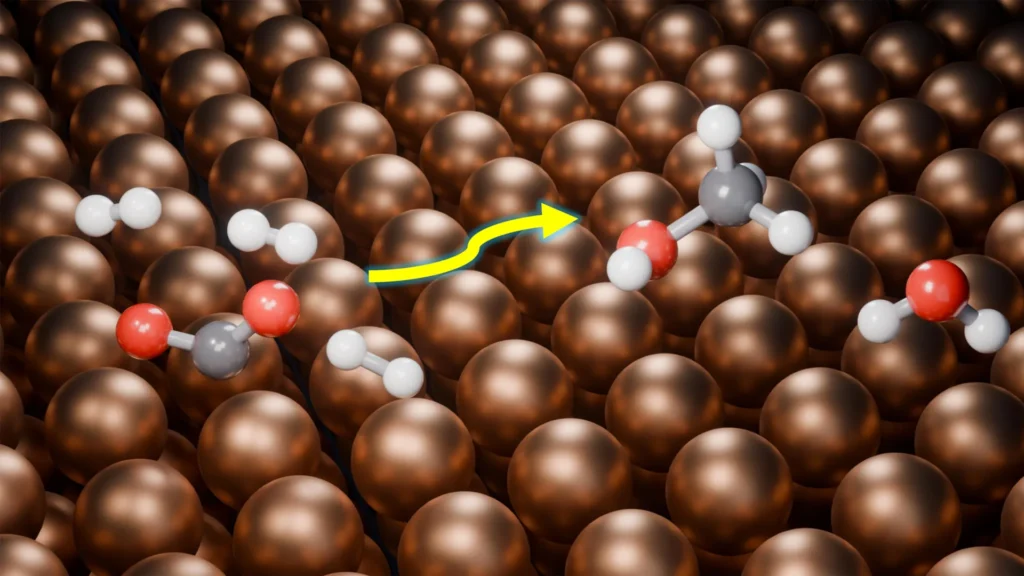
The fundamental difficulty in improving CO2 conversion lies in the sheer number of variables at play. In a typical catalytic reaction, CO2 and hydrogen gas are introduced to a solid surface—often copper—where they break apart and recombine into new molecules. To understand this process, scientists use "mechanistic modeling," a method that attempts to chart every step a molecule takes as it transforms.
Historically, this has been an arduous task. Simulating the behavior of atoms using quantum mechanics requires immense computational resources. Because of these limitations, researchers have traditionally focused on a small subset of reactions—usually fewer than 200—that they assumed were the most critical. This selective approach, while computationally manageable, inherently risks ignoring "minor" reactions that may, in aggregate, dictate the success or failure of the entire process.
Anand Mohan Verma, the study’s first author and an Assistant Professor at the Motilal Nehru National Institute of Technology (MNNIT) Allahabad, noted that this uncertainty is a constant shadow over the field. The central worry for any modeler is whether they have omitted the single, crucial step that defines the reaction’s efficiency. The IISc study sought to eliminate this uncertainty by replacing human selection with automated, AI-driven exploration.
A Massive Expansion: From 152 to 9,389 Reactions
The research team, led by Associate Professor Ananth Govind Rajan of the IISc Department of Chemical Engineering, began by building a foundational database using traditional quantum mechanics. They mapped 152 well-known reactions to serve as a training set for a machine learning algorithm. This AI was then tasked with predicting the "energy barriers" of thousands of other potential reactions. An energy barrier is essentially the amount of energy required for a chemical transformation to occur; knowing these barriers is vital for predicting which reactions will happen and how fast they will proceed.
Using automated computational tools, the team analyzed the potential interactions of 105 different chemical species that can exist on a copper catalyst surface. By considering every possible transformation that could occur in a single step, the researchers expanded their reaction network from the initial 152 to a staggering 9,389.
The implications of this expansion were immediate and profound. When the researchers ran simulations using only the traditional, smaller network, the model produced results that contradicted real-world experiments. The limited model incorrectly identified formic acid as the primary byproduct and significantly underestimated the total amount of CO2 being converted. However, when the 9,389-reaction network was applied, the model’s predictions shifted dramatically, identifying methanol and carbon monoxide as the major products—exactly what is observed in laboratory settings.
Quantitative Impact: 40 Times More Conversion
The most striking piece of data to emerge from the expanded model was the rate of conversion. The IISc researchers found that the larger network predicted a CO2 conversion rate approximately 40 times higher than the simplified model. This discrepancy highlights a massive "knowledge gap" in previous studies, where the cumulative effect of thousands of minor reactions resulted in a much higher throughput than scientists had previously been able to explain.
This 40-fold increase suggests that the copper catalyst is far more effective than earlier models gave it credit for, provided the full spectrum of chemical pathways is taken into account. This discovery is expected to change how chemical engineers design reactors, as they can now account for a much wider array of intermediate steps that contribute to the final yield of methanol.
Challenging Chemical Dogma: The Molecular Hydrogen Pathway
Perhaps the most scientifically provocative finding of the study involves the behavior of hydrogen. In conventional catalytic theory, it is generally accepted that hydrogen molecules (H2) must first split into individual hydrogen atoms (H) on the surface of a catalyst before they can react with other molecules. This is known as the "dissociative" pathway.
However, the IISc model revealed a surprising alternative: in several critical steps, hydrogen can be transferred to oxygen-containing intermediates as an intact H2 molecule. This "molecular" transfer pathway had been largely ignored because it was thought to be energetically unfavorable.
"The idea that hydrogen can transfer as an intact molecule, without first splitting into atoms, runs against what most of us were taught," said Shivam Chaturvedi, a PhD student at IISc and co-author of the study. The discovery only became possible because the AI-driven network was large enough to include such "unlikely" steps. Subsequent high-level quantum calculations confirmed that this molecular pathway is actually more favorable in certain conditions, particularly when interacting with intermediates containing oxygen. This insight suggests that future catalysts could be specifically engineered to favor this molecular hydrogen pathway, potentially streamlining the production of methanol.
Collaborative Validation and Industrial Relevance
To ensure that their computational breakthroughs translated to reality, the IISc team collaborated with industrial and international partners. Experimental validation was conducted by G. Valavarasu and Santhosh Kotni at the Green Research and Development Centre of Hindustan Petroleum Corporation Limited (HPCL). Further validation was provided by Amol Amrute and his colleagues at the Agency for Science, Technology, and Research (A*STAR) in Singapore.
The involvement of HPCL is particularly significant, as it underscores the industrial appetite for more efficient carbon utilization technologies. As India and other nations move toward "Net Zero" emissions targets, the ability to recycle industrial CO2 into fuel becomes a vital economic and environmental strategy. The study also benefited from the expertise of Ambedkar Dukkipati, a Professor in the Department of Computer Science and Automation at IISc, who helped refine the machine learning models that made the large-scale analysis possible.
Broader Implications for the "Methanol Economy"
The ability to efficiently convert CO2 into methanol is a cornerstone of the proposed "Methanol Economy," a concept championed by Nobel laureate George Olah. Methanol is an ideal liquid fuel because it can be easily transported using existing infrastructure, used in internal combustion engines with minimal modification, and utilized in fuel cells to generate electricity.
Beyond methanol, the computational framework developed by the IISc team has applications that extend far across the chemical industry. The integration of AI and quantum mechanics can be applied to:
- Nitrogen Reduction: Improving the production of ammonia for fertilizers, a process that currently consumes about 1% of the world’s total energy.
- Water Splitting: Enhancing the efficiency of green hydrogen production.
- Electrochemical CO2 Reduction: Using renewable electricity to drive carbon conversion at room temperature.
Conclusion: A New Era of "Digital Catalysis"
The research from IISc represents a shift toward a more holistic, data-driven era of chemistry. By proving that "minor" reactions are collectively major players, the study challenges researchers to move away from oversimplified models that have historically hampered the development of high-performance catalysts.
The discovery of nearly 9,400 reactions on a simple copper surface suggests that our understanding of more complex catalysts—such as alloys or supported nanoparticles—is likely just the tip of the iceberg. As machine learning continues to evolve, the ability to map these vast chemical landscapes will become a standard tool in the fight against climate change, turning CO2 from a waste product into a valuable resource for a sustainable future. The IISc team’s work serves as a definitive roadmap for this transition, providing both the theoretical framework and the empirical evidence needed to revolutionize carbon hydrogenation on a global scale.