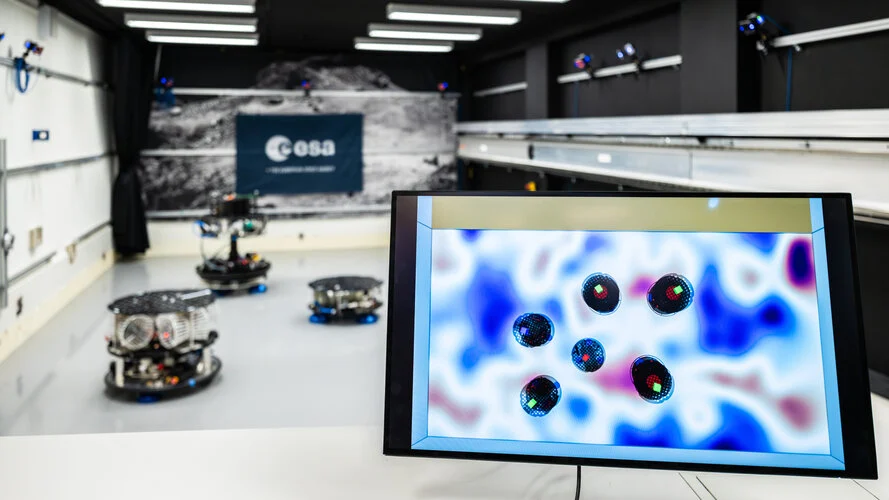
The European Space Agency’s (ESA) commitment to fostering innovation in space exploration and sustainability is underscored by its Academy Experiments Programme, which recently provided a platform for the Star-bots student team from the University of Bologna, Italy, to test a groundbreaking approach to tackling the growing menace of space debris. Their project, a sophisticated simulation of autonomous robots working in unison to capture derelict satellites and other orbital junk, offers a glimpse into the future of active debris removal (ADR) technologies.
The Growing Challenge of Space Debris
The Earth’s orbit is becoming increasingly cluttered with defunct satellites, rocket stages, and fragments from collisions. According to the European Space Agency’s Space Debris Office, as of early 2024, there are over 30,000 tracked objects larger than 10 centimeters in orbit, with millions more smaller pieces. This debris poses a significant threat to operational satellites, critical infrastructure, and future space missions. The Kessler Syndrome, a theoretical scenario where the density of objects in low Earth orbit becomes so high that collisions cascade, creating even more debris and rendering space unusable, is a constant concern.
The proliferation of space debris stems from several factors. The dramatic increase in satellite launches, particularly with the advent of large satellite constellations, contributes to the problem. Many satellites reach the end of their operational life, are retired, or suffer catastrophic failures, leaving them as silent, hazardous projectiles. Furthermore, collisions between existing debris and active satellites, or even between two pieces of debris, generate a vast number of smaller fragments, exacerbating the issue. The United Nations Committee on the Peaceful Uses of Outer Space (COPUOS) has repeatedly called for international cooperation and the development of effective mitigation and removal strategies.
Star-bots’ Innovative Solution: Swarm Robotics
The Star-bots team’s experiment focuses on a swarm of five autonomous robots designed to collectively encircle and track a tumbling, non-cooperative object. This approach leverages the power of swarm intelligence, where multiple simple agents working together can achieve complex tasks that would be impossible for a single agent. The core of their experiment lies in demonstrating the seamless integration of real and virtual robotic platforms, a crucial step in scaling up such operations without the prohibitive cost and complexity of launching a full swarm of physical robots.
"Our experiment involves a swarm of five robots, which together encircle and track a tumbling, non-cooperative object," explains Carlo Dallara from the Star-bots team. "To test our system, we are using a mix of real and virtual robotic platforms, which must all work together autonomously. This approach allows us to simulate large-scale swarm behaviour while maintaining the feedback of real robotic hardware."
This hybrid approach is particularly ingenious. By using a virtual environment that meticulously replicates the physical setup, the team can test the algorithms and coordination strategies for a larger number of robots than they could physically deploy in the laboratory. The real robotic platforms provide essential, tangible feedback on the dynamics of movement, grasping, and interaction, grounding the virtual simulations in practical reality. This not only reduces costs but also accelerates the development cycle, allowing for rapid iteration and refinement of the swarm’s behaviour.
Replicating the Space Environment: The Orbital Robotics Laboratory
The ESA Academy Experiments Programme provided the Star-bots team with invaluable access to ESA’s Orbital Robotics Laboratory at ESTEC, the agency’s technical centre in Noordwijk, the Netherlands. This state-of-the-art facility is specifically designed for testing robotic systems in conditions that mimic the space environment.
The team utilized specialized floating platforms within the laboratory. These platforms are equipped with air bearings that, by blowing air towards the floor, create a minimal air gap. This effectively reduces friction to near-zero levels, allowing the platforms and their payloads to float. This simulated state of weightless free-floating in two dimensions closely mirrors the dynamics of robots operating in the vacuum of space, where friction is absent and objects move according to Newton’s laws of motion.
"The bottom of each platform is equipped with air bearings that blow air out towards the floor to create a micrometre-scale air gap, making the platforms and their payloads float without any friction," states the project’s technical documentation. "Using this simulated state of weightless free-floating in two dimensions, Star-bots were able to test their system in a setting that closely mirrors the dynamics of space."
This meticulous replication of microgravity conditions is paramount for validating the effectiveness of the swarm’s algorithms. In space, without friction, objects will continue to move indefinitely unless acted upon by a force. Understanding how the robots can precisely control their movements, maintain formation, and interact with a tumbling target in such an environment is critical for the success of any ADR mission. The Orbital Robotics Laboratory provides the ideal controlled setting to gather this essential data.
The Timeline of Innovation: From Concept to Simulation
The ESA Academy Experiments Programme typically follows a structured timeline, allowing student teams to progress from conceptualization to experimental validation. While specific dates for the Star-bots project are not detailed in the provided information, such programs generally involve:
- Application and Selection: Student teams submit detailed proposals outlining their experiment, objectives, and methodologies. Selection is competitive, based on scientific merit, innovation, and feasibility.
- Design and Development: Selected teams receive technical guidance from ESA experts to refine their designs, develop their software, and prepare their hardware. This phase can take several months.
- Testing and Validation: Teams gain access to ESA’s facilities for hands-on testing. This is the critical phase where theoretical models are put to the test in a simulated environment, like the Orbital Robotics Laboratory.
- Data Analysis and Reporting: Following the experimental phase, teams analyze the collected data, draw conclusions, and present their findings in a comprehensive report and presentation.
The Star-bots’ successful testing within the Orbital Robotics Laboratory signifies the culmination of this rigorous process, demonstrating their ability to translate complex theoretical concepts into a viable experimental demonstration.
Active Debris Removal: A Necessary Frontier
The Star-bots’ project directly addresses the urgent need for Active Debris Removal (ADR) technologies. ADR aims to actively remove non-functional objects from orbit, preventing them from becoming hazards. This can involve various methods, such as:
- Grappling and De-orbiting: Capturing debris and then using a dedicated propulsion system to lower its orbit, causing it to burn up in the Earth’s atmosphere.
- Tethering: Attaching a tether to the debris to create drag or to pull it into a controlled de-orbit trajectory.
- Servicing Missions: Repairing or refueling existing satellites to extend their lifespan, thereby preventing them from becoming debris.
The concept of a swarm of robots for ADR offers several advantages. Firstly, it increases redundancy. If one robot malfunctions, the others can continue the mission. Secondly, it allows for greater maneuverability and adaptability. A swarm can surround and stabilize a tumbling object more effectively than a single, rigid robotic arm. Thirdly, it can potentially reduce the overall cost of ADR missions by utilizing simpler, mass-produced robots rather than a single, complex, and expensive capture vehicle.
Official Reactions and Expert Analysis
While specific quotes from ESA officials regarding the Star-bots’ project are not available in the provided text, the very existence and support of the ESA Academy Experiments Programme speak volumes. Dr. Josef Aschbacher, Director General of ESA, has consistently emphasized the importance of engaging young talent and fostering innovation in space technologies. He has highlighted that "investing in space research and development is crucial for ensuring the long-term sustainability of space activities and for addressing global challenges."
Experts in space debris mitigation and robotics have long recognized the potential of swarm robotics. Dr. Moriba Jah, an associate professor at the University of Texas at Austin and a leading expert on space traffic management and orbital debris, has previously commented on the necessity of developing autonomous systems for debris removal. He has stated that "the future of space sustainability hinges on our ability to develop intelligent, adaptable, and scalable solutions. Swarm robotics, with its inherent resilience and flexibility, represents a promising avenue." The Star-bots’ experiment is a tangible step in validating these expert opinions.
Broader Impact and Implications
The success of the Star-bots’ experiment has several significant implications:
- Advancement of ADR Technologies: It provides crucial experimental data and validation for swarm robotics approaches to active debris removal, paving the way for more sophisticated and larger-scale ADR missions in the future.
- Talent Development: The ESA Academy Experiments Programme continues to be a vital pipeline for nurturing the next generation of space engineers and scientists. The hands-on experience gained by the Star-bots team is invaluable for their future careers and for the European space sector.
- Cost-Effective Solutions: The hybrid real-virtual simulation approach demonstrated by Star-bots suggests a path towards more cost-effective development and testing of complex robotic systems, a critical factor for the economic viability of space debris removal.
- International Collaboration: While this specific project is from an Italian university, the ESA Academy is a pan-European initiative, fostering collaboration and shared learning across member states, which is essential for tackling a global challenge like space debris.
The journey from a university project to a full-scale operational debris removal system is long and complex, involving significant engineering challenges, regulatory hurdles, and international agreements. However, the work of teams like Star-bots, supported by organizations like ESA, represents a critical and hopeful step forward. Their ability to simulate complex orbital dynamics and test autonomous swarm behavior in a controlled environment demonstrates that innovative solutions to the pressing issue of space debris are not only conceivable but are actively being developed by the bright minds of today and tomorrow. The brightly colored artwork on their screen, mirroring the real-world setup, is more than just a visual representation; it is a testament to the power of human ingenuity in securing the future of our celestial commons.