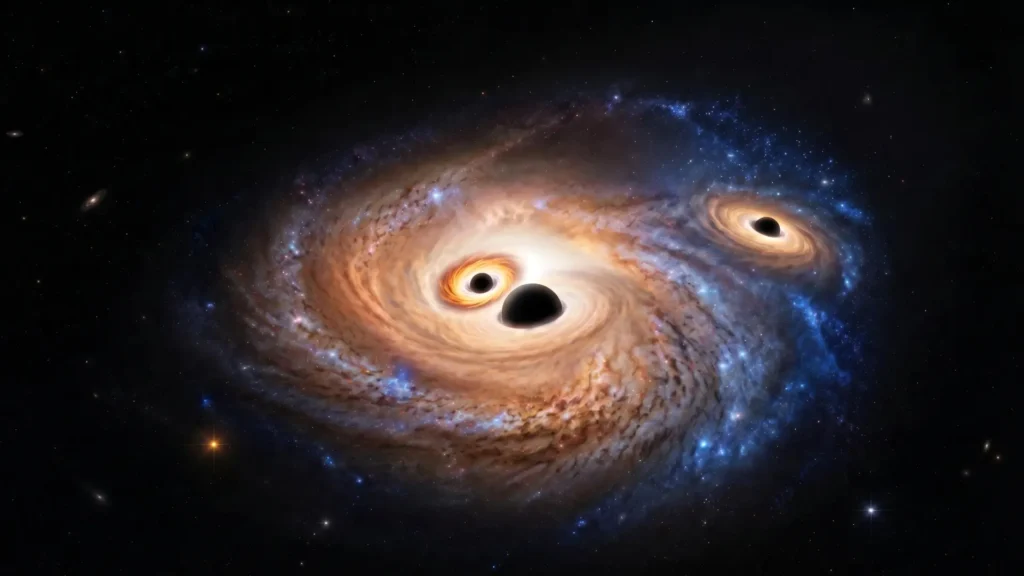
Astronomers have discovered three actively feeding supermassive black holes within a single galaxy located more than 12.5 billion light-years from Earth. This groundbreaking finding, achieved by an international research team led by the Max Planck Institute for Extraterrestrial Physics (MPE), offers an unprecedented glimpse into the tumultuous early universe, revealing how colossal black holes coalesced and interacted in the cosmos’ nascent stages. The discovery, made possible by the advanced capabilities of the James Webb Space Telescope (JWST), challenges existing models of black hole growth and provides crucial insights into the formation of the universe’s earliest massive structures.
A Glimpse into the Dawn of the Universe
The galaxy, designated J0148-4214, is so distant that its light has traversed approximately 12.5 billion years to reach us. This means scientists are observing it as it existed a mere 1.2 billion years after the Big Bang, a period characterized by rapid cosmic evolution and the formation of the first galaxies and their central black holes. The immense expansion of the universe over these vast distances stretches the light emitted by J0148-4214 to longer, redder wavelengths – a phenomenon measured by astronomers as redshift. The researchers determined the galaxy’s remarkable distance by measuring a redshift of z=5.02, a value indicative of its ancient origins.
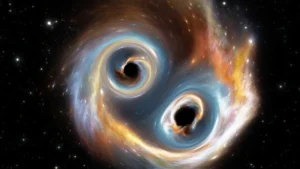
Within this ancient galactic realm, all three supermassive black holes are actively consuming surrounding matter. This material, drawn in by their immense gravitational pull, forms swirling disks of gas and dust that spiral inward before disappearing beyond the event horizon. The identification of multiple active black holes within a single galaxy at such an early epoch is exceptionally rare and has profound implications for our understanding of cosmic evolution.
The Unfolding Narrative of Three Ancient Giants
"This is the first evidence of three active black holes in a single galaxy in the distant Universe," stated Hannah Übler, a research group leader at MPE and the lead author of the study published in Nature Astronomy. "It suggests that processes in the early Universe were efficient at bringing massive black holes together, setting the stage for the massive black hole mergers we expect to detect with future gravitational wave observatories."
The spatial distribution of these three behemoths within J0148-4214 is particularly striking. Two of the black holes are situated in close proximity to the galaxy’s core, separated by a mere projected distance of 620 light-years. This close alignment suggests a history of gravitational interaction, potentially leading to a future merger. The third black hole is located significantly farther out, approximately 5,500 light-years from the galactic center. This spatial separation raises intriguing questions about its origin and current trajectory.
The prevailing theory for the formation of galaxies and their central black holes in the early universe involves frequent galaxy collisions and mergers. As smaller galaxies coalesced to form larger ones, their resident supermassive black holes were also drawn together. These cosmic encounters could lead to black hole mergers, resulting in the formation of increasingly massive central black holes within the newly formed, larger galaxies. This discovery provides compelling evidence supporting this model, demonstrating how these gargantuan structures could achieve their immense sizes so early in the universe’s history.
Unmasking the Hidden Black Holes: A Spectroscopic Triumph
Detecting these active black holes, especially at such extreme distances, is a formidable task. They are not directly visible; instead, their presence is inferred from their influence on surrounding matter. The research team identified the three black holes by analyzing distinctive emission patterns in hydrogen gas. Near a supermassive black hole, intense gravitational forces accelerate gas to extremely high velocities, leaving unique spectral signatures in the emitted light. These signatures act as telltale signs of black hole activity, even when the black holes themselves remain hidden.
In the heart of J0148-4214, the astronomers observed a particularly complex hydrogen emission pattern. This complexity could not be explained by a single black hole; the most plausible explanation was the presence of two closely spaced black holes, each exerting its own gravitational influence.
To differentiate between these two central black holes, the scientists employed a sophisticated technique known as spectro-astrometry. This method involves precisely tracking subtle variations in the positions of spectral emissions across the galaxy. By mapping these positional changes, the researchers were able to pinpoint the locations of both central black holes, even though the resolution of the telescope was insufficient to resolve them as distinct points of light. This innovative approach was critical in disentangling the signals from the closely packed black holes.
In addition to the central pair, the observations also revealed the presence of a third active black hole residing in the galaxy’s outer regions, further underscoring the complexity of this ancient galactic system.
A Spectrum of Masses and Surprising Growth Rates
The three black holes within J0148-4214 exhibit remarkably different masses. According to the researchers’ calculations, their masses are estimated to be approximately 80 million, 600,000, and 2 million times the mass of our Sun. This wide range of sizes within a single galaxy highlights the diverse evolutionary paths black holes can take.
Intriguingly, the most massive black hole is not the one accumulating matter at the highest rate. Its smaller neighbor, with a mass of roughly 600,000 solar masses, is feeding at an astonishing pace. Its estimated accretion rate exceeds the theoretical maximum predicted by fundamental models of black hole growth, known as the Eddington limit. This limit represents the point at which the outward pressure from radiation emitted by accreting matter balances the inward pull of gravity.
This exceptionally rapid growth of the smaller black hole offers crucial clues about how some black holes achieved supermassive status in the relatively short cosmic timeframe available in the early universe. Such rapid accretion could be a key factor in the swift assembly of the universe’s largest black holes.
Dr. Giovanni Mazzolari, the study’s second author and a researcher at MPE, elaborated on the significance of the JWST data: "The JWST data allowed us not only to identify the three black holes, but also to estimate their masses, accretion rates, and the stellar mass of the galaxy. We find a total stellar mass of about 1.3 billion suns, and the black holes represent a significant fraction of that." This indicates that black holes played a substantial role in the overall mass budget of this early galaxy.
An Imminent Cosmic Collision and a Rogue Black Hole
The close proximity of the two central black holes strongly suggests they are on a collision course. Scientists predict that these two behemoths will merge within the next few hundred million years. This eventual cosmic ballet, culminating in a catastrophic merger, could forge an even more massive black hole, providing a direct observation of a process believed to be fundamental to the growth of the universe’s earliest cosmic giants.
"These results are extremely exciting," commented Roberto Maiolino, a professor at the University of Cambridge and a co-author of the study. "They suggest that black hole merging may be an additional, fast route for their rapid growth in the early Universe."
The presence of the third black hole, located far from the galactic center, presents another compelling enigma. One leading hypothesis is that this black hole is a remnant of an earlier, more distant galaxy merger that was ejected from its original galactic core by a powerful gravitational recoil. Such a "kick" can occur when merging black holes emit gravitational waves asymmetrically, propelling the resulting, more massive black hole in the opposite direction. Alternatively, this rogue black hole might be on a slow, gradual trajectory towards the galaxy’s center, where it could eventually interact with the other two, potentially triggering further complex dynamics.
The James Webb Space Telescope: A New Era in Black Hole Discovery
This remarkable discovery underscores the transformative power of the James Webb Space Telescope (JWST) in probing the universe’s most distant and enigmatic objects, particularly supermassive black holes. The JWST’s advanced instrumentation, especially its Near Infrared Spectrograph (NIRSpec) operating in integral field spectroscopy mode (NIRSpec-IFS), was instrumental in achieving this breakthrough.
Integral field spectroscopy allows astronomers to analyze light and its spectral characteristics across different regions of a celestial object simultaneously. This capability was crucial for disentangling the complex spectral signals emanating from the crowded central region of J0148-4214. Without the precise spatial information provided by NIRSpec-IFS, astronomers would likely have mistaken the combined light from the two central black holes for that of a single entity, missing a significant part of the cosmic narrative.
The findings from J0148-4214 suggest that numerous other distant galaxies may harbor multiple actively growing black holes that have thus far eluded detection. Identifying more of these hidden multi-black hole systems could revolutionize our understanding of black hole merger histories and shed light on the mechanisms that facilitated the formation of the universe’s most massive black holes at such an early stage of cosmic development. This discovery opens a new frontier in the study of galaxy evolution and the fundamental processes that shaped our universe.