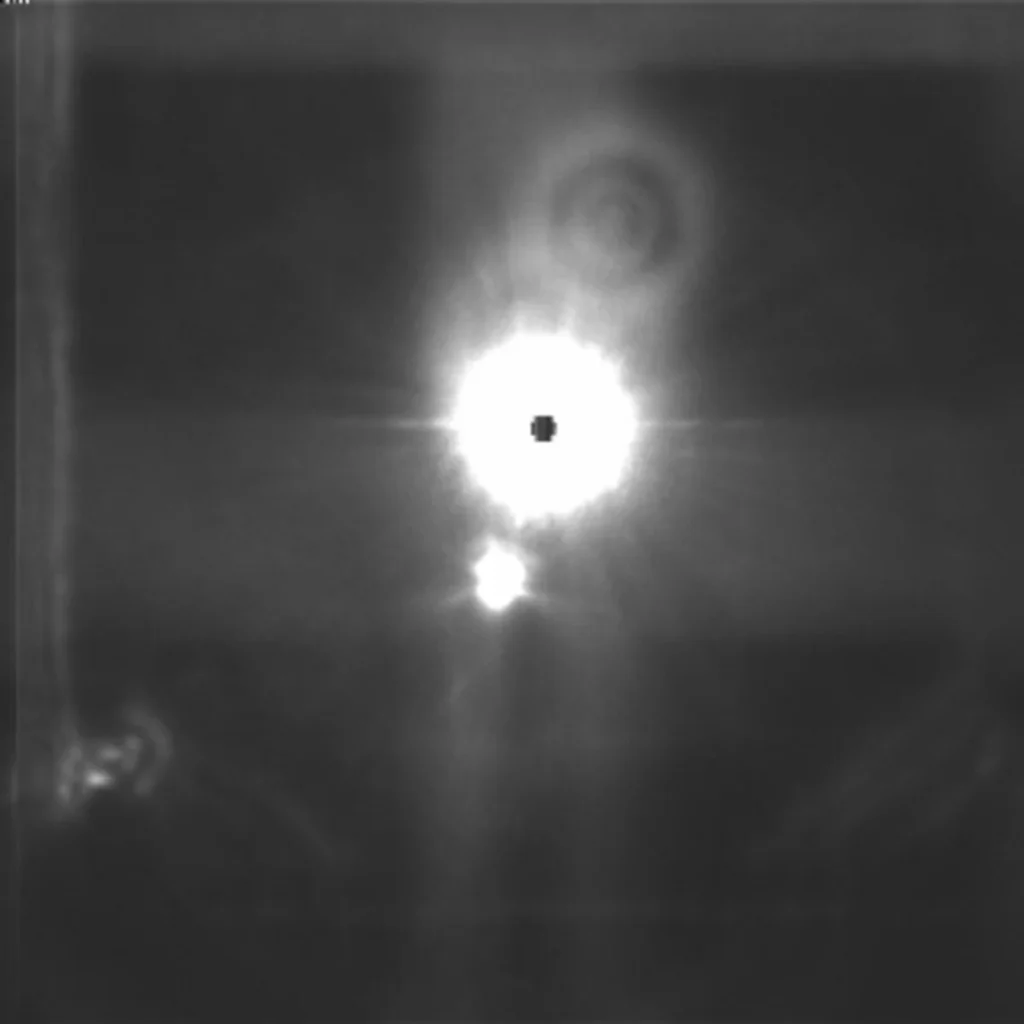
A striking image, reminiscent of a watchful eye in the cosmic void, has emerged from the depths of space, showcasing the Sun as a brilliant orb with a stark black dot at its center. This phenomenon, far from being a malfunction, is a testament to cutting-edge nanosatellite technology and a crucial element in the quest for autonomous spacecraft navigation. The image, captured by the miniature camera aboard the Trisat-S nanosatellite, represents a significant step forward for the mission team at the University of Maribor, Slovenia.
The "Black Sun" Effect: A Feature, Not a Flaw
The perceived black dot at the heart of the Sun is not a result of equipment failure but a predictable consequence of imaging sensors encountering extreme illumination. This effect, known as the "Black Sun" effect, occurs when the sheer intensity of light causes pixels to become over-saturated, paradoxically rendering these intensely bright areas as dark.
"The Black Sun effect might at first appear to be an unwanted imaging artefact, but for us it is a very useful visual feature," explains Iztok Kramberger, principal investigator of the Trisat programme at the University of Maribor. "Together with the observations of Earth and the Moon, the ‘Black Sun’ serves as a visual reference that can be used by a spacecraft to determine its attitude and orbit."
This principle is fundamental to visual navigation. By observing celestial bodies and their relative positions, a spacecraft can triangulate its own location and orientation in space. The Black Sun effect, by providing a consistent and identifiable feature of the Sun, enhances the reliability of these visual cues, especially in the dynamic and often featureless environment of space.
Building on Previous Success: The Trisat Legacy
The Trisat-S mission builds upon the foundational research conducted during the Trisat-R mission. This earlier endeavor, supported by the European Space Agency’s General Support Technology Programme (GSTP), also explored the capabilities of miniature cameras in space. During its operational period, Trisat-R, when not focused on solar observation, captured a remarkable image of Earth through its 2-millimeter lens from thousands of kilometers away, demonstrating the potential of miniaturized imaging for Earth observation.
The GSTP, a cornerstone of ESA’s technology development strategy, aims to mature promising technologies to a level where they can be adopted for future space missions. The support for Trisat-R underscores the agency’s commitment to fostering innovation in the European space sector, particularly in areas like advanced Earth observation and satellite technology.
Trisat-S: A New Era of Multi-Camera Observation
Launched in early September as part of a follow-up experiment, Trisat-S is a collaborative effort spearheaded by the University of Maribor in partnership with the Slovenian space company SkyLabs. This advanced nanosatellite is equipped with six miniature cameras, strategically positioned to provide comprehensive 360-degree coverage of its surroundings.
"While Trisat-R provides observations from two cameras in medium Earth orbit, offering a different perspective of the Earth and the space environment, Trisat-S gives us the opportunity to collect simultaneous observations from six cameras in low Earth orbit," Iztok Kramberger elaborates. This multi-camera configuration is a significant upgrade, enabling a richer and more detailed understanding of the spacecraft’s environment.
The ability to gather simultaneous data from multiple viewpoints is crucial for refining visual awareness models. By comparing these real-world space images with ground-based simulations, scientists can validate and improve their predictive algorithms. "The resulting images are particularly valuable because we can compare them with our ground-based simulations to further refine and validate our visual awareness models, closing the loop between simulations, laboratory testing and actual spaceflight," Kramberger adds. This iterative process of testing, simulating, and observing is vital for developing robust and reliable autonomous systems.
Rigorous Testing in Extreme Environments
The miniature imaging technology aboard Trisat-S has undergone rigorous testing to ensure its resilience in the harsh conditions of space. Earlier this year, the cameras were subjected to an intense radiation environment at CERN’s CHARM (CERN High-energy Accelerator for Mixed-field radiation) facility. This facility simulates the challenging radiation levels that spacecraft encounter in orbit, providing a critical testing ground for the radiation protection mechanisms developed by SkyLabs.
The tests aimed to evaluate how effectively these mechanisms maintain the functionality and imaging performance of the camera sensors under prolonged exposure to high-energy particles. The successful outcome of these tests is a significant endorsement of SkyLabs’ engineering capabilities and a crucial factor in the reliability of Trisat-S for its mission objectives.
Advancing Autonomous Navigation and Hibernation Technologies
Beyond its imaging capabilities, Trisat-S is also serving as a platform for demonstrating advanced spacecraft hibernation technologies. These technologies are essential for the future of long-duration space missions, allowing satellites to conserve power and resources during periods of inactivity, such as transit between celestial bodies or extended periods without essential tasks.
The ultimate goal of the Trisat program is to equip spacecraft with the ability to autonomously understand their position and orientation by simply observing their surroundings. This capability, achieved through highly miniaturized technology, is a critical stepping stone towards enabling autonomous navigation in deep space, far beyond the reach of direct human control.
"Ultimately, our goal is to give a spacecraft the ability to understand where it is and how it is oriented simply by looking at its surroundings using highly miniaturised technology, which is an important step towards autonomous navigation far beyond Earth," Kramberger concludes. This vision of self-sufficient spacecraft has profound implications for future space exploration, potentially reducing mission costs, increasing safety, and enabling more ambitious endeavors.
A Landmark Launch and European Achievement
The Trisat-S nanosatellite was among six commercial and educational CubeSats launched aboard Isar Aerospace’s Spectrum launcher in September 2026. This launch marked a significant milestone for Isar Aerospace, establishing them as the first European company to achieve orbit with their own launch vehicle. Furthermore, it signified their successful completion of ESA’s European Launcher Challenge, a testament to the continent’s growing capabilities in launch services.
The European Launcher Challenge, initiated by ESA, aims to foster competition and innovation among European companies developing new launch vehicle technologies. Isar Aerospace’s success in this challenge highlights the growing strength and competitiveness of the European space industry in a rapidly evolving global market.
Broader Implications for Space Exploration and Science
The achievements of the Trisat-S mission extend beyond the immediate scientific returns. The development of miniaturized, radiation-hardened imaging systems with autonomous navigation capabilities has far-reaching implications for a variety of space applications.
- Enhanced Earth Observation: Improved visual awareness can lead to more precise tracking of environmental changes, disaster monitoring, and resource management from orbit.
- Deep Space Exploration: Autonomous navigation is essential for missions to Mars, the asteroid belt, and beyond, where communication delays and the absence of real-time human guidance necessitate self-sufficient spacecraft.
- Space Situational Awareness: The ability to accurately determine a satellite’s position and orientation is crucial for avoiding collisions in increasingly crowded orbits and for managing space traffic.
- Commercial Satellite Operations: Reduced reliance on ground control for basic navigation tasks can lead to more efficient and cost-effective operations for commercial satellite constellations.
- Scientific Discovery: By enabling more ambitious and complex missions, these technological advancements will pave the way for new scientific discoveries about our solar system and the universe.
The "Black Sun" effect, once a curious anomaly, has been transformed into a valuable tool, demonstrating the ingenuity of space engineers and scientists. The Trisat-S mission, through its innovative use of miniaturized technology and its commitment to pushing the boundaries of autonomous navigation, is charting a course for the future of space exploration. The striking images it sends back are not just beautiful, but also serve as vital data points in the ongoing journey to understand our place in the cosmos and to venture further than ever before.