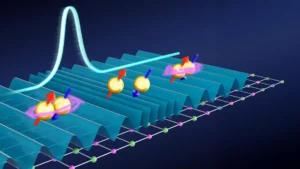
In a landmark achievement for the field of condensed matter physics, a multi-institutional collaboration led by the California Institute of Technology (Caltech) has successfully utilized quantum simulators to observe the energy spectra of conformal field theories. This study, published in the journal Nature, marks the first time that the precise energy levels predicted by these complex mathematical frameworks have been directly measured in an experimental setting. By leveraging highly controlled arrays of neutral atoms, the research team has bridged a 40-year gap between theoretical predictions and physical verification, opening new avenues for exploring the fundamental nature of quantum matter.
The research was a collaborative effort involving the experimental group of Manuel Endres, professor of physics at Caltech, and the theoretical group of Jason Alicea, William K. Davis Professor of Theoretical Physics at Caltech. They were joined by specialists from the Université Paris-Saclay and the Technical University of Munich. Together, they demonstrated that modern quantum simulators have matured to a level where they can test the most foundational laws of physics with unprecedented precision.
The Principle of Universality in Physical Systems
At the heart of this discovery lies the concept of universality. In physics, universality refers to the phenomenon where vastly different physical systems—ranging from boiling water to magnets losing their pull—begin to behave according to the same mathematical rules when they approach a critical point. As Jason Alicea explains, universality is a trait where the "messy, microscopic details wash out," leaving only a few essential features that dictate the system’s behavior.
This concept allows physicists to use a single mathematical framework, known as Conformal Field Theory (CFT), to describe systems that appear unrelated on the surface. CFT has been a cornerstone of theoretical physics for decades, providing the tools to calculate the behavior of systems undergoing phase transitions. However, while the mathematics of CFT suggested specific patterns in energy levels, directly observing these "energy rungs" in a laboratory setting remained elusive due to the extreme sensitivity and complexity of quantum systems.
The Historical Context of the Ising Model
The experiments focused on two specific theories: the Ising conformal field theory and the tricritical Ising conformal field theory. The namesake of these theories, Ernst Ising, was a German physicist who, in the 1920s, developed a mathematical model to explain ferromagnetism. His model described how individual "spins" (the magnetic orientation of atoms) interact with their neighbors to create a collective magnetic state.
Over the last century, the Ising model has evolved from a simple description of magnets into a fundamental tool for understanding phase transitions. The tricritical Ising model represents a more complex scenario where three distinct phases of matter meet at a single point. While these models are mathematically elegant, they describe "critical points" where a system is balanced precariously between two states of order. Reaching and measuring these points requires control over quantum effects that only manifest near absolute zero.
Quantum Simulators: A New Class of Scientific Tools
To test these theories, the researchers did not use a general-purpose quantum computer. Instead, they employed a quantum simulator. While quantum computers are designed to perform any variety of calculations using quantum bits (qubits), quantum simulators are specialized devices built to mimic specific quantum behaviors. They are "purpose-built" systems that allow scientists to "program" the laws of physics into a collection of atoms and observe the outcome.
The Caltech team utilized a platform based on neutral strontium atoms. Unlike ions, which are charged and can be difficult to pack together closely due to electrical repulsion, neutral atoms can be manipulated with extreme precision using "optical tweezers." These tweezers are essentially highly focused laser beams that act like microscopic tractor beams, holding individual atoms in place.
This technology has seen rapid advancement in recent years. A related platform in Professor Endres’s lab recently achieved a milestone by trapping 6,100 atoms in a single array, demonstrating the scalability of the technology. For the CFT experiment, the researchers arranged up to 35 strontium atoms in a perfectly straight line, creating a one-dimensional quantum "wire."
Engineering the Quantum Tipping Point
The experiment focused on a quantum phase transition. Unlike a classical phase transition—such as ice melting into water, which is driven by thermal energy—a quantum phase transition occurs at temperatures near absolute zero and is driven entirely by quantum fluctuations. At this temperature, the system reaches a "tipping point" where even the smallest change in external conditions can cause the entire chain of atoms to shift its collective state.
To induce the interactions necessary for CFT, the researchers used additional lasers to push the strontium atoms into "Rydberg states." In a Rydberg state, an atom’s outermost electron is pushed very far from the nucleus, making the atom significantly larger and highly reactive to its neighbors. These highly excited atoms interact strongly, causing the entire chain to behave as a single, entangled quantum many-body system rather than a collection of individual particles.
By carefully tuning the frequency and intensity of the lasers, the researchers moved the atomic chain to the exact critical point predicted by the Ising and tricritical Ising theories.
Many-Body Modulation Spectroscopy: Listening to the Quantum Ladder
Once the system was at the critical point, the challenge was to measure its energy levels. The researchers compared these levels to the rungs of a ladder. Theory predicted that these rungs would appear at very specific, fixed ratios. To find them, the team developed a technique called "many-body modulation spectroscopy."
The process is analogous to finding the resonant frequency of a wine glass. If you rub a wet finger around the rim of a glass, it will only sing when your movement matches its natural frequency. Similarly, the researchers "shook" the atomic chain by slightly modulating the laser intensity at specific frequencies. When the modulation frequency matched one of the system’s natural energy levels, the atoms responded strongly.
"We repeated the experiment on chains of up to 35 atoms, and the rungs came out as predicted by the Ising conformal field theory," said Xiangkai Sun, a co-lead author and graduate student at Caltech. "The spectra collapsed onto a single universal curve once rescaled for size."
When the team tuned the system to the more complex tricritical point, they observed a different set of ratios. Furthermore, because they had control over every individual atom, they could change the "boundary conditions"—the behavior of the atoms at the very ends of the chain. This allowed them to uncover "hidden" energy rungs that had never been seen before, further confirming the deep mathematical structures of CFT.
Implications for the Future of Physics and Computing
The successful measurement of these spectra is more than just a verification of 40-year-old math; it is a proof of concept for the future of fundamental research. For the first time, scientists have an "experimental realization" of CFT that they can, in the words of Professor Alicea, "poke and prod."
The implications of this work extend into several domains:
- Validation of Theoretical Frameworks: CFT is used in fields as diverse as string theory, black hole physics, and high-temperature superconductivity. Having an experimental platform to verify these theories provides a "ground truth" for theoretical physicists.
- Advancing Quantum Computing: The tools developed for this experiment—such as high-fidelity control of Rydberg atoms and many-body spectroscopy—are directly applicable to building more robust quantum computers.
- Exploring Uncharted Territory: The researchers now plan to move from one-dimensional chains to two-dimensional grids of atoms. While 1D CFT is well-understood mathematically, 2D CFT is significantly more complex and remains one of the great frontiers of theoretical physics.
Professor Manuel Endres noted that the most exciting aspect of this technology is its ability to explore regimes where the answer is not known. "The next step is to point this at systems where nobody knows the response… including regimes that classical computers can’t reach."
As quantum simulators continue to grow in size and precision, they are expected to solve problems in materials science and chemistry that are currently impossible for even the world’s most powerful supercomputers. This study marks a definitive transition for quantum technology: moving from the stage of development and "benchmarking" to becoming a primary tool for discovering the fundamental laws of the universe.
The research was supported by a wide array of institutions, including the U.S. Department of Energy (DOE), the National Science Foundation (NSF), the Army Research Office, and the Gordon and Betty Moore Foundation. This broad base of funding underscores the high level of importance the scientific community places on the intersection of quantum information science and fundamental physics.