Nestled discreetly on a Netherlands Aerospace Centre (NLR) site, mere steps from a verdant forest north of Amsterdam, stands an unassuming white shipping container. Its only outward distinction from a typical cargo unit is the prominent navy blue ESA logo emblazoned on its side. This modest exterior conceals a groundbreaking facility: the European Space Agency’s (ESA) brand-new Chemical Propulsion Laboratory (CPL), a vital new hub poised to accelerate the development of European space propulsion technologies.
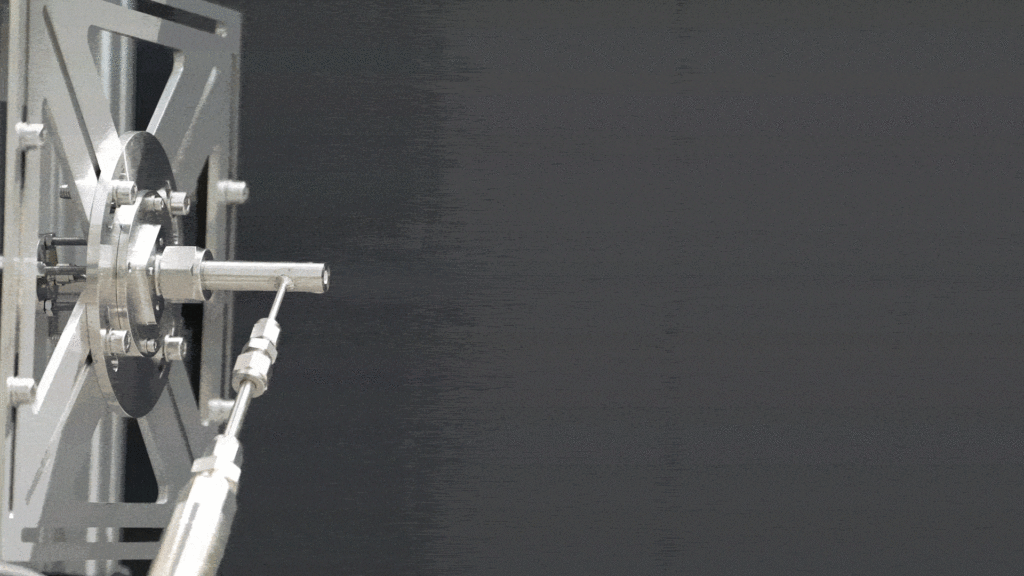
The recent commissioning tests, a critical phase before the lab’s official operational declaration, underscore the CPL’s readiness to support the next generation of space endeavors. During these initial trials, engineers meticulously calibrated and tested the laboratory’s sophisticated equipment using a robust, "battleship" design thruster. This specialized thruster, built exclusively for rigorous testing and not intended for spaceflight, served as the crucible for validating the CPL’s capabilities.
The thruster’s operational principle involves the controlled decomposition of highly concentrated hydrogen peroxide (98% purity). This potent propellant reacts with a catalyst housed within the combustion chamber, a component visibly integrated into the test setup. Early stages of the test footage reveal faint wisps of smoke, a tell-tale sign of the team’s deliberate strategy: firing ten short pulses of propellant. This initial sequence is designed to gently heat the catalyst, optimizing its efficiency and ensuring a more robust and predictable reaction during the primary firing. As Sebastian Klein, an ESA engineer instrumental in the CPL’s development, explained, "Once the catalyst is heated, a few seconds later we push the propellant through continuously to get a few seconds of static firing. This continuous operation was the goal that we wanted to achieve." He further emphasized the paramount importance of safety and verification during these crucial early stages, stating, "Of course, the whole test is not primarily on the thruster but to verify and ensure safe operation of the test bench itself."
A Vital Resource for European Space Ventures
The establishment of the CPL marks a significant strategic investment by ESA, aiming to democratize access to advanced propulsion testing facilities. The laboratory is designed to be a collaborative space, offering not only ESA itself but also burgeoning small and medium-sized enterprises (SMEs) and academic institutions the opportunity to rigorously test their innovative small propulsion technologies. Crucially, these entities will benefit from ESA’s extensive expertise and dedicated training programs, fostering a culture of knowledge sharing and skill development within the European space sector.
This initiative addresses a critical bottleneck that has historically hampered the progress of European space start-ups and research projects. Existing, well-established propulsion test centers are often heavily overbooked, with waiting lists extending for years. Such prolonged delays are often untenable for SMEs and academics operating under stringent deadlines and rapid development cycles. The CPL’s operational model, characterized by its safe, regulated environment and readily available trained support, is precisely what is needed to overcome these challenges. Working with propellants and complex combustion systems inherently involves significant safety considerations, making the CPL’s controlled environment and expert supervision indispensable. For startups, where rapid iteration and agile development are essential for survival and growth, the promise of quick turnaround testing and expert guidance is invaluable.
Chronology of a Crucial Development
The journey to the CPL’s operational status involved several key phases. While specific dates for early design and construction are not publicly detailed, the official symbolic opening event for the Chemical Propulsion Laboratory took place on July 3, 2026. This milestone marked the culmination of extensive planning, development, and rigorous testing. The CPL is strategically designed to complement, rather than duplicate, ESA’s existing Propulsion Laboratory. This synergy allows for a more comprehensive and specialized approach to propulsion research and development across the agency. The operational framework for the CPL is built upon a strong partnership between ESA and the Netherlands Aerospace Centre (NLR), leveraging the strengths and expertise of both organizations to ensure the laboratory’s long-term success and efficiency.
Supporting Data and Technical Specifications
The thruster utilized in the initial commissioning tests represents a class of propulsion systems crucial for various space applications, including satellite maneuvering, orbit adjustments, and small payload deployment. Hydrogen peroxide, particularly at high concentrations, is a well-established monopropellant. Its decomposition over a catalyst, such as iridium or a similar noble metal-based compound, releases hot gases that generate thrust. The efficiency and reliability of this decomposition process are heavily influenced by the catalyst’s temperature and surface area. The CPL’s ability to precisely control propellant flow rates, monitor combustion chamber temperatures and pressures, and analyze exhaust products is fundamental to validating the performance and safety of new thruster designs.
While specific thrust levels and firing durations achieved during these initial tests are proprietary to the ongoing calibration process, the successful execution of continuous static firing for several seconds demonstrates the CPL’s capability to handle sustained propulsive events. Future testing at the CPL will likely involve a wider range of propellants, including bipropellants (fuel and oxidizer combinations), and more complex engine architectures, catering to the diverse needs of the European space industry. The laboratory is equipped to handle propellants with varying toxicity and flammability characteristics, necessitating sophisticated safety protocols, including robust ventilation systems, remote operation capabilities, and emergency response procedures.
Official Responses and Strategic Vision
The opening of the CPL aligns with ESA’s overarching strategy to foster a competitive and innovative European space sector. By providing accessible and advanced testing infrastructure, ESA aims to reduce the barriers to entry for new players and accelerate the pace of technological advancement. This initiative directly supports the agency’s commitment to enabling European leadership in space exploration and utilization.
While direct statements from all stakeholders involved in the CPL’s development are not yet publicly available, the partnership with NLR signifies a shared vision for advancing aerospace capabilities. NLR, with its extensive experience in aerospace research and development, provides a critical foundation for the CPL’s successful operation. The collaboration underscores a trend towards synergistic partnerships between national aerospace centers and ESA, maximizing resource utilization and expertise across the continent.
Broader Impact and Implications for the European Space Industry
The establishment of the Chemical Propulsion Laboratory has far-reaching implications for the European space ecosystem. Its primary impact lies in its ability to significantly shorten development cycles for new propulsion systems. This is particularly critical in the rapidly evolving small satellite market, where miniaturization and cost-effectiveness are paramount. Startups and research institutions can now access state-of-the-art testing facilities without the prohibitive costs and long lead times associated with larger, established centers.
Furthermore, the CPL’s role in providing ESA expertise and training can lead to a more skilled and knowledgeable workforce within the European propulsion sector. This upskilling is vital for maintaining a competitive edge in the global space market. The laboratory also fosters a collaborative environment, encouraging cross-pollination of ideas and accelerating the adoption of best practices in propulsion system design and testing.
The CPL’s existence is a tangible manifestation of ESA’s dedication to nurturing innovation at all levels of the space value chain. By investing in such foundational infrastructure, ESA is not only supporting current space missions but also laying the groundwork for future breakthroughs in areas such as in-space propulsion for deep space exploration, advanced orbital maneuvering for constellations, and potentially even novel propulsion concepts. The ability to safely and efficiently test these technologies in a controlled environment will be a key differentiator for European companies seeking to establish themselves as leaders in the global space economy. The CPL, though housed in a modest shipping container, represents a significant leap forward for European propulsion capabilities, promising to unlock new possibilities and propel the continent’s ambitions further into the cosmos.