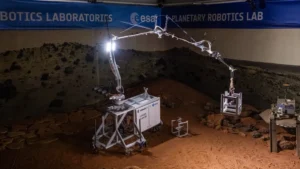
A new era of robotic exploration is dawning for Europe, marked by the hands-on assembly of its most sophisticated robotic arm to date. This advanced piece of engineering, dubbed the Sample Transfer Arm (STA), is meticulously coming together, signifying a significant leap forward in the continent’s capabilities for future missions to the Moon and Mars. Designed to perform delicate and complex tasks with unparalleled precision, the STA is a testament to European ingenuity and a crucial component in the growing drive for autonomous space exploration.
The STA boasts an impressive reach, extending up to 2.4 meters, and a remarkable range of motion with seven degrees of freedom, mirroring the dexterity of a human arm. This sophisticated articulation, combined with integrated cameras and an array of advanced sensors, allows the robotic appendage to perceive and interact with its environment in ways previously unattainable. Its configuration, featuring distinct shoulder, elbow, and wrist-like joints, is complemented by an on-board "brain" and "eyes," enabling it to process visual information, sense physical interactions, and make autonomous decisions. The arm culminates in a highly precise gripper, akin to a human hand, capable of handling objects with millimetric accuracy, a crucial feature for scientific sample collection and intricate operational tasks.
The Science of Touch: Force and Torque Sensing
A cornerstone of the STA’s advanced capabilities lies in its sophisticated force and torque sensor. This integral component provides the robot with a nuanced sense of touch, allowing it to manipulate objects with exceptional dexterity. Unlike simpler robotic systems, the STA’s sensor can detect and interpret precisely how an object is being pushed, pulled, and twisted in three-dimensional space simultaneously. This fine-grained feedback is essential for tasks that require subtle adjustments and careful handling, such as delicately grasping fragile geological samples or precisely positioning tools during extravehicular activities. Complementing this tactile sense, internal position sensors within the arm’s joints provide real-time data on the exact location of the arm’s tip, ensuring a high degree of positional accuracy for all operations.
This level of precision is not merely an engineering feat; it is a fundamental requirement for the increasingly complex operations envisioned for future space missions. Whether it involves carefully extracting unique geological specimens from the harsh Martian surface or providing essential support to astronauts engaged in challenging lunar surface activities, the STA’s refined control and sensory feedback will be paramount.
Origins and Evolution: The Mars Sample Return Connection
The development of the Sample Transfer Arm is deeply rooted in the ambitious joint NASA-ESA Mars Sample Return campaign. Initially conceived to address a critical operational challenge, the STA was tasked with the vital role of transferring precious Martian soil samples collected by NASA’s Perseverance rover and facilitating their secure delivery for eventual return to Earth. This challenging objective necessitated the development of a robotic arm capable of operating in an alien environment with extreme precision and reliability.
While its genesis lies in the Mars Sample Return mission, the STA’s versatility extends far beyond this singular objective. Its advanced design and capabilities make it an ideal candidate for a multitude of applications across both lunar and Martian exploration endeavors. The lessons learned and the technologies honed during its development for Mars are directly transferable to the unique challenges and opportunities presented by lunar exploration.
A Legacy of European Robotic Prowess
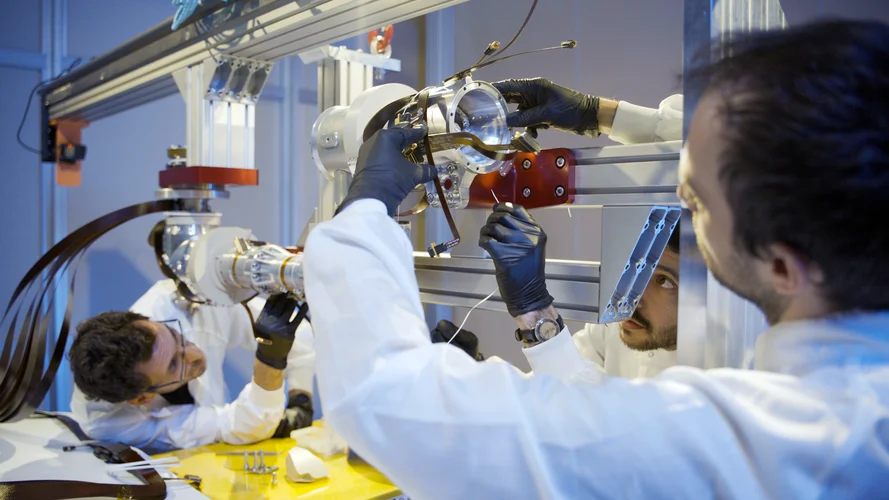
The Sample Transfer Arm stands as a culmination of decades of European expertise and innovation in the field of space robotics. The intricate process of its integration is currently underway at the Italian aerospace company Leonardo, a key player in the European space industry. Engineers at Leonardo’s Nerviano plant, located near Milan, are diligently working to bring the sophisticated arm to life. In the coming weeks, these dedicated teams will commence rigorous testing of the STA’s initial movements within simulated space environments, a critical phase to validate its performance and ensure its readiness for the rigors of space.
The industrial consortium behind the STA represents a significant pan-European collaborative effort, underscoring Europe’s commitment to developing independent space exploration capabilities. Led by Leonardo, the consortium includes prominent companies such as GMV and AVS from Spain, Maxon from Switzerland, 3DPlus from France, and COMOTI from Romania. This expansive network also incorporates specialized suppliers from Denmark, Greece, and Germany, demonstrating the breadth and depth of European industrial collaboration in advanced space technologies. This collective endeavor highlights Europe’s strategic drive towards greater autonomy in space exploration.
Timeline and Key Milestones
The journey of the Sample Transfer Arm from concept to assembly is a testament to a structured and phased approach to complex space hardware development. While specific dates for the initial design phases are not publicly detailed in the provided information, the STA’s development can be broadly understood within the context of ongoing and planned Mars exploration initiatives.
- Conceptualization and Design: The initial conceptualization and detailed design phases would have taken place several years prior to the current assembly stage, driven by the requirements of the Mars Sample Return campaign. This would have involved extensive simulations, trade studies, and the selection of key technologies.
- Component Manufacturing and Subsystem Development: Following the finalization of the design, individual components and subsystems would have been manufactured by the various partners within the industrial consortium. This phase would have included the development of the robotic joints, actuators, sensors, cameras, and the control system.
- Integration and Assembly (Current Phase): The current phase focuses on the meticulous integration of all these components into the complete Sample Transfer Arm. This is being undertaken by Leonardo in Italy.
- Simulated Space Testing: In the coming weeks, as mentioned, Leonardo will begin testing the STA’s functionality in simulated space environments at their Nerviano plant. This will involve vacuum chambers, thermal cycling tests, and vibration tests to mimic the harsh conditions of space.
- Further Qualification and Verification: Following initial simulations, further, more rigorous qualification and verification processes will be undertaken to ensure the arm meets all mission-critical performance and safety standards. This may involve testing at dedicated European Space Agency (ESA) facilities.
- Mission Integration: Once fully qualified, the STA will be integrated into its respective spacecraft or lander for its intended missions, likely involving the Mars Sample Return mission and potentially future lunar missions. The exact timeline for these integrations is dependent on the overall mission schedules of ESA and its international partners.
This phased approach, from initial design through to flight-ready hardware, is standard for complex space missions and ensures that each element is rigorously tested and validated before deployment.
Broader Impact and Implications for European Space Autonomy
The successful development and deployment of the Sample Transfer Arm carry significant implications for Europe’s strategic position in space exploration. The acceleration of space robotic technologies is directly contributing to Europe’s growing autonomy and strategic independence in its pursuit of lunar and Martian exploration. By mastering the design, manufacturing, and operation of such sophisticated robotic systems, Europe is reducing its reliance on external capabilities and forging its own path in venturing beyond Earth.
The inherent versatility of the STA, as highlighted by its potential to support future Moon missions, underscores its value beyond a single program. This adaptability means that the investment in its development yields long-term benefits, enabling Europe to respond to a wider range of scientific and exploratory opportunities. As nations and agencies increasingly look to establish a sustained presence on the Moon and prepare for human missions to Mars, robotic systems like the STA will play an indispensable role in site preparation, resource utilization, scientific investigation, and the essential groundwork that precedes human arrival.
Furthermore, the collaborative nature of the STA’s development fosters a stronger European space ecosystem. It strengthens the capabilities of individual companies, builds institutional knowledge, and promotes cross-border innovation. This collective strength is crucial for Europe to remain a competitive and influential player in the global space arena, capable of undertaking ambitious and groundbreaking missions. The success of the STA will undoubtedly pave the way for future European-led robotic missions, further solidifying its position as a leader in advanced space technology.
Future Prospects and Visual Insights
The ESA has provided further avenues for the public to engage with this significant technological advancement. Readers are encouraged to explore additional images of the Sample Transfer Arm’s assembly process on the ESA’s Mars blog, offering a visual journey into the creation of this groundbreaking robotic system. This transparency and public engagement are vital in building support and understanding for the complex and often unseen work that underpins humanity’s exploration of the cosmos. The STA represents not just a piece of hardware, but a tangible symbol of Europe’s ambition and its growing mastery of the robotic frontier, poised to make significant contributions to our understanding of the solar system and our place within it.