In one of the most remote and inhospitable environments on Earth, where temperatures routinely plunge below -60 degrees Celsius and the sun vanishes for months at a time, a small group of scientists is looking toward the stars and the very origins of the universe. John Della Costa, a researcher with the Background Imaging of Cosmic Extragalactic Polarization (BICEP) project, currently resides at the Amundsen-Scott South Pole Station. To maintain both professional rigor and community morale during the grueling Antarctic winter, Della Costa has integrated MIT OpenCourseWare (OCW) into the daily life of the station, specifically through a weekly "Fysics Fridays" series. This initiative centers on the course STS.042/8.225, titled "Einstein, Oppenheimer, Feynman: Physics in the 20th Century," taught by MIT Professor David Kaiser.
The intersection of high-level astrophysics research and open-access education highlights a unique synergy between the Massachusetts Institute of Technology’s pedagogical mission and the global scientific effort to understand the Big Bang. While the BICEP team utilizes some of the world’s most sophisticated radio telescopes to detect primordial gravitational waves, they are simultaneously engaging with the history and philosophy of their field through digital materials designed for the general public and students worldwide.
The BICEP Collaboration and the Search for Cosmic Inflation
The BICEP project represents a multi-institutional effort to map the Cosmic Microwave Background (CMB), the "afterglow" of the Big Bang. This light, emitted approximately 380,000 years after the universe began, carries the imprint of the earliest physical processes. The BICEP telescopes, located at the South Pole due to the region’s exceptionally dry and stable atmosphere, are specifically designed to look for "B-mode" polarization.
This polarization is theorized to be a "smoking gun" for cosmic inflation, a theory first proposed by MIT Professor Alan Guth in 1980. Inflation suggests that in the first fraction of a second after the Big Bang, the universe underwent an exponential expansion, growing by a factor of at least 10^26. This rapid stretching would have created ripples in the fabric of spacetime—primordial gravitational waves—which should be detectable in the CMB.
"Inflation is really important in making sense of our observations of our universe," Della Costa explains. "We have yet to discover the evidence for inflation that definitively proves that it did happen, and BICEP’s main role here at the South Pole is to discover gravitational waves from the very early universe."
The work is high-stakes and technically demanding. The telescopes must be maintained in a vacuum and cooled to temperatures near absolute zero to detect the faint signals from the dawn of time. The researchers who "winter-over" at the station are responsible for keeping these instruments operational during the period when the station is physically cut off from the rest of the world.
A Chronology of Open Learning: From the Pandemic to the Pole
The journey of MIT’s OpenCourseWare to the South Pole is a testament to the resilience of educational infrastructure in the face of global disruption. The course being watched by the BICEP team, "Einstein, Oppenheimer, Feynman," was itself a product of the COVID-19 pandemic’s constraints.
In the fall of 2020, Professor David Kaiser was forced to adapt his traditional in-person curriculum for a remote audience. Using Zoom and digital slides, he taught the material to approximately 100 students scattered across the globe. Recognizing the value of these refined digital assets, MIT Open Learning launched the course on the OCW platform in August 2022. Unlike standard physics courses that focus purely on mathematical derivations, Kaiser’s curriculum integrates the historical, philosophical, and sociological contexts of scientific breakthroughs.
For John Della Costa, the discovery of OCW occurred earlier, during his time as a graduate student at San Diego State University. The pandemic had disrupted his traditional learning schedule, leading him to seek out supplementary materials. He first engaged with Course 22.01, "Introduction to Nuclear Engineering and Ionizing Radiation," taught by Professor Michael Short. This initial exposure to the depth and accessibility of MIT’s open resources prompted him to prepare for his Antarctic mission by downloading several courses in advance.
The necessity of downloading content stems from the logistical realities of the South Pole. Internet access at the Amundsen-Scott Station is provided by a limited window of satellite visibility, often restricted to only a few hours a day with low bandwidth. Real-time streaming of high-definition lectures is impossible for most of the year. Consequently, Della Costa arrived at the station equipped with a digital library including 8.02 (Electricity and Magnetism), 8.03 (Vibrations and Waves), and Alan Guth’s own 8.286 (The Early Universe).
Fysics Fridays: Community and Mental Health in Isolation
The South Pole Station closes its doors to all incoming and outgoing flights in mid-February and does not reopen until late October or early November. During this "winter-over" period, the crew of approximately 45 people lives in total isolation. The psychological toll of constant darkness and extreme cold is a well-documented challenge for polar researchers.
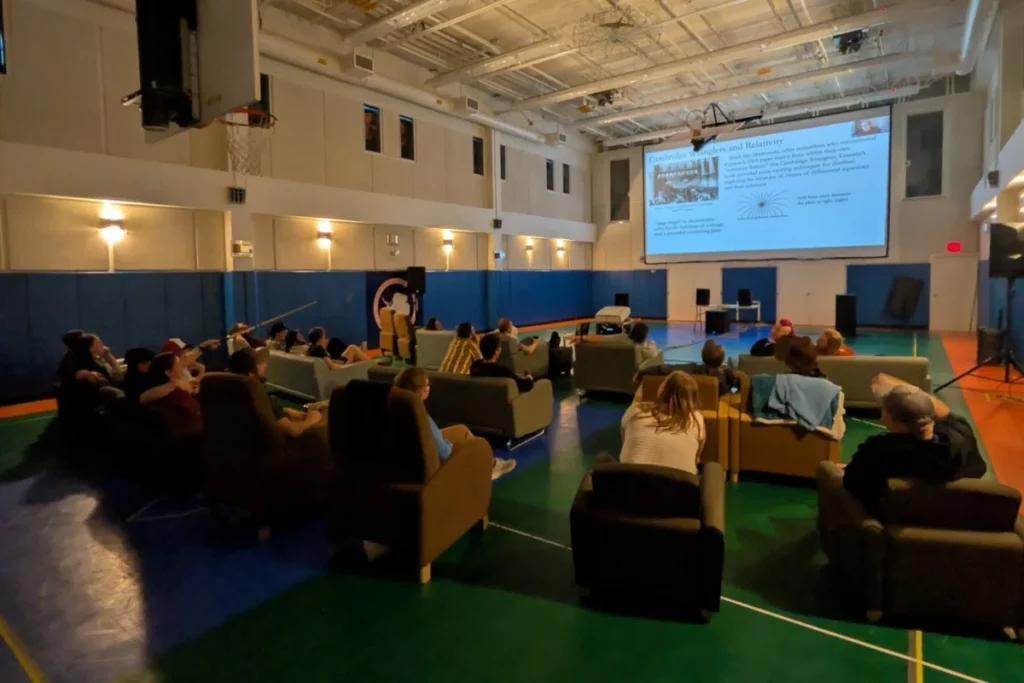
Della Costa recognized that maintaining a sense of community was vital for the mental well-being of the team. He launched "Fysics Fridays" as a way to bring people together for a shared intellectual purpose. The series began with a documentary on the development of the atomic bomb, which resonated with the crew given the historical weight of the subject.
"I thought this would be a perfect lecture series for us to watch, because it’s fairly introductory," says Della Costa regarding Kaiser’s course. "Not everyone here is a physicist, actually. It’s widely accessible, but still meaty, and worth people’s time to watch."
The "Fysics Fridays" group does more than just watch videos; they engage in hands-on science. The team has performed the classic double-slit experiment to demonstrate wave-particle duality and is currently working on constructing a cloud chamber. A cloud chamber allows observers to see the tracks of ionizing radiation, such as cosmic rays, passing through a supersaturated vapor—a tangible link between the abstract physics of the lectures and the high-energy particles that constantly pelt the Antarctic ice.
Academic and Official Responses
The news that MIT’s curriculum is being used to sustain a research team at the Earth’s axis has been met with enthusiasm back in Cambridge. Professor David Kaiser, who co-directs a research group on early-universe cosmology with Alan Guth, noted the profound connection between his classroom teaching and the active field research of the BICEP team.
"Hearing that John and his team are spending a part of their time with this course was just the best message to receive," Kaiser said. He emphasized that the course covers the very material—cosmology and the Big Bang—that the BICEP researchers are testing in real-time. In a gesture of academic solidarity, Kaiser has arranged to host a special Zoom colloquium for the South Pole community, providing a rare opportunity for live interaction between the researchers and the faculty whose materials they are studying.
This interaction underscores the success of the MIT Open Learning initiative, which seeks to "unlock the world’s potential" by providing free access to the institute’s entire curriculum. Since its inception in 2001, MIT OCW has reached over 500 million visitors, but the use case at the South Pole represents one of its most extreme and inspiring applications.
Implications for Global Education and Scientific Collaboration
The use of MIT OCW at the South Pole offers several insights into the future of scientific training and international collaboration:
- Democratization of Knowledge: Even for professionals at the top of their fields, like the BICEP researchers, open-access materials provide a way to broaden their intellectual horizons and engage with interdisciplinary content (such as history and philosophy) that they might not have explored during their formal technical training.
- Overcoming Geographic Barriers: The "offline" use of OCW materials demonstrates how digital education can bypass infrastructure limitations in the world’s most remote areas, from polar stations to rural villages with limited connectivity.
- Mental Health in Extreme Environments: Educational programs serve a dual purpose in isolated settings, providing both intellectual stimulation and a structured social activity that mitigates the effects of "winter-over" syndrome and isolation-induced stress.
- The Feedback Loop of Science: The fact that researchers are using introductory and intermediate materials to supplement their work on the frontiers of physics suggests that the "basics" remain a source of inspiration and clarity, even when dealing with the most complex questions of human existence.
As the BICEP team continues to scan the skies for the faint echoes of the Big Bang, they do so with a renewed connection to the history of the giants whose shoulders they stand upon—Einstein, Oppenheimer, and Feynman. Through the bridge of OpenCourseWare, the distance between the lecture halls of MIT and the frozen plains of Antarctica has been effectively erased, proving that the pursuit of knowledge knows no geographic or environmental bounds. The scheduled reopening of the station in late 2026 will mark the end of this particular winter-over, but the precedent set by "Fysics Fridays" is likely to influence how future crews manage the long, dark nights of the South Pole.