In the immediate aftermath of a nuclear detonation or a catastrophic reactor failure, the physics of the event transitions from high-energy nuclear reactions to complex chemical transformations within milliseconds. As a nuclear fireball expands and cools, it undergoes a phase transition from a high-temperature plasma to a cloud of vaporized debris, eventually condensing into the microscopic solid particles known as nuclear fallout. For decades, scientists have relied on atmospheric models to predict the distribution and composition of this fallout, but new research from Lawrence Livermore National Laboratory (LLNL) suggests that these models may require significant updates. A study published in the journal Analytical Chemistry reveals that the "thermal history"—the specific path and duration of cooling—plays a far more critical role in the chemical makeup of fallout than previously understood, potentially altering how international agencies assess nuclear events and conduct forensic investigations.
The LLNL research team, led by scientist Rakia Dhaoui, utilized advanced plasma flow reactors to simulate the extreme environments found within a cooling nuclear fireball. By manipulating the cooling rates of vaporized uranium, cerium, and cesium, the researchers demonstrated that chemical interactions between these elements are highly sensitive to the amount of time they remain at elevated temperatures. These findings indicate that the "independent behavior" assumption—a cornerstone of many current fallout models—fails to account for the extensive mixing and chemical bonding that occurs during the condensation phase. As global security landscapes evolve, the ability to accurately interpret the chemical "fingerprint" of nuclear debris has become a vital component of national defense and environmental safety.
The Physics of the Fireball: From Plasma to Particle
To understand the significance of the LLNL study, one must first consider the violent environment of a nuclear explosion. When a weapon detonates, energy is released in a burst lasting less than a microsecond. This energy instantly vaporizes the weapon components, the surrounding air, and, in the case of a ground burst, several tons of soil and infrastructure. The resulting fireball can reach temperatures exceeding tens of millions of degrees at its core, creating a state of matter known as plasma.
As the fireball expands, it entrains surrounding air, causing the temperature to drop rapidly. It is during this cooling phase, which lasts from seconds to minutes, that the vaporized elements begin to condense. Refractory elements—those with high boiling points, such as uranium—condense first, forming the cores of solid particles. Volatile elements, such as cesium, remain in the gas phase longer, eventually depositing onto the surfaces of the already-formed particles as the cloud continues to cool.
Historically, fallout studies have been based on "condensation sequences," which rank elements by their volatility. However, the LLNL team found that this sequence is not a rigid hierarchy. Instead, the chemical speciation—the specific chemical form an element takes—can be altered by the cooling trajectory. If a particle remains at a high temperature for a longer duration, elements that were thought to stay separate may instead react and fuse, creating complex mineralogical structures that change the particle’s overall stability and radioactive profile.
Recreating the Extremes: The Plasma Flow Reactor
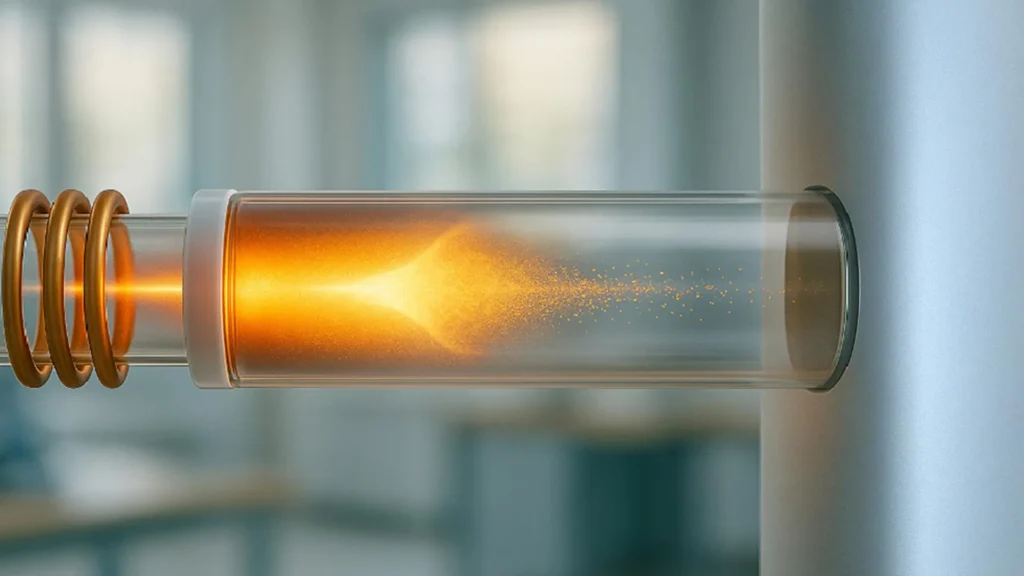
Because real-world nuclear testing has been banned by most nations under the Comprehensive Nuclear-Test-Ban Treaty (CTBTO), scientists must find innovative ways to recreate these conditions in a laboratory setting. The LLNL team utilized a plasma flow reactor, a sophisticated piece of equipment capable of generating stable, high-temperature plasma into which specific chemical precursors can be injected.
In this experiment, the researchers introduced combinations of uranium, cerium, and cesium. Uranium was chosen as the primary benchmark, as it is a central component of nuclear fuel and explosives. Cerium was utilized as a chemical surrogate for plutonium, sharing similar oxidation states and thermal properties without the extreme radiological hazards. Cesium represented the volatile fission products, which are of particular concern for long-term environmental contamination and public health.
The experimental design focused on two distinct thermal histories:
- Gradual Cooling: The vaporized material was allowed to cool steadily as it moved through the reactor tube.
- Extended Heat followed by Rapid Quenching: The material was held at a high temperature for a longer period before being subjected to a sharp temperature drop.
By sampling the particles at various points along the reactor’s flow path, the scientists were able to "freeze" the condensation process at different stages. This allowed them to observe, for the first time in such high resolution, how the elements moved from the gas phase to the solid phase and how they interacted with one another during that transition.
Key Findings: The Role of Cesium and Cerium
The results of the study challenged several long-standing assumptions in nuclear chemistry. The researchers found that while uranium and cerium behaved somewhat predictably—condensing early due to their refractory nature—their chemical states were not identical across the two cooling scenarios. The extended heat period allowed for more thorough oxidation and structural changes within the uranium-cerium matrices.
The most dramatic observations involved cesium. In models where elements are treated as independent actors, cesium is often expected to remain on the outer shell of fallout particles, making it susceptible to leaching by rainwater. However, the LLNL study showed that when materials remained hot for longer periods, the cesium did not just sit on the surface; it mixed extensively with the uranium and cerium.
"Changing how long materials remain at high temperature can alter chemical reactions and how volatile elements like cesium are incorporated into particles," Rakia Dhaoui explained. This internal mixing means that cesium could be "trapped" within the crystal lattice of the fallout particle. This has profound implications for environmental science: if cesium is chemically bound inside a refractory particle, it may be less bioavailable in the short term but could persist in the environment in unexpected ways.
Implications for Nuclear Forensics and Attribution
One of the primary applications of this research is in the field of nuclear forensics. In the event of an unattributed nuclear explosion, the international community would rely on the analysis of fallout debris to determine the nature of the device, its fuel source, and potentially its origin. This process, known as attribution, depends on the ability to work backward from a collected particle to the conditions of the blast.
If forensic scientists use models that ignore the impact of thermal history, they might misinterpret the ratio of elements found in a sample. For example, a high concentration of cesium mixed deep within a particle might be misread as a sign of a specific type of high-yield weapon, when in reality, it was simply the result of a specific cooling path caused by the local environment (such as the presence of concrete or specific soil types).
By replacing simplified assumptions with empirical measurements from the plasma flow reactor, LLNL is providing the forensic community with a more accurate "decoder ring" for nuclear debris. This improves the reliability of decision-making for policymakers and national security officials during a crisis.
Chronology of Fallout Research: From the Cold War to the Modern Era
The study of fallout has evolved through several distinct eras, each shaped by the technology and geopolitical realities of the time:
- 1945–1963 (Atmospheric Testing Era): Following the Trinity test and the bombings of Hiroshima and Nagasaki, the United States, the Soviet Union, and other powers conducted hundreds of atmospheric tests. During this period, "fallout" became a household word. Research focused on the "black box" approach—collecting dust on sticky paper or using high-altitude aircraft to scoop up debris. Scientists observed that fallout came in two forms: "local" (large particles falling near the site) and "global" (fine dust entering the stratosphere).
- 1963–1990s (The Modeling Era): With the signing of the Limited Test Ban Treaty, research moved underground. Scientists began developing computer codes like the DELFIC (Defense Land Fallout Interpretive Code) to predict where clouds would drift. These models were revolutionary but relied on many simplifications due to the limited computing power of the time.
- 2000s–Present (The Laboratory and Micro-Analytical Era): Modern research, like the LLNL study, focuses on the micro- and nano-scale. Using tools like secondary ion mass spectrometry (SIMS) and plasma reactors, scientists are now looking at the atomic structure of individual fallout grains to understand the chemistry of the fireball.
The current LLNL study represents the cutting edge of this third era, moving away from "what happened" to a granular understanding of "how it happened."
Data Analysis: The Shift in Fallout Modeling
The data generated by Dhaoui and her colleagues suggests a paradigm shift. Traditional models often use a "linear cooling" assumption. However, the LLNL data shows that the "time-at-temperature" variable is a non-linear driver of chemical composition.
| Element | Volatility | Traditional Model Behavior | Observed LLNL Behavior (Extended Heat) |
|---|---|---|---|
| Uranium | Refractory | Condenses early, forms core. | Forms complex oxides; incorporates other elements. |
| Cerium | Refractory | Follows uranium closely. | Strong chemical bonding with uranium; acts as a host for volatiles. |
| Cesium | Volatile | Condenses late, coats surface. | Deeply migrates into the particle matrix when heat is sustained. |
This table illustrates the gap between old assumptions and new experimental reality. The increased mixing of cesium into the particle core is perhaps the most significant data point, as it suggests that the "leachability" of fallout—how easily it enters the water supply—may be lower than predicted in certain cooling scenarios, but the difficulty of decontaminating such particles would be significantly higher.
Future Research and Global Safety
The LLNL team is not stopping with uranium, cerium, and cesium. The next phase of their research involves introducing more complex mixtures that include "environmental" materials. In a real-world scenario, a nuclear fireball would involve iron from building structures, silicon from sand, and calcium from concrete. Each of these elements adds a layer of chemical complexity to the condensation process.
"The team plans to expand the work by studying more realistic mixtures of materials," the report noted. By adding these common environmental elements, the researchers hope to create a comprehensive database of how different "urban" or "natural" environments affect the formation of fallout. This is particularly relevant for modern emergency response planning in major cities.
Beyond forensics, this research has implications for reactor safety. In the event of a meltdown, such as those seen at Chernobyl or Fukushima, understanding how fission products like cesium-137 interact with the structural materials of the reactor (like the zircaloy cladding or the concrete containment) can help engineers predict the spread of contamination and design better containment systems.
Conclusion: A New Standard for Nuclear Science
The study by Lawrence Livermore National Laboratory marks a significant step forward in our understanding of one of the most complex phenomena in physics and chemistry. By proving that the thermal history of a nuclear event is just as important as the materials involved, the LLNL researchers have provided a new framework for safety assessments, forensic attribution, and environmental protection.
As nuclear threats continue to be a focus of international security, the transition from "assumptions" to "measurements" is vital. The ability to look at a microscopic grain of dust and accurately reconstruct the thermal history of a fireball represents a triumph of modern analytical chemistry. It ensures that when decision-makers are faced with the most difficult questions in the wake of a nuclear event, they are supported by data that is as precise as the science allows. This research not only improves our models but also strengthens the global toolkit for monitoring and responding to nuclear activities, ultimately contributing to a more informed and secure world.