In a landmark achievement for the field of condensed matter physics and materials science, a collaborative team of researchers from the Institute of Science Tokyo, Tohoku University, and the Nagoya Institute of Technology has successfully observed an electronic transformation occurring within a mere 30 femtoseconds. This fleeting transition, captured within a metal-organic framework (MOF), reveals the existence of a "hidden state"—a phase of matter that does not exist under ordinary equilibrium conditions—and a previously unknown intermediate state that facilitates its birth. The study, recently published in the prestigious journal Physical Review Letters, provides a foundational blueprint for the future of "light-induced material design," where the properties of solids are manipulated not by heat or pressure, but by the precise application of ultrafast laser pulses.
The research was spearheaded by Assistant Professor Tadahiko Ishikawa of the Department of Chemistry at Science Tokyo (formerly Tokyo Institute of Technology), alongside Dr. Samiran Banu, currently a Special Postdoctoral Researcher at RIKEN, and a team of experts in spectroscopy and theoretical physics. By combining state-of-the-art ultrafast laser technology with sophisticated quantum mechanical calculations, the team has managed to peer into a temporal window so small that it represents a millionth of a billionth of a second.
The Quest for Photoinduced Hidden States
In the realm of modern materials science, researchers are constantly seeking ways to alter the physical properties of substances—such as their conductivity, magnetism, or transparency—on demand. Traditionally, this is achieved through thermodynamic variables like temperature and pressure. However, these methods are relatively slow and limited by the laws of equilibrium.
In contrast, "photoinduced phase transitions" offer a radical alternative. When a material absorbs a high-energy photon from a laser, its electrons are kicked into high-energy configurations. This sudden injection of energy can force the material into "hidden states"—phases that are inaccessible through heating or cooling. These states often possess exotic properties, such as high-temperature superconductivity or ultra-fast switching capabilities, which could revolutionize the next generation of electronic and optical devices.
The primary obstacle to utilizing these states has been the sheer speed at which they form. The initial "trigger" events of a photoinduced transformation occur on the femtosecond (fs) timescale. For context, a femtosecond is to one second what one second is to approximately 31.7 million years. Capturing these moments requires not only the world’s fastest "cameras"—in the form of ultrashort laser pulses—but also a deep theoretical understanding of how electrons and atoms dance together in the dark.
Understanding the Architecture: Metal-Organic Frameworks
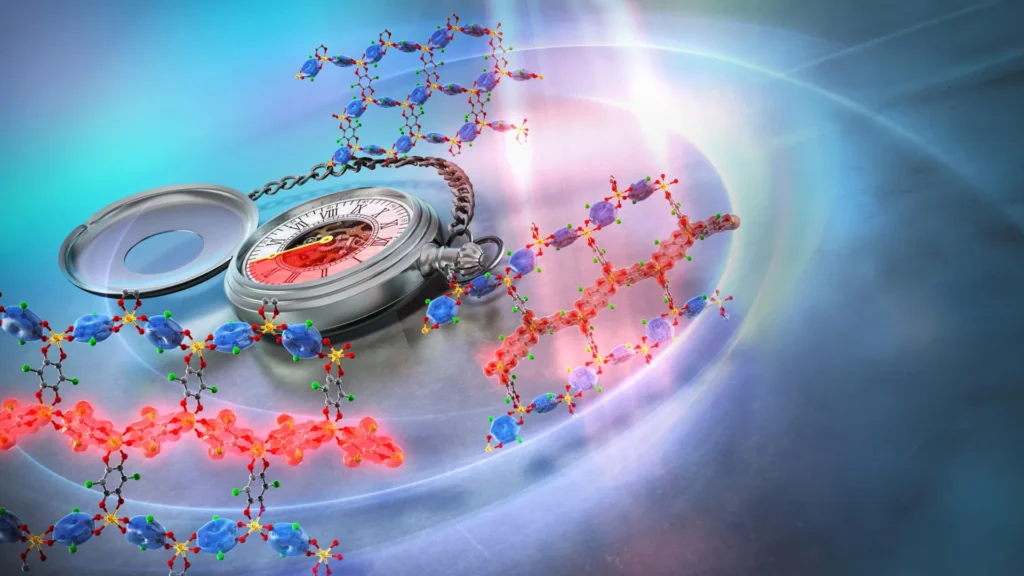
The material at the center of this discovery is a metal-organic framework (MOF). MOFs are a class of crystalline materials composed of metal ions or clusters coordinated to organic ligands to form one-, two-, or three-dimensional structures. They are often likened to "molecular LEGO" because of their highly tunable nature; by changing the metal or the organic bridge, scientists can customize the material’s porosity, surface area, and electronic behavior.
While MOFs are widely known for their applications in gas storage and carbon capture, they have recently emerged as prime candidates for optoelectronics. Their rigid yet flexible framework allows them to undergo significant electronic shifts when exposed to light. In this specific study, the researchers focused on a MOF system where the interaction between metal sites and organic molecules creates a delicate balance of electronic charges.
The Methodology: 6-Femtosecond Laser Spectroscopy
To observe the transformation, the Japanese research team utilized a technique known as time-resolved reflectance spectroscopy. This process involves a "pump-probe" setup. A "pump" pulse of light hits the MOF to initiate the electronic change, followed by a "probe" pulse that measures how the material’s reflectance has altered.
The breakthrough was made possible by the use of laser pulses lasting only 6 femtoseconds. This extreme temporal resolution allowed the team to track the material’s response almost the instant the light hit. By monitoring the reflectance spectrum, they observed a dramatic shift in the material’s optical absorption bands within the first 30 femtoseconds. This shift was the definitive "fingerprint" of a new, hidden electronic state taking hold.
The Discovery of the Bond-Order Wave Intermediate
While the spectroscopy data confirmed that a change had occurred, the experimental results alone could not explain the mechanics of how the transition progressed. To solve this, the team turned to theoretical calculations to simulate the movement of electrons and the vibration of the lattice.
The analysis revealed a surprising two-step process. Immediately after the light was absorbed, the MOF did not jump straight to the hidden state. Instead, it briefly entered a "bond-order wave" (BOW) state. In this intermediate phase, the electronic bonds between neighboring sites in the framework began to alternate in strength, creating a repeating pattern of strong and weak connections.
"We found that the photoinduced hidden state forms within 30 fs through a previously unknown intermediate electronic state," Assistant Professor Ishikawa noted. This BOW state acts as a bridge, a fleeting moment of electronic reorganization that prepares the structural framework for the subsequent shift.
From Electronic Shifts to Structural Realignment
The chronology of the event, as reconstructed by the researchers, follows a precise sequence:
- Photon Absorption (0–6 fs): The material absorbs the laser pulse, exciting the electron cloud.
- The Intermediate State (6–20 fs): The electronic bonds reorganize into the bond-order wave pattern. During this phase, the atoms themselves have not yet moved significantly; the change is almost entirely electronic.
- Atomic Displacement (20–30 fs): Driven by the new electronic configuration, the atoms within the MOF begin to shift their positions. These small structural movements stabilize the system into the "photoinduced hidden state."
- Formation of the Polar State: The theoretical models suggest that this final hidden state is polar. In a polar state, positive and negative electrical charges are distributed unevenly, creating an internal electric field.
The discovery of a polar hidden state is particularly significant. Materials that can switch between polar and non-polar states are the basis for ferroelectric memory, a type of non-volatile storage that is much faster and more energy-efficient than the flash memory used in today’s computers.
Collaborative Synergy and Institutional Impact
The success of this research highlights the strength of the Japanese scientific ecosystem. The project combined the experimental prowess of the Institute of Science Tokyo (Science Tokyo) with the computational expertise of Tohoku University and the material synthesis capabilities of the Nagoya Institute of Technology.
Science Tokyo, a newly formed entity resulting from the merger of the Tokyo Institute of Technology and the Tokyo Medical and Dental University, has placed "ultrafast science" at the heart of its mission. The involvement of Dr. Samiran Banu, who transitioned from a doctoral student during the study to a researcher at RIKEN, underscores the project’s role in cultivating the next generation of physicists.
Inferred reactions from the broader scientific community suggest that this work addresses a long-standing "black box" in photo-physics. While scientists have known for decades that light can change materials, the "first 100 femtoseconds" have largely remained a mystery. By narrowing the window to 30 femtoseconds, this team has provided a frame-by-frame look at the birth of a new phase of matter.
Broader Implications: The Future of Light-Driven Technology
The implications of this research extend far beyond the laboratory. By demonstrating that materials can be transitioned into new states within 30 femtoseconds, the study opens the door to several transformative technologies:
1. High-Speed Optoelectronic Switching
Current silicon-based electronics are limited by the speed at which electrons can move through a circuit, a process that generates significant heat. Light-driven switching, however, occurs at the speed of the laser pulse. If MOFs or similar materials can be integrated into circuits, we could see processors that operate at terahertz (THz) frequencies—thousands of times faster than current gigahertz (GHz) chips.
2. Energy-Efficient Data Storage
The ability to create polar states with light suggests a new way to write data. Using light to "flip" the polarity of a material would require far less energy than the magnetic or electrical methods currently used in hard drives and RAM, contributing to more sustainable "green" computing.
3. Precision Material Engineering
The identification of the bond-order wave intermediate gives scientists a new "lever" to pull. By tuning the organic molecules in a MOF to favor or inhibit this intermediate state, researchers can effectively design materials that respond to specific colors or intensities of light with surgical precision.
Conclusion and Next Steps
The work of Ishikawa, Banu, and their colleagues represents a significant leap forward in our ability to observe and eventually control the microscopic world. By revealing the hidden steps of an ultrafast transformation, they have shown that the path from light to matter is more complex—and more full of potential—than previously imagined.
Future research will likely focus on extending this technique to other classes of materials, such as transition metal oxides or organic superconductors. Additionally, the team aims to investigate how long these hidden states can be maintained; while they form in 30 femtoseconds, making them last long enough to perform useful work is the next great challenge in the field.
As Science Tokyo and its partners continue to refine these ultrafast "molecular cameras," the dream of materials that can be reshaped at the speed of light moves closer to reality. The "hidden states" of the universe are finally coming into view, one femtosecond at a time.