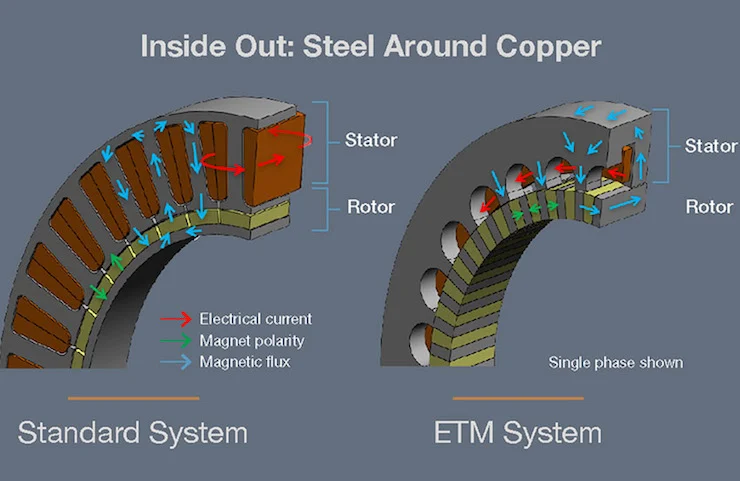
In the expansive and ever-evolving landscape of electric motors, a fascinating paradigm shift is underway with the increasing prominence of transverse flux motors (TFMs), a technology distinguished by its unique magnetic circuit properties and exceptional performance characteristics, particularly high torque density and efficiency. Unlike the widely adopted radial or axial flux designs, TFMs represent a departure from conventional architectures, offering a compelling solution for demanding direct-drive applications across various industries, from industrial robotics to electric vehicles and renewable energy systems. The recent introduction of TFM technology into the robotics market by companies like ETM underscores a pivotal moment, signaling its readiness for broader commercial adoption and challenging long-held engineering trade-offs.
Understanding the Spectrum of Electric Motor Design
To fully appreciate the significance of transverse flux motors, it is essential to first understand the established classifications of electric motors. Motors are typically categorized based on their power source (AC or DC), their construction methods, or, critically, their magnetic circuit properties. The latter classification primarily divides motors into radial flux and axial flux machines, referring to the orientation of the magnetic flux path relative to the motor’s axis of rotation.
Radial Flux Motors: The Industry Standard
The vast majority of electric motors in operation today are radial flux designs. In these motors, the magnetic flux path is perpendicular to the axis of rotation. This configuration is intuitive and forms the basis of most synchronous AC motors, induction motors, and various DC motor types. Picture a conventional motor: the rotor, encompassing the motor shaft, sits concentrically within a stationary stator. The magnetic fields generated by the stator windings interact with the rotor’s magnetic fields (or induced currents), causing the rotor to spin. This radial interaction of flux is robust and well-understood, leading to their widespread use in everything from household appliances to heavy industrial machinery and automotive alternators. Their design is relatively straightforward to manufacture and control, making them a cost-effective and reliable choice for countless applications.
Axial Flux Motors: Compactness and Planar Design
In contrast, axial flux motors are engineered such that the magnetic flux path runs parallel to the axis of rotation. This distinct arrangement often results in a flatter, thinner profile, earning them the moniker "pancake-style motors." The rotor and stator typically consist of discs arranged coaxially, with the magnetic flux crossing the air gap between them in an axial direction. Their compact form factor and high power-to-weight ratio make them attractive for applications where space is at a premium, such as electric vehicle traction motors, drones, and certain types of robotics where a slim profile is advantageous. While offering benefits in specific contexts, they still operate within the constraints of coupling magnetic flux and winding dimensions, which can limit ultimate torque density.
The Paradigm Shift: Introducing Transverse Flux Motors
Transverse flux motors distinguish themselves from both radial and axial designs by featuring a magnetic flux path that is "transverse" to the axis of rotation, meaning it flows across, rather than along or perpendicular to, the axis. This seemingly subtle difference in magnetic circuit topology unlocks profound performance advantages. In practical terms, the design typically involves a single winding for each phase wound circumferentially around the stator, or the axis of rotation. This innovative winding strategy allows the magnetic flux to traverse multiple paths, including axially across the stator, along the circumference of the rotor, and radially through the air gap separating these components.
The core ingenuity of this design lies in its ability to decouple the number of machine poles from the physical size of the windings. In conventional motors, increasing the number of poles typically necessitates smaller windings, which can limit current capacity and lead to thermal issues. TFMs circumvent this limitation. By allowing a larger number of poles to be incorporated without compromising winding volume, TFMs inherently achieve a significantly higher torque density. This translates directly into more power output from a smaller, lighter motor package, alongside superior efficiency due to optimized magnetic paths and reduced copper losses from simplified winding structures.
Advantages and Unprecedented Performance Metrics
The distinctive architecture of transverse flux motors culminates in a suite of advantages that position them as a potentially disruptive force in various high-performance applications:
- Exceptional Torque Density: This is arguably the most significant benefit. By effectively decoupling magnetic flux from electrical windings, TFMs can achieve torque densities dramatically higher than conventional motors. ETM, for instance, has claimed its patented architecture provides up to 10 times greater torque density compared to traditional designs. This means a TFM can produce the same or even greater torque than a much larger and heavier conventional motor, making it ideal for applications where space and weight are critical constraints. For example, a robotic joint could utilize a TFM that is a fraction of the size and weight of a traditional motor-gearbox combination, enabling more agile and compact robotic arms.
- High Efficiency: The optimized magnetic circuit and simplified winding structure of TFMs contribute to higher operational efficiencies. With fewer windings and an ability to better manage flux paths, copper losses (I²R losses) are minimized. This translates into less wasted energy as heat and more power delivered to the load, a crucial factor for battery-powered systems like electric vehicles and robotics, where maximizing range and operational time is paramount. Typical efficiencies can exceed 90-95% under optimal conditions, a competitive edge over some traditional geared systems that incur significant losses.
- Direct-Drive Capability: The high torque density inherent in TFMs often eliminates the need for mechanical gearboxes, which are typically required to multiply torque from conventional motors. Direct-drive systems offer numerous advantages: reduced mechanical complexity, lower maintenance requirements, elimination of backlash (play in the gears), improved positional accuracy and stiffness, and higher overall system efficiency by removing gearbox-related energy losses. This simplification is transformative for applications requiring precise control and smooth motion, such as robotics, machine tools, and direct-drive wind turbines.
- Superior Thermal Management Potential: While complex, the unique construction can sometimes lend itself to better thermal dissipation. ETM’s design, where the steel stator is wrapped around the outside of the low-resistance copper coil, suggests that heat generated in the windings can be more effectively transferred to the external housing, improving thermal reliability and allowing for sustained high-power operation without overheating. This is critical for industrial applications demanding continuous heavy loads.
A Glimpse into the Historical Trajectory and Recent Milestones
The concept of transverse flux machines is not entirely new, with theoretical explorations dating back to the late 20th century. Early designs, however, faced significant hurdles that prevented widespread commercialization. These included complex manufacturing processes, challenges in achieving optimal magnetic material utilization, and difficulties in mitigating inherent issues like cogging torque and ripple.
The resurgence of interest in TFMs can be attributed to several advancements over the last two decades. Progress in materials science, particularly the development of high-performance rare-earth permanent magnets (like Neodymium magnets), has significantly boosted the achievable magnetic flux densities. Concurrently, sophisticated computational modeling tools, such as Finite Element Analysis (FEA), have enabled engineers to meticulously optimize magnetic circuits, predict performance characteristics, and address design challenges with unprecedented precision. Advancements in additive manufacturing and precision machining have also made the intricate geometries of TFMs more feasible and cost-effective to produce.
The recent announcement by ETM to introduce transverse flux motors into the robotics market marks a significant commercial milestone. This move validates the maturity of the technology and its readiness to move beyond academic research and niche applications. ETM’s strategic focus on robotics highlights the industry’s demand for motors that can offer a superior balance of power, precision, and compactness—attributes where TFMs excel.
ETM’s Robotics Breakthrough: A Case Study in Innovation
ETM’s entry into the robotics sector with its transverse flux motor technology is a compelling case study. The company asserts that its motor design "eliminates trade-offs between efficiency and size by decoupling magnetic flux from electrical windings, enabling the torque density of high-ratio systems with the efficiency and thermal reliability of low-ratio drives." This statement directly addresses a long-standing dilemma in motor design: the need to compromise between achieving high torque (often through gearing or larger motors) and maintaining high efficiency and compact size.
For the robotics industry, where every gram and millimeter counts, ETM’s claims are revolutionary. Traditional robotic joints often rely on powerful but bulky motors coupled with complex, high-ratio gearboxes to achieve the necessary torque and precision. These gearboxes introduce backlash, friction losses, and additional weight, which can limit a robot’s agility, payload capacity, and energy efficiency. By offering up to "10x greater torque density," ETM’s TFMs could allow for the direct drive of robotic joints, leading to:
- More Compact Robots: Smaller, lighter joints enable more slender and agile robotic arms, capable of operating in confined spaces or performing delicate tasks with greater dexterity.
- Enhanced Precision and Control: Eliminating gearboxes removes sources of backlash and compliance, leading to higher stiffness and more accurate, repeatable movements—crucial for applications like surgical robotics or precision manufacturing.
- Improved Energy Efficiency: The high efficiency of TFMs, combined with the absence of gearbox losses, significantly reduces power consumption, extending battery life for mobile robots and reducing operational costs for industrial systems.
- Greater Reliability and Reduced Maintenance: Fewer mechanical components mean fewer points of failure, leading to increased uptime and lower maintenance overhead.
Industry analysts and robotics manufacturers are likely observing these developments with keen interest. The potential for a new class of high-performance, direct-drive robotic actuators could fundamentally reshape the design philosophy for collaborative robots (cobots), industrial automation, and even humanoid robotics, paving the way for more integrated and human-like machine movements.
Acknowledging the Hurdles: Challenges and Drawbacks
Despite their impressive advantages, transverse flux motors are not without their complexities and challenges, which have historically limited their broader adoption:
- Complex Mechanical Design and Manufacturing: The intricate geometries of the stator and rotor, coupled with the unique winding arrangements, make TFMs inherently more complex to design and manufacture than conventional motors. This complexity often translates to higher production costs, particularly for smaller volumes. Precision assembly is critical to ensure optimal performance and mitigate issues like vibration and noise.
- Cogging and Ripple Torque: TFMs can be prone to higher levels of cogging torque (unwanted torque variations when the motor is unexcited) and ripple torque (periodic torque variations during operation). These phenomena can lead to vibrations, acoustic noise, and reduced smoothness of motion, which are undesirable in high-precision applications. Advanced magnetic design optimization and sophisticated control algorithms are continuously being developed to mitigate these issues.
- Non-linear Dynamics: The complex magnetic flux paths and interactions within TFMs often result in non-linear dynamic behavior. This characteristic makes accurate modeling and control of TFMs more challenging compared to linear motor models. Developing robust and efficient control strategies requires advanced computational methods and deeper understanding of their electromagnetic interactions, potentially increasing development time and cost.
- Lower Power Factor: Some TFM designs can exhibit a relatively low power factor. A low power factor means that the motor draws more apparent power (in kVA) from the supply than it delivers as real power (in kW), leading to higher current draw for the same mechanical output. This can necessitate larger conductors, transformers, and power electronics, and can increase losses in the electrical supply system. Power factor correction circuitry may be required, adding to the system’s complexity and cost.
Broader Implications and the Future Outlook
The trajectory of transverse flux motor technology extends far beyond robotics, promising significant implications across a multitude of industries.
- Electric Vehicles (EVs): The automotive sector, particularly the rapidly expanding EV market, could be a prime beneficiary. Smaller, lighter, and more efficient traction motors could lead to increased range, improved vehicle performance, and greater interior space. While axial flux motors are already gaining traction in some high-performance EVs, TFMs offer an alternative pathway to superior power density.
- Renewable Energy Generation: In direct-drive wind turbines and hydrokinetic energy systems, TFMs could offer highly efficient, compact generators, eliminating gearboxes that are a common source of failure and maintenance. Their ability to generate high torque at low speeds is particularly advantageous for these applications.
- Aerospace and Drones: For electric aircraft and advanced drone designs, where power-to-weight ratio and efficiency are paramount, TFMs could enable lighter propulsion systems and extended flight times, potentially revolutionizing aerial mobility.
- Industrial Automation and Machine Tools: The precision, stiffness, and high torque density of TFMs make them ideal candidates for high-accuracy machine tools, material handling systems, and other industrial automation equipment where precise control and robust performance are critical.
- Medical Devices: In medical robotics and other precision instruments, the compact size and smooth operation of TFMs could enable more intricate and less invasive procedures.
The development of transverse flux motors aligns perfectly with broader market trends emphasizing electrification, miniaturization, and sustainability. As industries strive for greater energy efficiency and reduced carbon footprints, high-efficiency motor technologies like TFMs become increasingly attractive. Ongoing research and development efforts are focused on mitigating the current drawbacks—reducing manufacturing complexity, improving thermal management, and developing advanced control strategies to minimize cogging and ripple torque. As these challenges are overcome, and economies of scale begin to take hold, the cost-effectiveness of TFMs is expected to improve, paving the way for even wider adoption.
In conclusion, transverse flux motors represent a compelling evolution in electric motor technology, offering a distinctive blend of high torque density, efficiency, and direct-drive capability that positions them as a powerful alternative to conventional radial and axial flux designs. While challenges related to complexity and cost persist, the breakthroughs achieved by innovators like ETM underscore a burgeoning readiness for commercial deployment, particularly in the demanding field of robotics. As the world continues its march towards electrification and automation, TFMs are poised to play a pivotal role, driving innovation and reshaping the performance benchmarks for a new generation of machines.