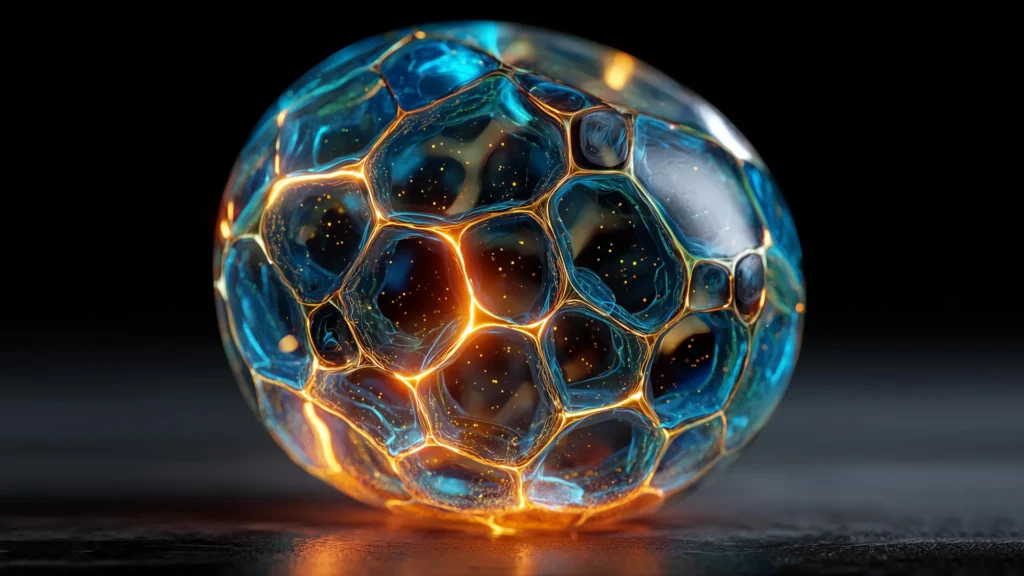
These groundbreaking materials, composed of metal atoms intricately connected by organic molecules, are highly valued for their exceptional ability to trap various gases, including critical greenhouse gases like carbon dioxide, clean energy carriers such as hydrogen, and even atmospheric water vapor. The recent advancement, detailed in a Nature Chemistry publication on May 4, signifies a pivotal step towards making MOF glasses more accessible for real-world applications by borrowing principles from millennia-old glass manufacturing processes.
The international research team, a collaborative effort involving prominent scientists from TU Dortmund University and the University of Birmingham, has demonstrated that MOF glasses can now be engineered and fine-tuned using methods remarkably similar to those traditionally employed for conventional silicate glasses. This breakthrough addresses a significant hurdle in the material’s widespread adoption: its challenging processability due to high softening temperatures.
A Deep Dive into MOF Glasses: Materials of the Future
Metal-Organic Frameworks (MOFs) represent a class of porous, crystalline materials that have garnered immense scientific interest since their discovery in the late 20th century. Their unique structure, characterized by vast internal surface areas and tunable pore sizes, makes them ideal candidates for a multitude of applications, including gas storage, separation, catalysis, and drug delivery. However, the crystalline nature of traditional MOFs often limits their processability and mechanical stability, making it difficult to form them into thin films, membranes, or complex shapes.
This is where MOF glasses come into play. MOF glasses are the amorphous, non-crystalline counterparts of MOFs, formed by melting and cooling certain crystalline MOFs. This transformation from an ordered crystal to a disordered glass state can impart improved mechanical properties, optical transparency, and enhanced processability while often retaining the essential porosity that makes MOFs so valuable. One of the best-known examples is ZIF-62 (Zeolitic Imidazolate Framework-62), a specific MOF that, when melted and cooled, forms a glass retaining a significant portion of its internal pores. These preserved pores are crucial for applications requiring selective molecular sieving, such as gas separation membranes or catalytic converters.
The Ancient Art Meets Modern Science: Inspiration from Traditional Glassmaking
The concept of modifying material properties through chemical additives is not new; it has been a cornerstone of human civilization for millennia. Dr. Dominik Kubicki from the University of Birmingham eloquently articulated this historical continuity, stating, "Glass has been part of human civilization for millennia. From ancient Mesopotamia to modern fiber-optic cables, small amounts of chemical modifiers make it easier to process glass and change its functional properties." Indeed, the addition of soda ash (sodium carbonate) to silica sand allowed ancient Egyptians and Romans to lower the melting point of sand, transforming it into workable glass for vessels, windows, and decorative items. These "fluxing agents" disrupt the strong covalent network of silica, making the molten glass less viscous and easier to shape.
The challenge with MOF glasses like ZIF-62 has been their high softening temperatures, often exceeding 300°C. This temperature range is perilously close to their degradation temperature, where the organic linkers begin to decompose, compromising the material’s integrity and functionality. Such narrow processing windows make manufacturing extremely difficult, expensive, and limit the scalability of MOF glass production, thus hindering their broader technological deployment.
The Breakthrough: Tailoring MOF Glasses with Alkali Modifiers
The international team’s pivotal discovery lies in demonstrating that this ancient principle of chemical modification can be successfully transferred to the realm of hybrid metal-organic glasses. By introducing small chemical compounds containing alkali metals such as sodium or lithium, researchers observed a significant and desirable change in both the structure and behavior of the MOF glass material.
Crucially, these additives were found to lower the temperature at which the MOF glass softens and, consequently, make it flow more easily when heated. This reduction in viscosity at lower temperatures is a game-changer, simplifying manufacturing processes dramatically. Professor Sebastian Henke from TU Dortmund University elaborated on this conceptual leap, explaining, "Our approach is inspired by how conventional silicate glasses have been modified: disrupting the network structure to tune melting behavior and mechanical properties. Our study shows the same principle can be transferred to hybrid metal-organic glasses. This advance brings MOF glasses a step closer to real-world manufacturing and applications in gas separation, storage, catalysis and beyond."
Unveiling the Mechanism: Advanced Spectroscopy and AI-Driven Insights
To understand the precise atomic-level interactions responsible for these transformative changes, the research team employed a sophisticated arsenal of analytical techniques. Scientists at the University of Birmingham, under the leadership of Drs. Dominik Kubicki and Benjamin Gallant, were instrumental in conducting atomic-level structural studies. Their work included high-temperature solid-state Nuclear Magnetic Resonance (NMR) spectroscopy experiments, carried out at the cutting-edge UK High-Field Solid-State NMR Facility.
NMR spectroscopy is a powerful technique that probes the local atomic environment of specific nuclei within a material, providing invaluable information about bonding, structure, and dynamics. By performing these experiments at elevated temperatures, the researchers could observe how the MOF glass structure changed as it approached its softening point, both with and without the alkali additives. The data revealed that sodium ions, in particular, were not merely occupying empty spaces within the MOF glass network but were actively integrating into it, weakening some of the critical connections that define the material’s structural integrity. This weakening effectively reduces the energy required for the network to rearrange, thus lowering the softening temperature.
Complementing these experimental findings, another Birmingham team, led by Professor Andrew Morris and Dr. Mario Ongkiko, leveraged the power of artificial intelligence (AI)-driven computational modeling. Machine-learning-assisted simulations were employed to interpret the complex and often ambiguous NMR data. These advanced computational models provided atomistic-level insights into how sodium interacted with the glass network, confirming and elaborating upon the experimental observations. The synergy between high-resolution experimental data and sophisticated computational modeling allowed for an unprecedented understanding of the modification mechanism. The combined experimental and computational findings definitively showed that sodium does more than simply occupy interstitial spaces. Instead, some sodium atoms were found to replace zinc atoms within the MOF framework, subtly but significantly loosening the overall glass structure and thereby altering its macroscopic properties like softening point and flow characteristics.
Implications for Advanced Technologies: Paving the Way for New Applications
This discovery creates a new, flexible framework for designing customized MOF glasses, significantly broadening their potential for advanced technologies across multiple sectors. The ability to precisely tune the processing parameters and material properties opens doors for:
-
Gas Separation and Storage: MOF glasses are already excellent at selectively capturing and storing gases. With easier manufacturing, they could become more cost-effective for large-scale industrial applications, such as carbon capture from power plants or industrial emissions. Enhanced processability means MOF glass membranes could be more readily fabricated for efficient separation of gas mixtures (e.g., hydrogen purification, nitrogen/oxygen separation).
-
Clean Energy Systems: The ability to store hydrogen safely and efficiently is crucial for a hydrogen-based economy. MOF glasses offer high storage capacities. Easier processing allows for the creation of robust, lightweight hydrogen storage tanks or components for fuel cells. Furthermore, their potential for water capture could be harnessed in humid environments for clean water generation, a critical application in arid regions.
-
Chemical Storage and Catalysis: The tunable porosity and chemical environment within MOF glasses make them excellent candidates for storing sensitive chemicals or acting as catalysts in various reactions. The improved processability means these materials could be integrated into microreactors or used as advanced coatings on reactor surfaces, enhancing reaction efficiency and selectivity.
-
Advanced Coatings and Membranes: The newfound ability to make MOF glasses flow more easily at lower temperatures is a boon for coating applications. Thin, uniform MOF glass coatings could be applied to various substrates to impart specific functionalities, such as anti-corrosion properties, gas selectivity, or enhanced adhesion. Similarly, robust and defect-free membranes for water purification or gas separation could be manufactured more efficiently.
-
Sensors: The precise control over pore size and chemical functionality, combined with improved processability, could lead to the development of highly sensitive MOF glass-based sensors for detecting specific gases, volatile organic compounds, or even biomolecules.
Expert Perspectives and Collaborative Efforts
The success of this research underscores the power of interdisciplinary and international collaboration. The study involved a consortium of leading institutions: Technische Universität Dortmund, the University of Birmingham, Ruhr-University Bochum, SRM University-AP, the Technical University of Munich, and the University of Cambridge. This broad collaboration brought together expertise in materials synthesis, advanced spectroscopy, and computational chemistry, which was essential for tackling such a complex scientific challenge. The enthusiasm from the lead researchers reflects the profound impact they anticipate. Dr. Kubicki’s remark about unlocking "new possibilities for future high-performance materials" encapsulates the forward-looking vision of the team, emphasizing that this is not merely an incremental improvement but a foundational shift in how MOF glasses can be designed and deployed.
Looking Ahead: Challenges and Future Directions
While this discovery marks a significant leap forward, the scientific journey continues. Now that scientists possess a clearer understanding of how to chemically modify these materials to improve their processability, further research is needed to refine their properties and ensure their real-world viability. Key areas for future investigation include:
- Improved Stability: Ensuring that the modified MOF glasses maintain their structural integrity and functionality over long periods, especially under challenging operational conditions (e.g., high temperatures, corrosive environments).
- Predictive Modeling: Developing more sophisticated computational models that can accurately predict the behavior of MOF glasses with various chemical modifiers, accelerating the discovery of new compositions with tailored properties.
- Performance Evaluation: Rigorous testing and evaluation of these modified MOF glasses in prototype technologies to assess their performance in real-world applications and validate their commercial potential.
- Exploring Other Modifiers: Investigating a broader range of chemical additives beyond sodium and lithium to uncover even more diverse property tunability.
- Scalability: Developing cost-effective and environmentally friendly methods for large-scale production of these modified MOF glasses.
This groundbreaking research has effectively bridged a gap between ancient artisanal knowledge and cutting-edge materials science. By demonstrating that the fundamental principles of traditional glassmaking can be applied to the sophisticated world of MOF glasses, the international team has not only overcome a critical manufacturing barrier but also laid a robust new framework for the design and deployment of these futuristic materials, promising a significant impact on clean energy, environmental remediation, and advanced manufacturing. The path is now clearer for MOF glasses to move from the laboratory to widespread industrial application, fulfilling their potential as truly transformative materials of the 21st century.






