In a landmark achievement for the fields of nanotechnology and condensed matter physics, a collaborative research team from Brown University and the University of Michigan has successfully synthesized and stabilized a previously theoretical state of matter. By meticulously engineering silver nanoparticles into specialized geometric configurations, the researchers have captured a "missing link" in the structural evolution of materials—an intermediate state that exists momentarily during the transition between two common atomic arrangements in metals. The findings, published in the journal Science, represent a significant leap forward in our understanding of phase transformations and open new avenues for the development of room-temperature quantum technologies.
For decades, scientists have sought to observe the precise moments when a material’s internal structure shifts from one crystal lattice to another. In metals, these transitions are fundamental to determining mechanical properties like hardness, ductility, and conductivity. However, because these intermediate phases are inherently unstable and fleeting, they have remained confined to mathematical models and computer simulations until now. The successful stabilization of these structures at the nanoscale provides a tangible blueprint for "bottom-up" material design, where scientists can dictate the properties of a material by controlling the assembly of its smallest components.
The Architectural Blueprint of Metals: FCC vs. BCC
To appreciate the magnitude of this discovery, one must first understand the primary ways in which atoms organize themselves in solid matter. Most metallic elements naturally gravitate toward one of two highly efficient arrangements: face-centered cubic (FCC) and body-centered cubic (BCC).
In an FCC structure—found in metals like gold, silver, and copper—atoms are packed as tightly as possible. Imagine a cube where an atom sits at each of the eight corners and another atom is embedded in the center of each of the six faces. This configuration maximizes density and is responsible for many of the unique properties of precious metals. Conversely, the BCC structure is slightly less dense, featuring an atom at each corner of the cube and a single atom at the very center of the cube’s volume. Iron, for example, exists in a BCC state at room temperature but undergoes a dramatic transformation into an FCC state when heated above 912 degrees Celsius.
While these end-states are well-documented, the "pathway" between them has been a subject of intense debate. How does an atom at the center of a cube’s face migrate to the center of the cube itself? What does the material look like during that split-second of movement?
Unmasking the Nishiyama-Wassermann Pathway
Several theoretical models have been proposed to explain these transitions. One of the most prominent is the Nishiyama-Wassermann (NW) pathway, which predicts a specific sequence of intermediate, "distorted" structural states. Because these states represent a high-energy, unstable bridge between two stable valleys, they usually vanish as soon as they form.
"Materials scientists have cared about how to control the amount of FCC and BCC in their metals for a long time, but the transitions between these phases have been hard to study because they are so unstable," explained Tim Moore, a study co-author and assistant research scientist at the University of Michigan.
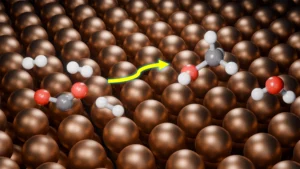
The research team realized that if they could not capture this transition in bulk metal, they might be able to recreate it using nanoparticles as "artificial atoms." By treating nanoparticles like building blocks, they could potentially freeze the transition in place.
Engineering the "Mecon": A New Class of Building Block
The breakthrough began with the synthesis of silver nanoparticles with a very specific geometry: the truncated octahedron. The researchers dubbed these particles "mecons." A mecon is essentially a diamond-like shape with its points sliced off, resulting in a 14-sided polyhedron.
Ou Chen, an associate professor of chemistry at Brown University and a lead author of the study, noted that the mecon shape is uniquely suited for this experiment because it sits geometrically between a sphere and a cube. "Our work is a little bit like kids playing with LEGO blocks," Chen said. "We synthesize unique nanoscale building blocks and stack them into interesting structures."
By adjusting the heating and cooling cycles during the chemical synthesis of these silver mecons, the team, led by senior research scientist Yasutaka Nagaoka, was able to fine-tune the "roundness" or "cubicity" of the particles. This precision allowed them to mimic the different stages of the Nishiyama-Wassermann pathway.
The Role of Molecular "Hairs" and Superlattices
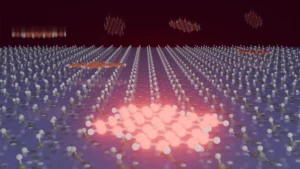
Creating the particles was only the first step. To observe the intermediate state, the particles had to be organized into a "superlattice"—a larger, periodic structure where the nanoparticles themselves act as the repeating units, much like atoms in a traditional crystal.
To facilitate this assembly, the researchers coated the silver mecons with long-chain organic molecules (ligands). These molecules acted like flexible, sticky "hairs." When the particles were brought together, these molecular chains entangled, providing the necessary structural support to hold the mecons in orientations that would normally be energetically unfavorable.
"You can kind of picture them like hairy particles," Moore said. "The hairs are flexible enough that the particles have more freedom to shift, but they also fit together nicely, which allows the particles to mesh together."
The stabilization was verified through a combination of high-resolution electron microscopy and advanced computer simulations. Sharon Glotzer’s research group at the University of Michigan provided the computational backbone, running simulations that confirmed the "hairy" particles were indeed forming the exact transitional arrangements predicted by the NW pathway. The synergy between laboratory observation and digital modeling proved that the team had successfully "trapped" a state of matter that nature usually refuses to let linger.
Quantum Breakthrough: Room-Temperature Light-Matter Coupling
While the structural implications of the research are profound for materials science, the team discovered an even more surprising phenomenon: the new silver superlattices exhibited extraordinary optical properties.
When the material was exposed to light, the researchers observed evidence of "deep-strong light-matter coupling." In this state, the electrons within the silver nanoparticles begin to oscillate in perfect unison with the incoming light waves. This oscillation becomes so intense that the light and matter become "entangled," effectively creating a hybrid state where the photon and the electron are no longer distinct entities.
Typically, such quantum effects are fragile and only observable at cryogenic temperatures (near absolute zero), where thermal noise does not disrupt the delicate synchrony. However, the unique geometry of the mecon superlattices allowed this coupling to occur at room temperature.
This discovery has significant implications for quantum information science. Materials that can maintain quantum states at room temperature are the "holy grail" for developing practical quantum computers, ultra-secure communication networks, and highly sensitive quantum sensors.
Implications for the Future of Material Design
The ability to stabilize transitional states of matter suggests a shift in how we approach manufacturing and chemistry. Instead of relying on the inherent properties of bulk elements, scientists can now envision a "bottom-up" approach where they design the building blocks first to achieve a specific result.
"Anytime you’re able to identify a new phase of matter, new applications are going to emerge," Chen said. The potential applications range from more efficient catalysts for chemical reactions to new types of optical filters and sensors that leverage the deep-strong coupling effect.
Furthermore, the study provides a new lens through which to view metallurgy. By understanding the intermediate steps of the FCC-to-BCC transition, engineers might develop new ways to heat-treat steel and other alloys, creating materials that are stronger or more resistant to fatigue by "tuning" the phase transitions at a granular level.
Timeline of Discovery and Institutional Support
The journey to this discovery involved years of cross-disciplinary collaboration. The project integrated expertise in synthetic chemistry from Brown University with the computational physics and engineering prowess of the University of Michigan.
The timeline of the research reflects a meticulous process:
- Phase I (Synthesis): Development of the mecon-shaped silver nanoparticles and the refinement of the "hairy" ligand coating.
- Phase II (Assembly): The creation of superlattices under varying thermal conditions to find the "sweet spot" for the intermediate state.
- Phase III (Verification): Utilizing X-ray scattering and electron microscopy to map the structure, followed by Michigan’s simulations to confirm the NW pathway.
- Phase IV (Optical Testing): Discovering the room-temperature quantum effects that set the material apart from standard silver structures.
The research was made possible through extensive funding from the National Science Foundation (NSF) and the Department of Energy (DOE). Multiple grants supported the various stages of the study, highlighting the federal commitment to advancing United States leadership in nanotechnology and quantum materials.
As the scientific community digests these findings, the Brown and Michigan teams are already looking toward the next step: exploring whether other metals, such as gold or platinum, can be coaxed into similar intermediate states. If successful, this "LEGO-block" approach to physics could redefine our mastery over the physical world, turning theoretical models into the foundations of next-generation technology.