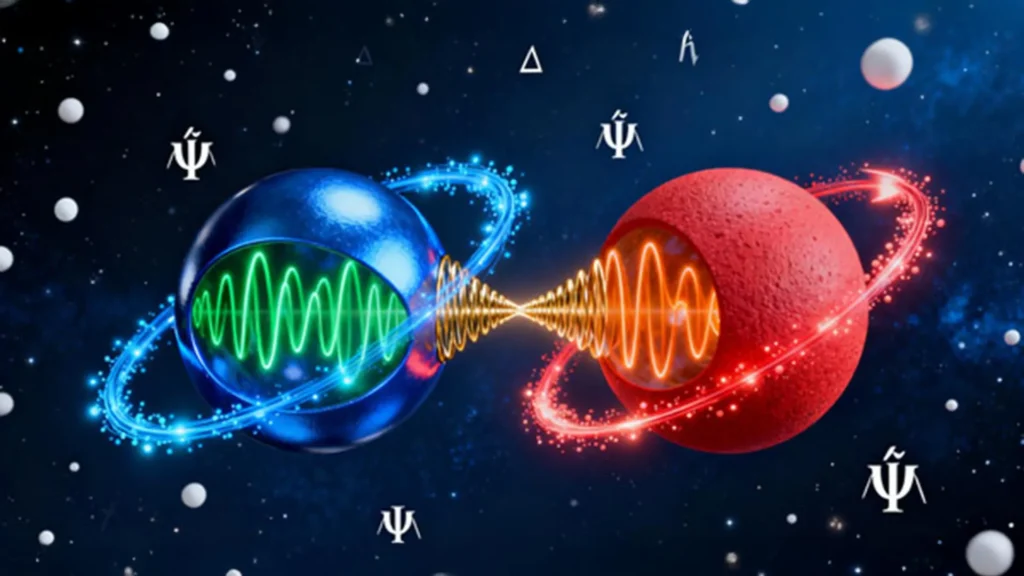
The field of quantum mechanics has long been characterized by the delicate nature of its primary actors: qubits, photons, and phonons. In a significant advancement for the practical application of quantum technologies, a research team at the RIKEN Center for Quantum Computing (RQC) in Japan has unveiled a theoretical framework for achieving one-way, or nonreciprocal, quantum synchronization of phonons. This discovery, authored by Deng-Gao Lai, Adam Miranowicz, and Franco Nori, represents a departure from traditional quantum synchronization methods, which are often paralyzed by the twin challenges of manufacturing imperfections and environmental interference. By establishing a "one-way street" for sound particles at the quantum level, the RIKEN team has provided a blueprint for more resilient quantum processors and sophisticated signal-processing hardware.
The Mechanics of Nonreciprocity in Modern Technology
To understand the magnitude of the RIKEN proposal, one must first consider the role of nonreciprocal components in existing electronic and optical infrastructure. In classical engineering, a nonreciprocal device is one that allows a signal to pass in one direction but blocks or attenuates it in the reverse. A common example is the diode in an electrical circuit, which permits current to flow in one direction, or an optical isolator, which prevents reflected light from returning to a laser source and causing damage or instability.
In the burgeoning field of quantum information science, achieving this same one-way flow is significantly more complex. Nonreciprocity is essential for directing quantum signals through complex networks without the risk of "back-action" or unwanted reflections that can corrupt fragile quantum data. While nonreciprocal systems for photons (light) and electrons are well-documented, the control of phonons—the discrete units of vibrational energy or "particles" of sound—has remained a more elusive goal. Phonons are integral to the operation of many quantum devices, particularly those involving optomechanical resonators where light and mechanical motion interact.
A Historical Perspective on Synchronization
The concept of synchronization itself has a storied history in physics, dating back to the 17th century. In 1665, the Dutch scientist Christiaan Huygens, the inventor of the pendulum clock, noticed that two clocks hanging from the same wooden beam would eventually swing in perfect unison, regardless of their starting positions. This phenomenon, known as mutual synchronization, occurs because of small vibrations transmitted through the supporting structure.
As physics transitioned into the 20th and 21st centuries, scientists began to explore whether this classical phenomenon could be replicated in the quantum realm. Quantum synchronization involves two or more quantum systems—such as atoms, ions, or mechanical resonators—locking into a shared phase or frequency. However, until recently, most research focused on reciprocal synchronization, where each system influences the other equally. The quest for nonreciprocal quantum synchronization—where System A synchronizes to System B, but System B remains unaffected by System A—has been a primary objective for researchers seeking to build directional quantum networks.
Overcoming the Fragility of Quantum States
The primary barrier to implementing nonreciprocal quantum synchronization in real-world settings has been the extreme sensitivity of quantum states. In a laboratory environment, quantum systems are shielded from "noise"—the chaotic thermal and electromagnetic fluctuations of the surrounding world. However, for quantum technologies to become commercially viable, they must operate in conditions where environmental noise and fabrication imperfections are inevitable.
"Practical quantum technologies face critical challenges from random fabrication imperfections and environmental noise," explains Adam Miranowicz, a lead researcher at the RQC. In traditional models, even a slight deviation in the manufacturing of a resonator or a minor increase in ambient temperature can cause decoherence, a process where the quantum system loses its "quantumness" and reverts to classical behavior. This sensitivity has historically made nonreciprocal synchronization appear as a "fragile" resource, one that exists in theory but collapses under the weight of physical reality.
The RIKEN Strategy: Merging Effects for Robustness
The RIKEN team’s proposal, detailed in their recent theoretical study, introduces a technique that transforms nonreciprocal quantum synchronization from a fragile state into a robust one. Their approach utilizes a combination of two distinct quantum effects within a single framework, creating a system where phonons—the quantum units of sound—synchronize only when an external influence, such as a laser or a magnetic field, is applied from a specific direction.
This method relies on the strategic manipulation of optomechanical systems, where light is used to control the mechanical vibrations of a physical object. By carefully tuning the interaction between light and phonons, the researchers demonstrated that they could induce a state where information flows unidirectionally. If the light or magnetic field is reversed, the synchronization effect vanishes, fulfilling the criteria for nonreciprocity.
The most striking aspect of the study, according to the researchers, was the system’s inherent resilience. "We were thrilled to discover that quantum synchronization persists even in the presence of substantial imperfections and noise," says Deng-Gao Lai. This discovery contradicts the long-standing assumption that complex protection schemes, which add layers of hardware and computational overhead, are required to preserve nonreciprocal states.
Supporting Data and Theoretical Implications
The RIKEN study provides a mathematical foundation for what the researchers call "fragile-to-robust" transitions. In their simulations, the team tested the synchronization of phonons across a range of "noisy" parameters. They found that while conventional methods saw a total breakdown of synchronization when faced with a 10% variance in resonator frequency (a common fabrication defect), their proposed method maintained high levels of phase-locking.
Furthermore, the data suggests that the system can handle significant levels of thermal noise. In quantum computing, thermal noise is often the enemy of "entanglement" and "superposition." The RIKEN model, however, utilizes the environmental interaction in a way that stabilizes the one-way synchronization rather than destroying it. This suggests a paradigm shift: instead of fighting against the environment, quantum systems can be designed to function within it.
Broader Impact on Quantum Networking and Computing
The implications of this research extend far beyond the laboratory. As the world moves toward the development of a "Quantum Internet," the ability to send information in one direction without interference is paramount.
- Quantum Signal Processing: Nonreciprocal phonon devices could serve as the quantum equivalent of diodes and transistors, allowing for the creation of complex acoustic circuits that process information with minimal energy loss.
- Invisible Cloaking: In the realm of advanced materials, the ability to control the direction of sound waves (phonons) could lead to the development of "acoustic cloaks" that render objects invisible to sonar or other sound-based detection methods by directing sound waves around them.
- Error-Resilient Processors: One of the greatest hurdles in quantum computing is error correction. By utilizing robust nonreciprocal synchronization, engineers can design quantum processors where the components are naturally shielded from the "back-talk" of neighboring qubits, reducing the error rate and the need for massive error-correction protocols.
- Quantum Sensing: Devices that use phonons for sensing—such as ultra-sensitive microphones or accelerometers—could benefit from one-way synchronization to filter out background noise while maintaining high sensitivity to the target signal.
Expert Reactions and Future Directions
The announcement has garnered attention from the global physics community. While the current study is theoretical, its foundations are built on existing optomechanical technology, suggesting that experimental verification could be on the horizon.
Franco Nori, a prominent figure in the study of quantum optics and condensed matter physics, emphasizes that this research "establishes a new foundation for generating nonreciprocal quantum resources with future practical applicability." The RIKEN team is now preparing for the next phase of their research, which involves collaborating with experimentalists to build physical prototypes based on their theoretical models.
"We’re now planning to explore applications in quantum networking and error-resilient quantum information processing," adds Lai. The goal is to move from the abstract world of equations into the physical world of hardware, where these robust phonons can be put to work.
Conclusion: A New Frontier in Quantum Control
The RIKEN Center for Quantum Computing’s proposal for one-way phonon synchronization marks a pivotal moment in the evolution of quantum mechanics. By demonstrating that nonreciprocity can be both directional and durable, the research addresses one of the most persistent criticisms of quantum technology: its inability to function outside of pristine, controlled environments.
As the timeline of quantum development accelerates, the transition from fragile laboratory experiments to robust, real-world applications becomes the primary objective. The work of Nori, Miranowicz, and Lai suggests that the future of quantum technology may not just be about making systems quieter or more perfect, but about designing them to be inherently resilient to the chaos of the natural world. In the quest to build the next generation of computers and communication networks, the ability to create "one-way streets" for quantum sound may be the breakthrough that finally allows the technology to scale.