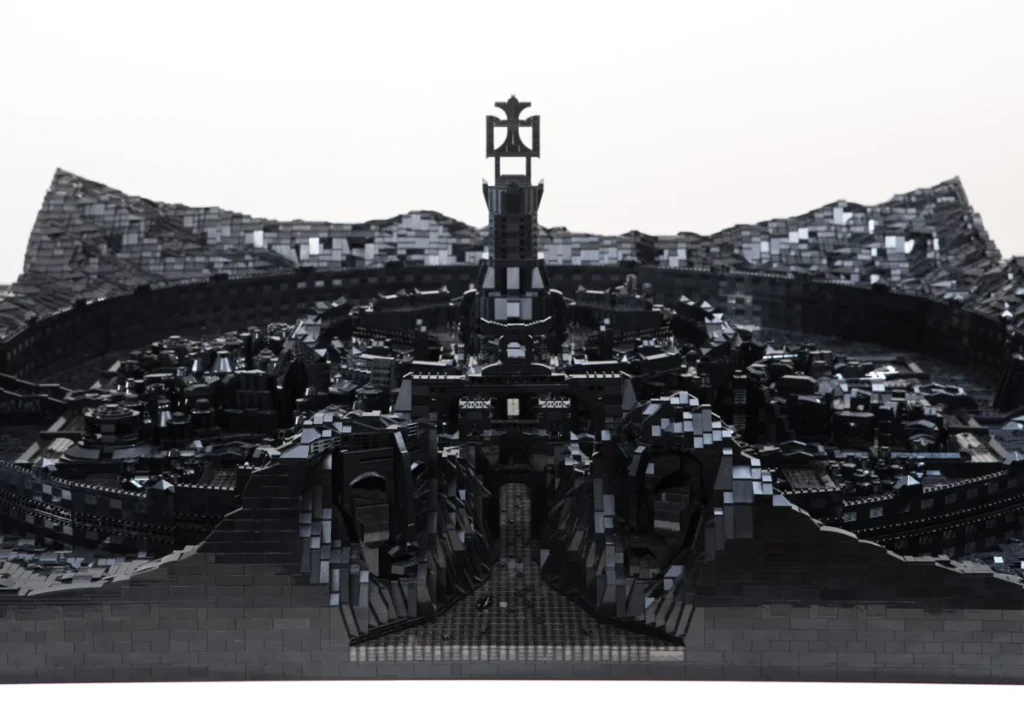
The intersection of contemporary art, historical reclamation, and popular culture has found a singular voice in Toronto-based artist Ekow Nimako, whose massive, monochromatic sculptures made entirely from LEGO elements are redefining the boundaries of Afrofuturism. Nimako’s work, most notably his sprawling installation Kumbisaleh 3020 CE, serves as a bridge between the ancient civilizations of Africa and a speculative future where Black identity is explored through the lens of liberation, technological advancement, and architectural majesty. By utilizing a medium traditionally associated with childhood play, Nimako constructs complex narratives that challenge the historical erasure of Black contributions to civilization while envisioning a world devoid of the scars of colonization and systemic violence.
The Concept of Afrofuturistic Liberation
At the heart of Nimako’s creative process is the philosophy of Afrofuturism—a cultural aesthetic that combines elements of science fiction, historical fiction, and fantasy to explore the African diaspora’s experience and to imagine a future through a Black lens. For Nimako, this is not merely an artistic choice but a method of liberation. He asserts that the act of imagining a reality is the first step toward making that reality manifest. This sentiment is echoed in his most famous work, which reimagines the capital of the ancient Ghana Empire, Kumbi Saleh, not as a ruin of the past, but as a thriving metropolis in the year 3020.
"I reached into the past to essentially propel us into the future," Nimako explained regarding his motivations. By looking at the heights of medieval African kingdoms, he provides a counter-narrative to the prevailing Western historical focus on the transatlantic slave trade and the subsequent eras of subjugation. In Nimako’s vision, the future is an extension of a sovereign and prosperous past. This reimagining is akin to the cultural phenomenon of Marvel’s Wakanda—a fictional African nation that remained untouched by external interference, allowing it to become the most technologically advanced society on Earth. Nimako’s sculptures serve as a physical manifestation of this "what if" scenario, inviting viewers to contemplate a world where Black brilliance has been allowed to flourish unimpeded for millennia.
The Architectural Masterpiece: Kumbisaleh 3020 CE
The centerpiece of Nimako’s current portfolio is Kumbisaleh 3020 CE, a 30-square-foot architectural landscape that is permanently housed at the Aga Khan Museum in Toronto. The sculpture is a feat of both engineering and imagination, constructed from over 100,000 individual LEGO elements. The choice of the Ghana Empire as a subject is significant; at its peak in the 9th to 11th centuries, the empire was a global hub of trade, particularly in gold and salt, and was known for its sophisticated administrative structures and urban centers.

Nimako’s futuristic rendition of this city features soaring obsidian-like towers, intricate geometric patterns, and sprawling residential complexes, all rendered in a stark, uniform black. This monochromatic approach is a signature of Nimako’s work, intended to emphasize the form, texture, and structural integrity of the pieces while simultaneously serving as a visual metaphor for the beauty and resilience of Blackness. The sheer scale of the project required months of meticulous planning and assembly, pushing the limits of the plastic building blocks to create organic curves and sharp, futuristic angles that defy the medium’s typical rectangular constraints.
A Chronology of Artistic Evolution
Ekow Nimako’s journey from a child playing with toys to an internationally recognized artist is a testament to the power of sustained creative vision. His relationship with LEGO began at the age of four, a formative period during which he first expressed a desire to build for the rest of his life. However, the path to professional artistry was paved through formal education and a diversifying of his creative skillset.
- 2010: Nimako graduated from York University in Toronto with a Bachelor of Fine Arts (BFA). This academic foundation allowed him to transition from hobbyist building to conceptual sculpture, integrating themes of identity and social justice into his work.
- 2014–2020: During this period, Nimako rose to prominence within the Canadian art scene. He produced several major series, including "Building Black," which focused on the representation of Black children and mythical figures. By 2021, he had completed 16 exhibitions and three major public artworks.
- 2019: The commission of Kumbisaleh 3020 CE for the Aga Khan Museum marked a turning point, bringing his work to a global audience and solidifying his role as a leading figure in contemporary Afrofuturistic art.
- 2022: Nimako expanded his "Building Black" series with the debut of Journey of 2,000 Ships at the Dunlop Gallery in Regina, Saskatchewan. This exhibition explored the legendary 14th-century voyage of Mansa Abu Bakr II of the Mali Empire, who reportedly set sail into the Atlantic with a massive fleet to discover the edge of the ocean.
Technical Precision and the Medium of LEGO
The use of LEGO as a primary medium presents unique challenges and opportunities. Unlike traditional clay or bronze, LEGO elements are manufactured to strict tolerances, requiring the artist to work within a predefined geometric system. Nimako’s ability to transcend these limitations is what sets his work apart. He utilizes specialized "SNOT" (Studs Not On Top) techniques to create smooth surfaces and complex facades that mask the interlocking nature of the bricks.
The decision to use exclusively black bricks is both an aesthetic and a political statement. In the world of "Adult Fans of LEGO" (AFOL), black is often used for structural support or specific details, but Nimako uses it as the sole palette. This forces the viewer to focus on the interplay of light and shadow, highlighting the architectural nuances of his Afrofuturistic cities. Furthermore, it serves to center Blackness in a medium that, for decades, lacked diverse representation in its minifigures and themes.
Data regarding the scale of his work highlights the intensity of his process. A single large-scale sculpture can take upwards of 500 to 1,000 hours to complete, involving the sorting of tens of thousands of pieces by shape and size. Nimako often sources his materials from global secondary markets to find the specific quantities of black elements needed for his massive installations.

Institutional and Public Response
The reception of Nimako’s work has been overwhelmingly positive, drawing praise from both art critics and the general public. The Aga Khan Museum, known for its focus on Islamic arts and heritage, noted that Nimako’s work provides a vital link between historical African civilizations and modern creative expressions. Critics have pointed out that his work occupies a rare space where "high art" meets "pop culture," making complex themes of decolonization accessible to a younger, more diverse audience.
Furthermore, Nimako’s success has caught the attention of the LEGO Group itself. The company, which has recently made efforts to improve diversity and inclusion within its product lines and marketing, has engaged in collaborations with Nimako. This partnership represents a full-circle moment for the artist, as the toy that sparked his childhood imagination now serves as the vehicle for his professional and political message.
Broader Impact and Future Implications
The implications of Nimako’s work extend far beyond the walls of a museum. By centering Black history and future in his sculptures, he addresses a profound "imagination gap" in contemporary society. For centuries, the future—as depicted in literature and film—was largely envisioned as a Western, Eurocentric space. Nimako’s work is part of a broader cultural movement that insists on the presence and agency of Black people in the "tomorrow" of human civilization.
His work also has significant educational implications. By using a familiar medium like LEGO, Nimako engages children in conversations about history and social justice that might otherwise feel abstract or inaccessible. His exhibitions often include workshops where young people are encouraged to build their own visions of the future, fostering a new generation of "architects of the imagination."
As Nimako continues to develop his "Building Black" series, the art world anticipates further explorations into the "submerged" histories of the African continent. His upcoming projects are expected to delve deeper into the maritime histories of Africa and the speculative technologies that might have emerged had the continent’s development not been interrupted by external forces. Through 100,000 bricks at a time, Ekow Nimako is not just building sculptures; he is building a new way of seeing the world—one where the past is a springboard, and the future is a limitless horizon of Black excellence.