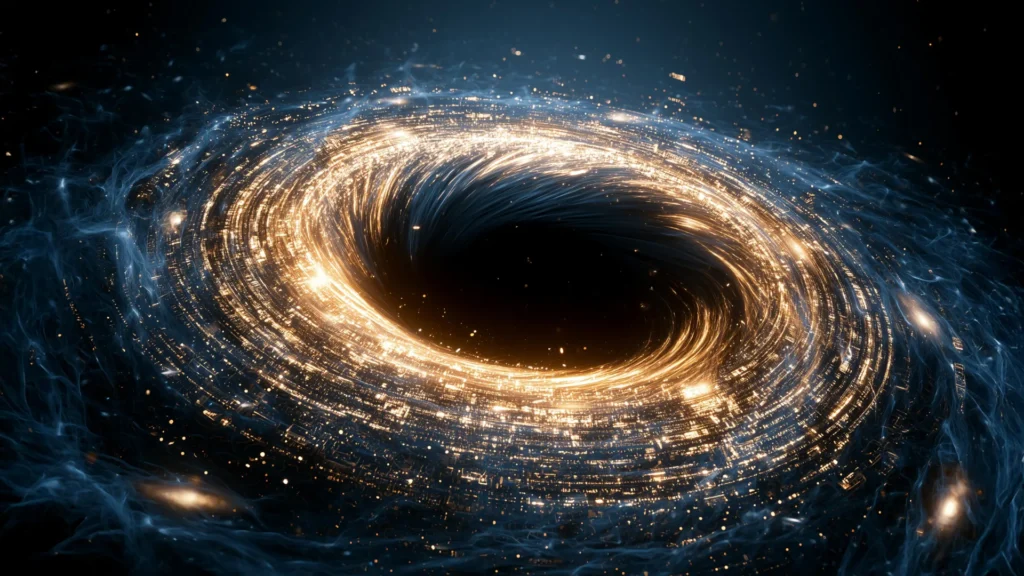
For nearly half a century, the field of theoretical physics has been haunted by a fundamental contradiction that threatens the very foundations of how we understand the universe. Known as the black hole information paradox, this puzzle pits the deterministic laws of quantum mechanics against the gravitational collapse described by general relativity. However, a groundbreaking theoretical study led by researcher Richard Pinčák and recently published in the journal General Relativity and Gravitation offers a provocative new solution. By moving beyond the standard four-dimensional view of the cosmos and utilizing a complex seven-dimensional mathematical framework, Pinčák’s team suggests that black holes do not truly vanish, but instead leave behind stable remnants that preserve the history of everything they have consumed. Furthermore, this geometric model appears to solve a second, seemingly unrelated mystery: the origin of the mass of fundamental particles and the nature of the Higgs field.
The Genesis of a Cosmic Contradiction
To understand the weight of this new research, one must look back to 1974, when Stephen Hawking published his seminal work on black hole thermodynamics. Before Hawking, black holes were viewed as "eternal" traps from which nothing, not even light, could escape. Hawking’s calculations, which applied quantum field theory to the curved spacetime surrounding a black hole, revealed a startling phenomenon: black holes should emit a faint glow of thermal radiation, now known as Hawking radiation.
This radiation is the result of virtual particle pairs popping into existence near the event horizon. Occasionally, one particle falls into the black hole while the other escapes. Over vast eons, this process drains the black hole of its mass-energy. According to Hawking’s original theory, a black hole would eventually shrink to nothing and disappear entirely.
The "Information Paradox" arises because quantum mechanics dictates that information is "unitary"—it can never be destroyed. If a book is thrown into a black hole and that black hole subsequently evaporates into a featureless cloud of Hawking radiation, the information contained in that book appears to be permanently erased from the universe. For decades, this has left physicists with a grim choice: either Einstein’s theory of gravity is incomplete, or the fundamental laws of quantum mechanics are flawed.
The 7-Dimensional Einstein-Cartan Framework
The study by Pinčák and his colleagues approaches this problem through the lens of Einstein-Cartan theory, an extension of general relativity that incorporates "torsion." While standard general relativity describes spacetime as a fabric that curves in the presence of mass, Einstein-Cartan theory allows that fabric to also "twist." This twisting, or torsion, is coupled to the intrinsic spin of matter.
The researchers constructed their model within a seven-dimensional universe, utilizing a specific mathematical structure known as a G2-manifold. These manifolds are of particular interest in M-theory and string theory because they provide a way to "compactify" extra dimensions while preserving certain physical symmetries. In this 7D environment, the geometry of spacetime becomes far more complex than the 4D (three dimensions of space, one of time) reality we perceive.
The core of Pinčák’s discovery lies in how torsion behaves at the Planck scale—the smallest possible scale of length in the universe. As a black hole collapses and its density reaches these extreme levels, the torsion field generates a powerful repulsive force. Unlike the attractive force of gravity, which seeks to crush matter into an infinitely small point (a singularity), this torsion-induced repulsion acts as a "braking mechanism."
The Discovery of Black Hole Remnants
According to the study’s calculations, the repulsive force of torsion becomes strong enough to halt the evaporation process before the black hole reaches zero mass. Instead of vanishing, the black hole reaches a state of equilibrium, leaving behind a stable "remnant."
The researchers predict that these remnants are incredibly tiny, with a mass of approximately $9 times 10^-41$ kilograms. Despite their microscopic size, these relics are the keys to resolving the information paradox. The study posits that the information about the matter that originally formed the black hole is not lost; rather, it is encoded within the remnant’s internal geometry.
Specifically, the information is stored in "quasi-normal modes"—long-lived vibrations of the torsion field within the 7D structure. For a black hole with the mass of our Sun, the researchers calculated that its remnant could store approximately $1.515 times 10^77$ qubits of information. This capacity is mathematically consistent with the amount of information required to account for the entropy of the original black hole, effectively satisfying the requirements of quantum unitarity.
A Bridge to the Higgs Field and Particle Physics
Perhaps the most surprising aspect of the research is its application to the "mass hierarchy problem" in particle physics. For decades, scientists have wondered why the Higgs boson—the particle that gives other particles mass—has the specific mass it does, and why there is such a massive gap between the energy scales of gravity and the other fundamental forces.
The Pinčák study suggests that when the 7-dimensional geometry of their model is reduced to the 4-dimensional spacetime we experience, a specific energy scale naturally emerges: the electroweak scale, valued at approximately 246 GeV. This is the exact energy scale associated with the vacuum expectation value of the Higgs field.
In this framework, the Higgs field is not just an independent field existing in space; it is a dynamic manifestation of the torsion of the extra dimensions. The same geometric mechanism that prevents a black hole from disappearing also sets the stage for how particles acquire mass. This provides a unified geometric explanation for both the macro-scale physics of black holes and the micro-scale physics of the Standard Model.
Chronology of the Information Paradox
The publication of this study marks a significant milestone in a timeline of theoretical developments that have defined modern physics:
- 1915: Albert Einstein publishes the General Theory of Relativity, predicting the existence of black holes.
- 1974: Stephen Hawking proposes Hawking Radiation, suggesting black holes evaporate and creating the information paradox.
- 1997: Juan Maldacena proposes the AdS/CFT correspondence, suggesting that information in a volume of space is encoded on its boundary, supporting the idea that information is preserved.
- 2012: The "Firewall Paradox" is proposed, suggesting that if information is preserved, an intense wall of energy must exist at the event horizon, contradicting general relativity.
- 2019-2020: "Island" formulas in semiclassical gravity suggest that information can escape black holes via quantum entanglement, though the physical mechanism remains debated.
- 2024: Richard Pinčák’s study introduces 7D torsion and stable remnants as a concrete geometric solution to the paradox and the mass hierarchy problem.
Supporting Data and Technical Specifications
The study provides several concrete figures that allow for potential future verification. These include:
- Remnant Mass: $9 times 10^-41$ kg (The "Planckian relic").
- Storage Capacity: $1.515 times 10^77$ qubits for a solar-mass black hole.
- Electroweak Scale Identification: ~246 GeV (Dynamically identified with the torsion field’s vacuum expectation value).
- Kaluza-Klein Particle Mass: $8.6 times 10^15$ GeV (The predicted mass of particles associated with the 7D extra dimensions).
Challenges and Potential for Observation
While the theory is mathematically robust, testing it presents significant challenges. The Kaluza-Klein particles—heavy partners to known particles that would exist if extra dimensions are real—are predicted to have masses seven orders of magnitude higher than what the Large Hadron Collider (LHC) can currently detect.
However, the researchers point to astronomical observations as a more likely path for validation. One intriguing possibility is that these black hole remnants could account for some or all of the "Dark Matter" in the universe. If the universe is filled with these $9 times 10^-41$ kg relics, their cumulative gravitational effect could explain the rotation curves of galaxies and other dark matter signatures.
Additionally, the extremely high energy scales involved in 7D geometry would have been present in the very early universe. This means that the "fingerprints" of this geometry might be hidden in the Cosmic Microwave Background (CMB) radiation or in primordial gravitational waves that have been traveling through space since the Big Bang.
Expert Analysis and Implications
The physics community has long sought a "Theory of Everything" that can bridge the gap between the very large (gravity) and the very small (quantum mechanics). While Pinčák’s model is currently a theoretical proposal, its ability to link the information paradox with the Higgs field is seen by many as a significant step toward unification.
If the theory holds, it would mean that the universe is far more complex than our four-dimensional senses suggest. It would imply that space is not just a passive stage where events happen, but a dynamic, twisting, multi-dimensional structure that actively stores information and generates mass.
Critics may argue that the introduction of higher dimensions and torsion adds layers of complexity that are difficult to prove. However, proponents of the Einstein-Cartan theory note that torsion was always a mathematical possibility in Einstein’s work—it was simply set to zero for the sake of simplicity in the early 20th century. By reintroducing it in a 7D context, Pinčák may have found the "missing gear" in the machinery of the cosmos.
As telescopes and gravitational wave detectors become more sensitive, the search for these "Planckian relics" and the vibrations of the 7D torsion field will likely become a primary focus of high-energy astrophysics. For now, the study stands as a bold attempt to resolve two of the most daunting challenges in science, suggesting that the answers to our biggest questions may be found in the subtle twists of a higher-dimensional reality.