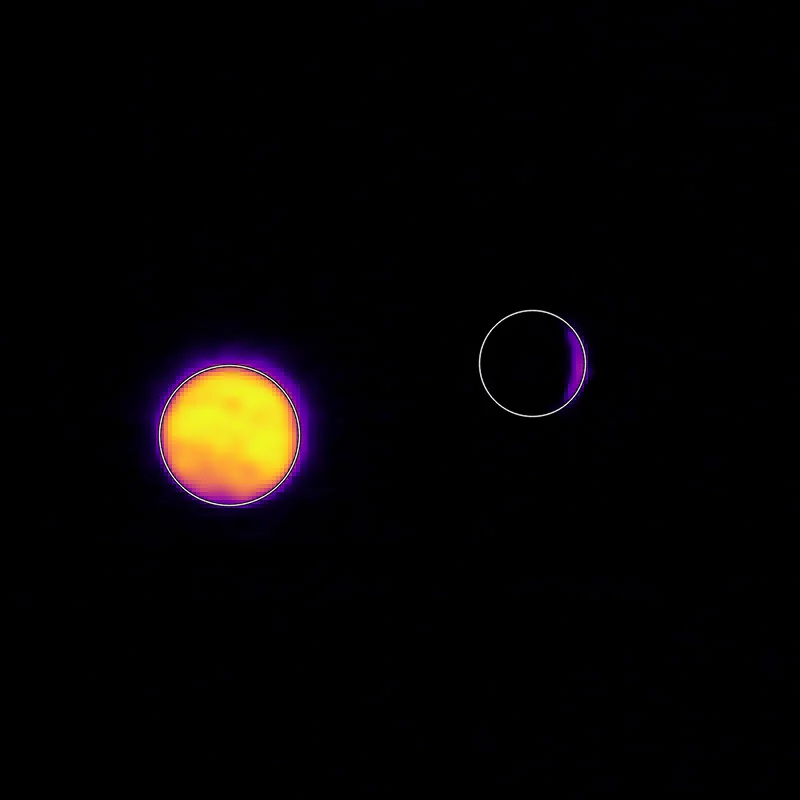
On July 3, 2024, one of NASA’s two ESCAPADE (Escape and Plasma Acceleration and Dynamics Explorers) spacecraft, en route to Mars, performed a significant calibration exercise by capturing striking images of Earth and its Moon. These images, taken in both visible and thermal infrared light, offer a unique perspective on our home planet and its celestial companion from a considerable distance. At the time of capture, the ESCAPADE spacecraft was positioned 363,250 miles (584,600 kilometers) from Earth and 115,600 miles (186,100 kilometers) from the Moon. This advantageous vantage point allowed the Moon to appear relatively large in the captured frames, providing a detailed view of both bodies.
The visible light image showcases Earth and the Moon as delicate crescents. This phenomenon occurred because the Sun was only partially illuminating the sides of both celestial bodies facing the spacecraft. Consequently, only about 8% of each face was bathed in sunlight, rendering them as thin slivers of light against the darkness of space. This visual representation, while aesthetically compelling, serves a critical scientific purpose.
In stark contrast to the visible light image, the thermal infrared imaging reveals a different aspect of Earth. The shadowed hemisphere of our planet, not directly illuminated by the Sun, is rendered visible by its own internal heat. This emitted thermal radiation originates from both the atmosphere and the planet’s surface, allowing the spacecraft’s instruments to detect temperatures ranging from minus 10 to minus 44 degrees Fahrenheit (250 to 280 kelvins). This capability is crucial for understanding planetary atmospheres and surface conditions, particularly on worlds like Mars. The Moon, however, lacking the insulating blankets of oceans and a substantial atmosphere that Earth possesses, exhibits a much cooler far side in the thermal infrared. Its surface temperature plunged to a frigid minus 280 degrees Fahrenheit (100 kelvins), highlighting the significant differences in thermal properties between the two bodies.
A Glimpse into ESCAPADE’s Scientific Mission
The ESCAPADE mission, a key component of NASA’s Small Innovative Missions for Planetary Exploration (SIMPLE) program, is designed to investigate the complex interaction between the solar wind and the Martian atmosphere. The spacecraft utilize Visible and Infrared Observation System (VIIRS) cameras, developed and provided by Northern Arizona University in Flagstaff. These instruments are not merely for capturing aesthetic snapshots; they are sophisticated tools designed for scientific discovery.
"We are thrilled that ESCAPADE was able to accommodate these excellent space-qualified cameras which will search for visible Martian aurora and investigate thermal properties of the Martian surface and atmosphere," stated Rob Lillis, the mission’s principal investigator at the University of California, Berkeley. He further emphasized the practical significance of these initial images: "Since Earth and the Moon are well-known targets, imaging them provides an important calibration check for ESCAPADE’s cameras." This calibration process is fundamental to ensuring the accuracy and reliability of the scientific data that will be collected once the spacecraft reach their Martian destination. By comparing the captured images of Earth and the Moon against known parameters and scientific models, mission scientists can fine-tune the performance of the VIIRS instruments, guaranteeing that subsequent Martian observations will be as precise as possible.
Journey to the Red Planet: A Strategic Trajectory
The ESCAPADE spacecraft, constructed by Rocket Lab, are currently executing a carefully planned "loiter" orbit around Earth’s second Sun-Earth Lagrange point, known as L2. This gravitationally stable location in space is situated approximately one million miles from Earth, offering a strategic position for their interplanetary journey. This positioning is not accidental; it is a crucial element of their mission trajectory.
The spacecraft are scheduled to perform a critical maneuver in November 2026. During this event, they will execute a flyby of Earth, leveraging the planet’s gravitational pull in a maneuver known as a gravity assist. This slingshot effect will provide the necessary boost and alter their trajectory, propelling them towards Mars. The anticipated arrival date for the ESCAPADE twin spacecraft at Mars is September 2027.
Upon arrival, their primary scientific objective will be to study the intricate relationship between the solar wind and the Martian environment. The solar wind is a continuous stream of charged particles emanating from the Sun, traveling at speeds of up to a million miles per hour. Understanding how this powerful cosmic force interacts with Mars’s tenuous atmosphere is a central question in planetary science. Scientists believe that this interaction plays a significant role in driving atmospheric loss at the Red Planet, a process that has likely contributed to Mars’s transition from a potentially habitable world to the cold, arid planet we observe today.
Mission Background and Broader Implications
The ESCAPADE mission is a testament to NASA’s commitment to advancing our understanding of planetary evolution and the conditions necessary for habitability. Funded by NASA’s Heliophysics Division, it represents a strategic investment in the Small Innovative Missions for Planetary Exploration program, which aims to develop cost-effective, high-value scientific missions.
The scientific leadership for ESCAPADE rests with UC Berkeley’s Space Sciences Laboratory. This prestigious institution collaborates with a formidable team of key partners, underscoring the collaborative nature of modern space exploration. These partners include Rocket Lab, responsible for the spacecraft’s construction; NASA’s Goddard Space Flight Center, contributing expertise and resources; Embry-Riddle Aeronautical University, bringing in valuable academic and engineering talent; Advanced Space, a company specializing in innovative space solutions; and Blue Origin, a prominent aerospace manufacturer.
The Science Behind the Images: Visible vs. Infrared
The dual imaging capability of the VIIRS cameras provides complementary scientific data. The visible light images, while appearing as artistic renderings of crescents, are crucial for understanding the geometry and relative positions of celestial bodies. For the calibration exercise, this meant precisely determining the spacecraft’s position relative to Earth and the Moon. In the context of Martian exploration, visible light imaging can be used to observe surface features, atmospheric phenomena like dust storms, and potential signs of geological activity.
The thermal infrared imaging, however, offers a unique window into the thermal state of a planet. Earth, as observed, glows with its own heat. This capability is particularly vital for Mars, where surface temperatures fluctuate dramatically. By mapping the thermal emissions from the Martian surface and atmosphere, scientists can infer information about the composition of materials, the presence of subsurface ice, and the dynamics of atmospheric circulation. For instance, understanding the thermal inertia of different Martian terrains can help scientists distinguish between rocky areas and sand dunes, or identify regions that might retain heat longer, potentially influencing the conditions for any subsurface microbial life. The extreme cold observed on the Moon’s far side in infrared highlights the absence of atmospheric insulation, a stark contrast to Earth’s relatively balmy –10 to –44 degrees Fahrenheit in its shadowed regions.
A Timeline of ESCAPADE’s Journey
July 3, 2024: ESCAPADE spacecraft captures visible and thermal infrared images of Earth and the Moon during calibration maneuvers. The spacecraft is approximately 363,250 miles from Earth and 115,600 miles from the Moon.
November 2026: ESCAPADE spacecraft will perform an Earth gravity assist maneuver, altering their trajectory towards Mars.
September 2027: ESCAPADE spacecraft are projected to arrive at Mars.
Post-Arrival (2027 onwards): The mission will commence its primary scientific objectives: studying the interaction of the solar wind with the Martian atmosphere and its role in atmospheric loss.
Data and Context: Understanding the Solar Wind and Martian Atmosphere
The solar wind is not a uniform flow; it varies in density, speed, and magnetic field strength, influenced by solar activity such as solar flares and coronal mass ejections. These variations can significantly impact planetary atmospheres. For planets with strong global magnetic fields, like Earth, the magnetosphere acts as a protective shield, deflecting most of the solar wind. Mars, however, lost its global magnetic field billions of years ago. As a result, its atmosphere is directly exposed to the solar wind.
This direct interaction leads to a process called atmospheric sputtering, where solar wind particles collide with atmospheric gases, ejecting them into space. Over geological timescales, this continuous erosion can lead to substantial loss of atmospheric mass, contributing to the thinning of the atmosphere and the desiccation of the planet’s surface. ESCAPADE’s instruments are designed to measure the rate of this atmospheric loss with unprecedented detail, providing crucial data to refine models of planetary atmospheric evolution.
Furthermore, ESCAPADE will investigate the Martian aurora. While Earth’s aurora is primarily driven by interactions between the solar wind and its global magnetic field, Mars exhibits different auroral phenomena. These Martian auroras are thought to be caused by the direct interaction of solar wind particles with the planet’s upper atmosphere, particularly in regions where localized magnetic fields exist on the surface. The ESCAPADE mission’s ability to detect visible Martian aurora could offer direct visual evidence of these complex electrodynamic processes.
Official Statements and Anticipation
While specific direct statements from all involved parties are not immediately available beyond the principal investigator’s comments, the scientific community’s reaction to missions like ESCAPADE is generally one of anticipation and enthusiasm. NASA’s Heliophysics Division consistently prioritizes missions that contribute to fundamental questions about space weather and its impact on planetary environments. The successful deployment and initial calibration of the ESCAPADE spacecraft are viewed as positive early indicators of the mission’s potential. Representatives from partner institutions, such as Rocket Lab and UC Berkeley, would undoubtedly echo the sentiment of scientific progress and the importance of this endeavor. The successful capture of these initial images serves as a tangible demonstration of the mission’s capabilities and a promising prelude to the in-depth scientific investigations awaiting the spacecraft at Mars. The successful completion of the calibration phase is a critical milestone, ensuring that the subsequent scientific data collected will be of the highest quality and contribute significantly to our understanding of Mars and the broader field of planetary science.