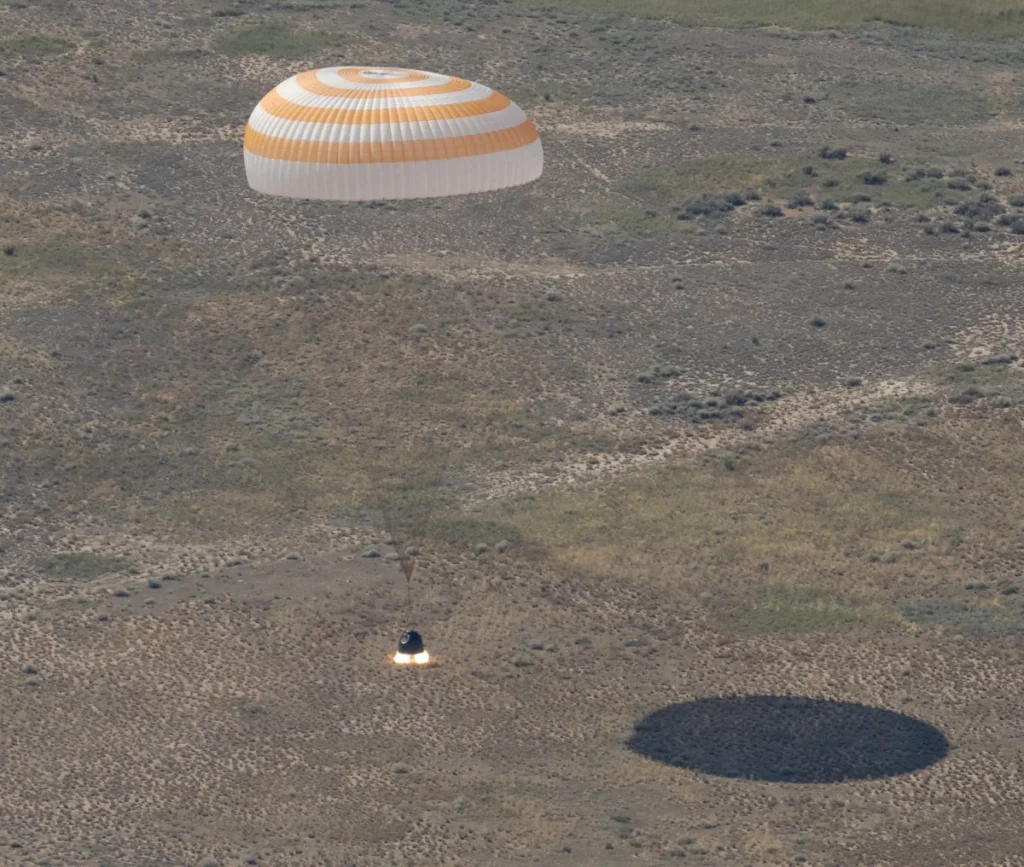
Concluding an eight-month science mission aboard the International Space Station, NASA astronaut Chris Williams returned to Earth on Sunday alongside Roscosmos cosmonauts Sergey Kud-Sverchkov and Sergei Mikaev. The trio touched down southeast of Dzhezkazgan, Kazakhstan, at 5:27 a.m. CDT (3:27 p.m., Kazakhstan time), marking the successful completion of a critical period of scientific endeavor and international collaboration in low Earth orbit. Their departure from the orbiting laboratory occurred at 2:03 a.m. CDT, aboard the Soyuz MS-28 spacecraft, initiating their journey home after 241 days in space.
During their extensive stay, the crew completed 3,856 orbits of Earth, traversing a remarkable distance of over 102 million miles. This mission, which began with their launch on November 27, 2025, represented a significant milestone for several crew members. For astronaut Chris Williams and cosmonaut Sergei Mikaev, it was their inaugural mission to space, a testament to years of rigorous training and dedication. Cosmonaut Sergey Kud-Sverchkov, a veteran of spaceflight, added this mission to his second orbital experience, bringing valuable continuity to the station’s operations.
A Deep Dive into Scientific Advancements and Technical Operations
While aboard the International Space Station (ISS), astronaut Chris Williams played an integral role in a diverse array of scientific investigations and cutting-edge technology demonstrations. His contributions are expected to have far-reaching implications for both human health and technological progress. A key focus of his work involved advancing research into novel cancer treatments. This research, conducted in the unique microgravity environment of space, allows scientists to observe cellular behavior and biological processes in ways that are impossible on Earth, potentially unlocking new pathways for therapeutic development.
Furthermore, Williams contributed to groundbreaking work in improved in-space manufacturing of advanced materials. These materials are crucial for the production of high-performance computers and sophisticated electronics, areas where miniaturization and enhanced efficiency are paramount. The ability to manufacture complex components in space could revolutionize future space missions, enabling on-demand production of critical parts and reducing reliance on Earth-based supply chains.
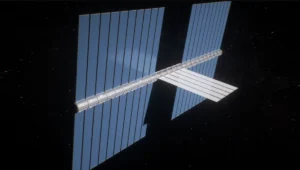
Beyond the laboratory, Williams also undertook critical external operations, completing two spacewalks. These excursions were vital for the ongoing infrastructure maintenance and upgrades of the ISS. The first spacewalk was dedicated to preparing the station for significant power system upgrades, a complex undertaking that will enhance the ISS’s energy capabilities and support future scientific endeavors. The second spacewalk addressed a more immediate concern: replacing a faulty joint on the Canadarm2 robotic arm. This robotic appendage is an essential tool for station assembly, maintenance, and astronaut operations, and its reliable functioning is paramount for the safety and efficiency of all external activities. The successful repair underscores the critical role of astronauts in maintaining the operational integrity of this vital orbital outpost.
The collective work of the ISS crew, including Williams, Kud-Sverchkov, and Mikaev, extends far beyond the confines of low Earth orbit. Their efforts on the space station are fundamental to improving life on Earth through scientific discovery and are directly contributing to the foundational knowledge and technological capabilities required for future human exploration missions, most notably those targeting the Moon and Mars.
The Journey Home: A Detailed Chronology
The return journey for the crew of Soyuz MS-28 began with undocking from the International Space Station at 2:03 a.m. CDT. This maneuver, executed with precision, signaled the end of their extended stay aboard the orbiting laboratory. Following a series of orbital adjustments, the Soyuz spacecraft initiated its deorbit burn, a critical maneuver that slows the spacecraft down, allowing it to re-enter Earth’s atmosphere.
The parachute-assisted landing occurred at 5:27 a.m. CDT, precisely as planned, in a remote area southeast of Dzhezkazgan, Kazakhstan. This landing zone has been a traditional touchdown site for Soyuz missions for decades, chosen for its vast, open terrain, which is ideal for safe recovery operations. The landing was successful, with the spacecraft and its crew making contact with solid ground after their long sojourn in space.
Post-Landing Procedures and Crew Recovery
Immediately following their landing, the crew underwent essential post-landing medical checks. These evaluations are crucial to assess their physical condition after spending an extended period in microgravity, which can have significant physiological effects on the human body, including bone density loss and muscle atrophy. Trained medical personnel were on hand to ensure a smooth transition back to terrestrial gravity.
Following these initial medical assessments, the crew members were transported by helicopter to Karaganda, Kazakhstan. This city serves as the central hub for the recovery teams, where more comprehensive medical evaluations and rehabilitation protocols will commence. For astronaut Chris Williams, the journey will continue. He is scheduled to board a NASA aircraft for a flight back to the agency’s Johnson Space Center in Houston, Texas. This return to Houston signifies the formal end of his mission and the beginning of his reintegration into terrestrial life, including extensive debriefing sessions and continued medical monitoring.
The Enduring Legacy of the International Space Station
The International Space Station, a marvel of engineering and a symbol of international cooperation, has been continuously inhabited for over 25 years. This sustained human presence in space has been instrumental in advancing scientific knowledge and achieving research breakthroughs that are simply not possible on Earth. The unique microgravity environment, coupled with the ISS’s position as a platform for long-term human spaceflight, allows scientists to conduct experiments in fields ranging from biology and medicine to physics and materials science.
The ISS serves as a critical testbed for understanding and overcoming the challenges associated with human spaceflight. The data gathered from long-duration missions aboard the station provides invaluable insights into the physiological and psychological effects of living in space, informing the development of countermeasures and technologies necessary for future deep-space expeditions. Moreover, the ISS is fostering the growth of commercial opportunities in low Earth orbit, paving the way for a more robust space economy.
Crucially, the ISS provides the foundational experience and technological advancements that underpin NASA’s ambitious Artemis program. This program aims to return humans to the Moon and establish a sustainable lunar presence, serving as a stepping stone for eventual human missions to Mars. The lessons learned and the technologies developed aboard the ISS are directly contributing to the realization of these future goals, pushing the boundaries of human exploration further into the solar system.
Supporting Data and Mission Milestones
- Mission Duration: 241 days
- Orbital Revolutions: 3,856
- Distance Traveled: Over 102 million miles
- Launch Date: November 27, 2025
- Landing Date: Sunday (specific date not provided in source, but context implies recent)
- Crew: NASA Astronaut Chris Williams (first mission), Roscosmos Cosmonaut Sergey Kud-Sverchkov (second mission), Roscosmos Cosmonaut Sergei Mikaev (first mission).
The successful completion of this mission underscores the robust partnership between NASA and Roscosmos, highlighting their continued collaboration in space exploration despite geopolitical complexities. Such joint missions are vital for maintaining the operational capability of the ISS and for advancing the shared goals of scientific discovery and human spaceflight.
Broader Implications and Future Outlook
The scientific research conducted during Chris Williams’s mission has the potential to yield significant benefits for humanity. The progress in cancer treatment research, for example, could lead to new therapies that save lives and improve patient outcomes on Earth. Similarly, advancements in in-space manufacturing of materials for electronics could accelerate technological innovation across various industries, from telecommunications to aerospace.
The successful completion of the two spacewalks also demonstrates the resilience and adaptability of the ISS. The ability of astronauts to perform complex repairs and upgrades in the harsh environment of space is a testament to their training and the advanced technology that supports them. These operations are not just about maintaining the current station but also about ensuring its readiness for future scientific experiments and the integration of new modules or components.
The ISS continues to be a beacon of international cooperation and a critical platform for scientific advancement. As humanity looks towards bolder explorations of the Moon and Mars, the lessons learned from missions like Chris Williams’s will be invaluable. The experience gained in living and working in space for extended periods, the development of advanced life support systems, and the continuous testing of new technologies are all building blocks for future deep-space missions. The legacy of the ISS is one of pushing boundaries, fostering collaboration, and ultimately, enriching our understanding of the universe and our place within it.
For further information on the International Space Station, its research, operations, and crews, interested parties can visit: www.nasa.gov/station.
Contact Information:
Joshua Finch / Jimi Russell
Headquarters, Washington
202-358-1100
[email protected] / [email protected]
Leah Cheshier / Anna Schneider
Johnson Space Center, Houston
281-483-5111
[email protected] / [email protected]