Massachusetts Institute of Technology (MIT) researchers have unveiled a groundbreaking, low-cost design for specialized electronic nozzles, dubbed triaxial electrospray emitters. This innovation promises to significantly enhance the efficiency and scalability of manufacturing complex microparticles, opening doors for advanced drug delivery systems and novel self-healing materials. The breakthrough lies in the researchers’ ability to 3D-print these intricate devices, overcoming the prohibitively expensive and time-consuming microfabrication processes traditionally required.
A New Era for Microparticle Fabrication
The core of this advancement is the triaxial electrospray emitter, a sophisticated device that harnesses electrical fields to precisely eject three distinct liquids from microscopic nozzles. This controlled extrusion results in a steady stream of liquid that forms multilayered droplets. Upon solidification, these droplets transform into layered microparticles, each possessing a unique internal structure.
This capability is particularly significant for pharmaceutical applications. Imagine a scenario where a drug delivery nanoparticle is engineered with three distinct layers. The outermost layer might be designed to slowly degrade in the harsh environment of the stomach, gradually exposing a second layer. This intermediate material could then regulate the release of a core payload, ensuring that a vital medicine is delivered to a specific section of the intestines at the optimal time. Such precise control over drug release has the potential to dramatically improve treatment efficacy and reduce side effects for a wide range of conditions.
Beyond medicine, these layered microparticles hold promise for the development of advanced materials. For instance, self-healing composites could incorporate microcapsules containing repair agents. When a crack forms, these capsules rupture, releasing the healing substance and mending the material. The layered structure offered by triaxial electrospray emitters could allow for the precise control of the release of these agents, or even the incorporation of multiple repair mechanisms within a single microparticle.
Overcoming Traditional Manufacturing Hurdles
Historically, the creation of even a small array of electrospray emitters has been a formidable challenge. The process typically necessitates highly specialized and costly microfabrication techniques performed within pristine semiconductor cleanrooms. These environments, while crucial for producing the microscopic features required, are expensive to maintain and limit the speed and flexibility of innovation. The time and financial investment required have thus significantly restricted the widespread adoption and development of these advanced nozzle technologies.
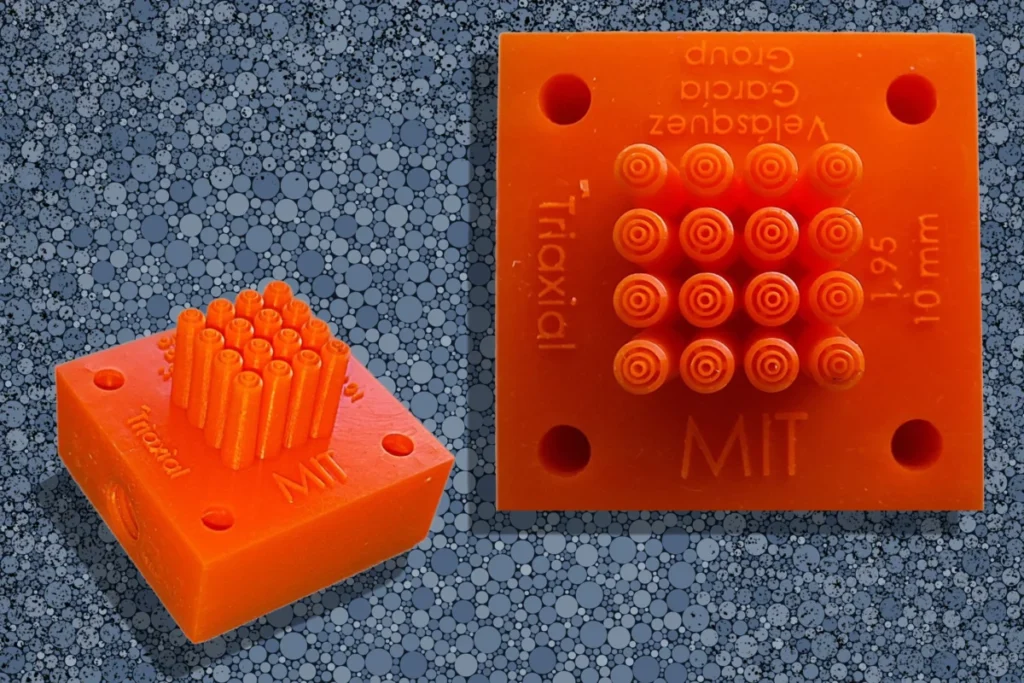
The MIT team, led by Luis Fernando Velásquez-García, a principal research scientist at MIT’s Microsystems Technology Laboratories (MTL), has ingeniously circumvented these limitations. They employed advanced 3D printing techniques to fabricate arrays of triaxial electrospray emitters. Their innovative design allows for the integration of 16 individual nozzles within an area of approximately one square centimeter. Each printed device features an intricate network of three-dimensional microchannels, meticulously engineered to ensure a uniform and consistent supply of liquid to every nozzle.
This one-step fabrication process represents a paradigm shift, reducing the production time for these complex emitter arrays from weeks or months to a mere few hours. This dramatic acceleration in manufacturing capability is expected to democratize access to this powerful technology, enabling a broader range of researchers and industries to explore its potential.
Precision and Uniformity at Scale
Crucially, when tested, the 3D-printed arrays demonstrated their ability to generate highly uniform, three-layered droplets at scale. This consistency is paramount for the high-throughput manufacturing of layered microparticles. Such uniformity is essential for a myriad of applications, including the development of highly sensitive biosensors capable of detecting minute quantities of chemical substances, or the creation of artificial cells designed to facilitate tissue regeneration.
"We couldn’t make a device like this in a semiconductor cleanroom," stated Velásquez-García. "This is only possible because they are 3D-printed. The particles these devices generate, whether they are used for a self-healing composite or to deliver medicine, can have a big impact in many applications. We want to democratize this technology so the benefits can touch many more people."
The research, published in the journal Virtual and Physical Prototyping, highlights the collaborative efforts of lead author Bryan Ivan Quintanar-Abarca from the Technological Institute of Monterrey in Mexico and Velásquez-García. This international collaboration underscores the global significance of this technological leap.
The Electrospray Mechanism: A Detailed Look
The fundamental principle behind electrospray emitters involves applying a high electrical voltage to a liquid as it exits a nozzle. This electrical charge induces a repulsive force within the liquid, causing it to break apart into a fine, consistent stream of extremely tiny droplets, often in the nanometer to micrometer range.
Triaxial devices elevate this process by incorporating three concentric nozzles. These nozzles are designed to emit three immiscible liquids—liquids that do not readily mix—simultaneously. As these liquids emerge, they form layered droplets, which can then be solidified into compound microparticles with distinct, concentric layers. This allows for the encapsulation of different materials or functionalities within a single microparticle.
For example, a biosensing particle could be engineered using a triaxial electrospray emitter. Each layer could encapsulate a different chemical marker, allowing the particle to simultaneously detect multiple substances. The speed and small droplet size achievable with electrospray emitters far surpass those of many other microparticle generation techniques, making it ideal for rapid and efficient production.
Miniaturization plays a critical role in the efficiency of electrospray devices. Smaller emitters require lower voltages to initiate and sustain droplet formation. While a single emitter’s output might be modest, the true power lies in creating arrays of these emitters. By arranging multiple nozzles in close proximity, researchers can significantly increase the overall droplet production rate without compromising the uniformity of the particles.
Innovations in 3D Printing for Microfluidics
The challenge in fabricating multi-emitter electrospray devices has always been the complexity of integrating multiple fine structures into a compact footprint while ensuring uniform operation. Traditional semiconductor fabrication processes, while precise, often impose limitations on the achievable geometries and the complexity of internal channel designs.
Velásquez-García elaborated on the engineering challenges: "When you build a triaxial array, you need to find a way to create geometries that have many integrated parts and extremely fine structures in the smallest footprint possible. And you need to ensure the devices will work uniformly."
To address this, the research team utilized a 3D printing technique known as vat photopolymerization. This method employs light to selectively cure and solidify liquid resin layer by layer, allowing for the creation of highly intricate and complex structures. The researchers were able to achieve layer heights as small as 25 micrometers—a fraction of the width of a human hair. This remarkable precision was instrumental in fabricating the sophisticated internal geometry required for the triaxial electrospray emitter.
Refining the Design for Optimal Performance
The resulting 3D-printed array, measuring slightly larger than a U.S. penny, houses an intricate network of coiled channels. These internal channels are designed to efficiently deliver liquid to the 16 nozzles. The helical design of these microchannels is not merely for aesthetics; it plays a crucial role in maintaining a uniform spray of microdroplets across all nozzles, ensuring consistent particle production and minimizing device size.
"In a sense, the emitters in the array never learn they have company, or otherwise there would be cross-talking and causing interference between them. We achieved uniformity because of the work that went into our designs," Velásquez-García explained, emphasizing the careful engineering to prevent interference between adjacent nozzles.
A significant fabrication hurdle in 3D printing microfluidic devices is the need to create fine channels without supporting structures that could later clog the device. Furthermore, ensuring the complete removal of uncured resin before use is critical for device functionality and longevity. The researchers successfully navigated these challenges, producing clean and functional microchannel networks.
The microchannels are meticulously designed to funnel liquid to the concentric nozzles. Perfect alignment of these nozzles is paramount to ensure that microdroplets are emitted consistently and with the desired layered structure.
"We were able to aggressively optimize the design because we could iterate in a much timelier manner. This ability to exquisitely refine designs is a key advantage of 3D printing," Velásquez-García highlighted the iterative nature of design and fabrication enabled by this technology.
Key Findings and Future Directions
The research team conducted extensive testing of multiple array architectures, systematically varying liquid flow rates to identify the optimal conditions for maximizing droplet stability and consistency. One surprising and significant finding was the crucial role of the middle liquid’s viscosity in achieving droplet stability. The viscosity of this intermediate layer was found to be critical in preserving the integrity and thickness of each individual layer within the microdroplet.
Moreover, the researchers discovered that by precisely adjusting flow rates and applied voltages, they could finely tune the thickness of each microdroplet layer. This level of control empowers scientists to design drug-delivery particles with tailor-made layer compositions, ensuring that medicine is released at precisely the intended time and rate. This level of customization is a game-changer for personalized medicine and advanced therapeutic strategies.
"By making such intricate devices more practical, we can empower others to pursue entrepreneurial and scientific advances," Velásquez-García expressed his vision for the future impact of this technology.
Looking ahead, the MIT researchers plan to further refine their fabrication processes and device designs. Their future work will focus on achieving even smaller dimensions for the nozzles and microchannels, and on integrating conductive or dielectric materials into the devices. These advancements will pave the way for the development of even more sophisticated and capable electrospray emitter arrays, potentially leading to new breakthroughs in fields ranging from advanced electronics to novel biomedical devices.
This pioneering research was supported in part by the Tecnológico de Monterrey – MIT Nanotechnology Program, a testament to the power of international collaboration in driving scientific innovation. The implications of this work are far-reaching, promising to accelerate progress in drug delivery, materials science, and biosensing, ultimately benefiting a broad spectrum of industries and improving human health and well-being.