In a discovery that challenges established timelines of cosmic evolution, astronomers at the Massachusetts Institute of Technology (MIT) and several partner institutions have identified a flickering quasar dating back to the very infancy of the universe. Traced to a period known as the "cosmic dawn," the light from this supermassive black hole began its journey toward Earth approximately 13 billion years ago, a mere 850 million years after the Big Bang. This finding, published in the journal Nature Astronomy, marks the earliest instance of a flickering quasar ever recorded and provides a rare glimpse into the feeding habits of the universe’s first gravitational giants.
The detection of this ancient flickering signal is more than a chronological milestone; it offers a profound look into the physical structure of early supermassive black holes. By analyzing the fluctuations in light, the research team determined that the quasar’s accretion disk—the swirling whirlpool of gas and dust that fuels the black hole—is surprisingly thin and stable, resembling the "flat pancake" structures seen in much older, more modern-day systems. This observation heightens a longstanding mystery in cosmology: how supermassive black holes managed to reach such a high state of maturity and stability in such a short window of cosmic time.
The Nature of Quasars and the Role of Supermassive Black Holes
To understand the significance of this discovery, one must first consider the role of supermassive black holes in the architecture of the cosmos. Astronomers believe that a supermassive black hole, often weighing millions or billions of times the mass of our sun, resides at the center of nearly every large galaxy, including the Milky Way. While these objects are invisible by nature, they become "active" when they begin to consume surrounding interstellar material.
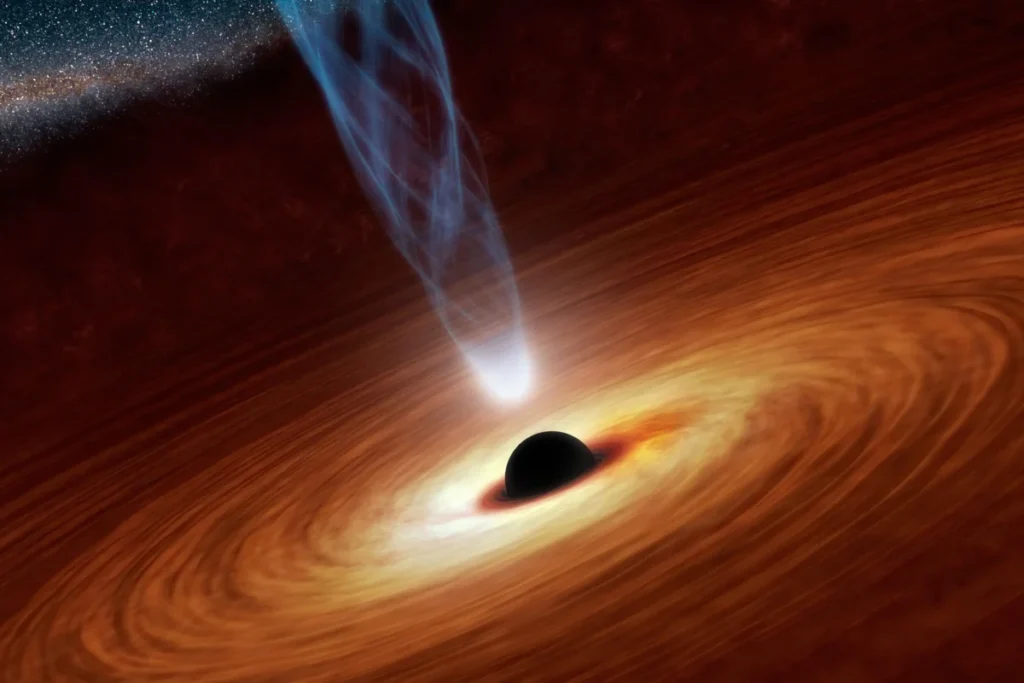
As gas and dust are drawn toward the black hole’s event horizon, they form an accretion disk. The intense gravitational forces and friction within this disk heat the material to millions of degrees, causing it to radiate immense amounts of energy across the electromagnetic spectrum. When this process is particularly intense, the system is classified as a quasar. Quasars are among the most luminous and energetic objects in the known universe, often outshining the combined light of all the stars in their host galaxies.
"Without supermassive black holes, no galaxy would look the way it does today," explained Anna-Christina Eilers, an assistant professor of physics at MIT and a co-author of the study. "Black holes play a major role in shaping how galactic ecosystems look, regulating star formation and influencing the overall growth of their host galaxies."
The Technical Challenge: Detecting Light from the Cosmic Dawn
The primary obstacle in studying the early universe is the physical expansion of space itself. As light travels through the expanding universe, its wavelength is stretched—a phenomenon known as "redshift." Light that was originally emitted as visible or ultraviolet radiation billions of years ago arrives at Earth as infrared light. Furthermore, time itself appears to dilate; a physical process that might take a week to occur in the local universe would appear to take months when observed from 13 billion light-years away.
To capture the "flicker" of a quasar from the cosmic dawn, the MIT team required a dataset that was both sensitive to infrared wavelengths and captured over a long enough duration to account for this time dilation. They found their answer in the archival data of NASA’s Near-Earth Object Wide-field Infrared Survey Explorer (NEOWISE).
Originally launched as the Wide-field Infrared Survey Explorer (WISE), the mission has scanned the entire sky in infrared for approximately 14 years. By re-processing this decade-plus of data, the researchers, led by MIT postdoc Gene Leung and former MIT postdoc Kishalay De (now at Columbia University), were able to isolate the subtle variations in brightness from a distant quasar that had previously been seen only as a static pinprick of light.
"We saw the quasar flickering randomly over the 14-year period, much like a candle’s flame flickers without a fixed pattern," noted Gene Leung. "The flickering comes from fluctuations in the way the gas is being fed into the black hole. How a quasar flickers tells us something about the structure of its accretion disk and the size of the ‘bites’ the black hole is eating."
Analyzing the Data: A "Pancake" in the Early Universe
The quantitative data revealed by the flicker is staggering. The researchers estimate that the quasar possesses a baseline brightness equivalent to 12 trillion suns. The observed "flicker" represented a fluctuation of approximately 20 percent, meaning the energy output was rising and falling by an amount equal to the light of 2 trillion suns.
By tracking these fluctuations across different infrared wavelengths, the team was able to map the temperature and proximity of the material in the accretion disk. Higher temperatures generally indicate material closer to the black hole’s center. The analysis revealed that the disk was thin and flat.
In the standard cosmological model, early black holes are expected to be "unsettled." Because they are growing rapidly and consuming vast amounts of matter in a chaotic environment, their accretion disks should theoretically be "puffy," thick, and turbulent. A flat, thin disk is a hallmark of a mature system that has reached a state of equilibrium. Finding such a structure only 850 million years after the Big Bang suggests that the "messy" phase of black hole growth must occur much faster and much earlier than previously hypothesized.
A Chronology of the Early Universe and Black Hole Evolution
The discovery fits into a broader timeline of the universe that scientists are still struggling to reconcile:
- 0 Years: The Big Bang occurs, initiating the expansion of the universe.
- 100–400 Million Years: The "Dark Ages" end as the first stars begin to form, marking the start of the Cosmic Dawn.
- 500–900 Million Years: The first galaxies and supermassive black holes appear.
- 850 Million Years: The date of the newly detected flickering quasar, showing a mature, flat accretion disk.
- 1 Billion Years: Previously, this was the era when scientists expected to see the first "settled" galactic structures.
- 13.8 Billion Years: The present day.
The existence of a "mature" quasar at the 850-million-year mark implies that the precursor black holes must have formed almost immediately after the first stars, or perhaps even before them, through mechanisms such as the direct collapse of massive gas clouds.
Implications for Modern Cosmology
The findings have sparked significant discussion within the astrophysics community regarding the "seeding" of black holes. There are two primary theories for how supermassive black holes began: "light seeds" (the remnants of the very first stars) and "heavy seeds" (massive clouds of gas that collapsed directly into black holes without forming stars first).
The maturity of the flickering quasar detected by MIT leans toward the "heavy seed" or "rapid growth" models. If black holes started as light seeds, they would have had to consume matter at rates exceeding the theoretical "Eddington Limit"—the point at which the outward pressure of radiation balances the inward pull of gravity—to reach such a massive and stable state by 850 million years.
"This provides direct evidence that the same feeding processes and structures observed in the nearby universe were already in place at very early times, despite very different cosmic environments," Eilers said. "This means something happened even earlier on that led to these systems looking so mature so quickly."
Future Directions in Infrared Astronomy
The success of the NEOWISE data re-processing highlights the growing importance of "time-domain" astronomy—the study of how celestial objects change over time. While the James Webb Space Telescope (JWST) provides unprecedented resolution and depth, archival missions like NEOWISE offer the long-term temporal baseline necessary to see "flickers" that occur over years or decades.
The MIT team plans to continue their search for even earlier flickering signals. By pushing the boundaries further back into the Cosmic Dawn, they hope to catch a quasar in its "infant" stage—the chaotic, puffy-disk phase that has so far eluded observation. Such a discovery would provide the missing link between the birth of the first black holes and the surprisingly sophisticated systems found in this latest study.
As researchers continue to peel back the layers of the early universe, the "standard model" of galaxy formation continues to be refined. The flickering light of a quasar 13 billion light-years away has clarified one thing: the early universe was a far more efficient and organized engine of creation than anyone had previously imagined. This research was supported, in part, by NASA, and involves collaboration with the MIT Kavli Institute for Astrophysics and Space Research.